Edu Lobo Covered Twice

By , August 24, 2010 5:28 pm

Example
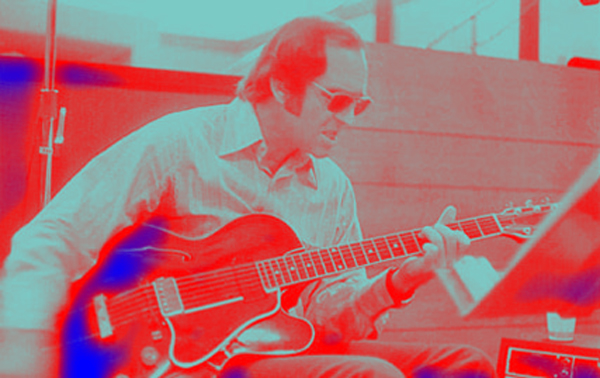
Howard Roberts

Example

Example

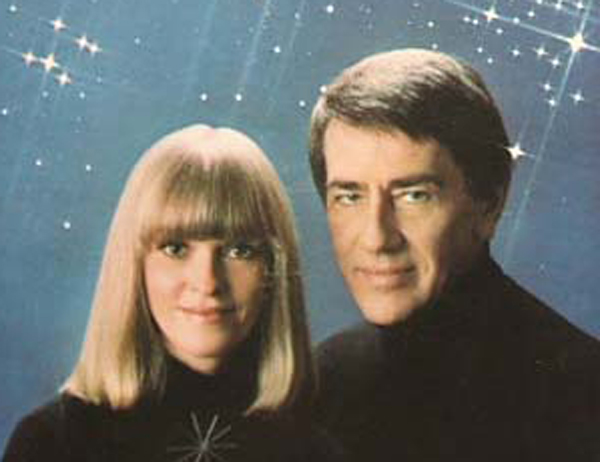
Jackie Cain and Roy Kral

Example

Listen/Download – Howard Roberts – Crystal Illusions

Listen/Download – Jackie & Roy – Crystal Illusions


Greetings all.

When I left you on Monday, I promised that I would return with something mellow.

Back in the day, when I was falling in love with the sounds of Tropicalia, I happened upon a reissue CD of an album by a singer who’s name was familiar, but who’s music I’d never actually heard.
That man was Edu Lobo, and the album was ‘Sergio Mendes Presents Edu Lobo’.

This is not to say that Lobo was part of the Tropicalia movement, but rather that I was seeking out any and all Brazilian music from the late 60s and early 70s in the hopes that I would discover sounds of a similarly progressive bent that mixed Brazilian music with contemporary pop from other points of the musical landscape.

It was this search that led to to Edu Lobo, and folks like Dom Salvador and Tamba 4.

‘Sergio Mendes Presents Edu Lobo’ was recorded in the United States (in 1970) with a number of Brazilian musicians (including several members of Brasil 66), and includes rerecorded versions of a number of songs that had appeared (generally sung in Portuguese) on Lobo’s ‘Cantiga de Longe’ LP (which has also been reissued).

Lobo’s sound at the time was an updated take on MPB, which was already a mixture of traditional Brazilian music and other Western pop and rock styles. Lobo also whipped jazz into the mix, though you kind of get into a chicken/egg situation when it comes to jazz and Brazilian music at the time in that it’s not always clear whether what your hearing is the influence of Brazil on jazz or vice versa.

I was completely captivated by the ‘Sergio Mendes Presents…’ album, and it quickly became a favorite. Among the many great songs on that album (which I’ve never been able to score an original copy of) is the sublime ‘Crystal Illusions’.

I haven’t been able to nail down when ‘Crystal Illusions’ was first recorded, but there are a number of versions from 1969 and 1970, including those by Brasil 66 (who’s singer Lani Hall is credited with co-writing the song) and jazz saxophonist Paul Desmond, who’s ‘From the Hot Afternoon’ album is composed entirely of covers of songs by Lobo and Milton Nascimento.

That said, the tune was clearly getting around.

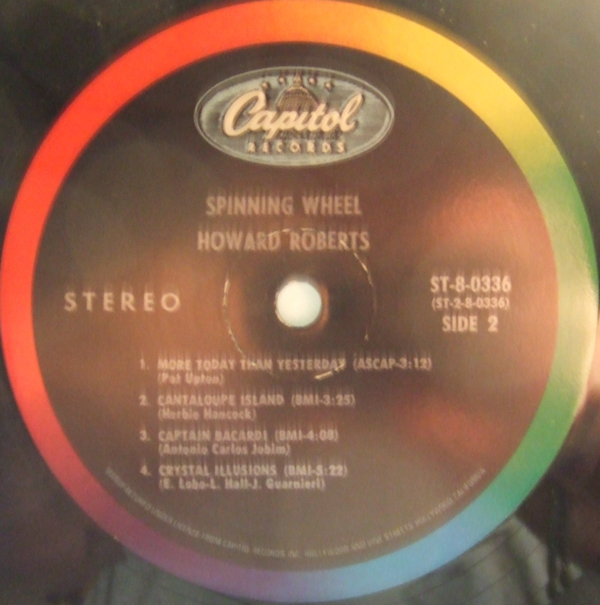
The first of the two versions of ‘Crystal Illusions’ I bring you today is from guitarist Howard Roberts’ 1970 album ‘Spinning Wheel’. I grabbed this record following the diggers credo of ‘never pass up a version of either ‘Spinning Wheel’ or ‘Get Out Of My Life Woman’ because of the possibility of drums’, and was pleasantly surprised when I found the version of today’s selection.

Featuring a young band that included Dave Grusin on keys, John Guerin on drums (nice drums on this one) and Tom Scott on sax, Roberts’ version of the song applies some sharper edges than the song is usually played with. It is unlike anything else on the album and is a real gem.

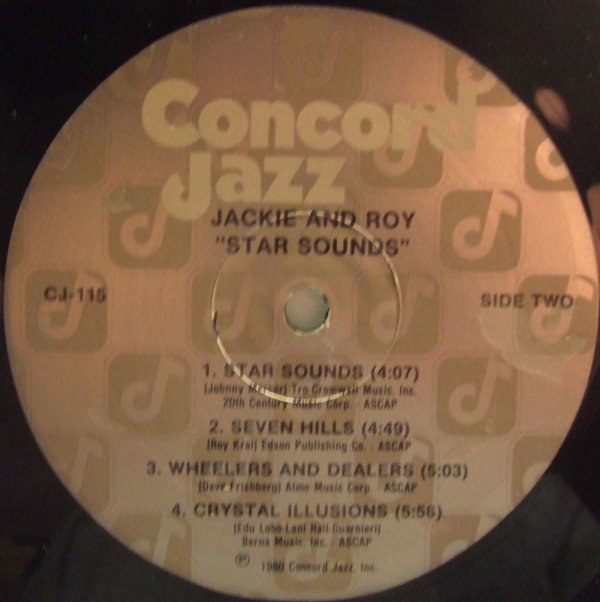
The second take on the song is from a 1980 album by hip singers Jackie Cain and Roy Kral.

Though Jackie and Roy go back to the big band era (where they recorded as part of Charlie Ventura’s band) through the 50s, 60s, 70s and 80s they perfected a light, swinging style touching on wide ranging sounds like Bob Dorough, Mark Murphy and Lambert Hendricks and Ross, that while something of an acquired taste (there‘s a supper club/cabaret feel to some of their work), I happen to dig a lot.

Their take on ‘Crystal Illusions’ comes from their ‘Star Sounds’ album, which was devoted largely to the sounds of Brazil. You get a little more of a feel for Lobo’s delicately crafted melody in the Jackie and Roy version. The arrangement may be a little ‘light’ for some of you, but it’s all about the song.

Both ‘Sergio Mendes Presents Edu Lobo’ and ‘Cantiga de Longe’ can be obtained via iTunes. If you want either of the versions presented here today (in solid, vinyl form), you’re going to have to start digging, since I don’t think either one has been reissued.

I hope you like the tunes, and I’ll be back on Friday.

Peace

Larry


Example


Check out the Funky16Corners Store at Cafe Press

PS Head over to Iron Leg for a Lennon/McCartney tune.


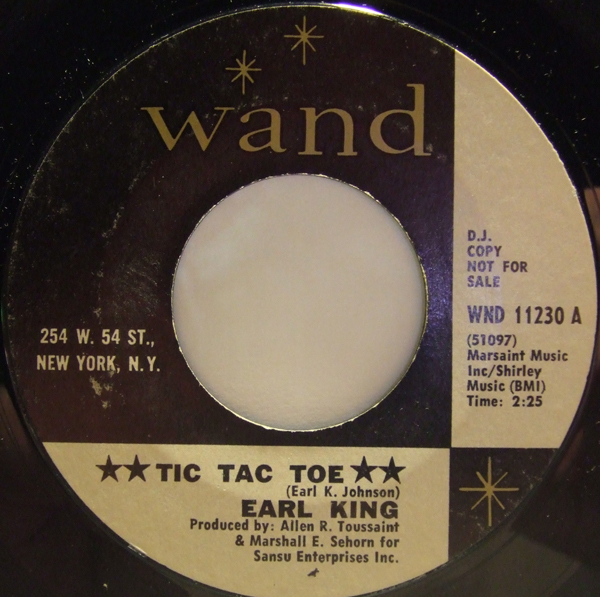
Earl King – Tic Tac Toe

By , August 22, 2010 1:18 pm

Example

Earl King

Example

Listen/Download – Earl King – Tic Tac Toe


Greetings all.

I’m sitting here, and it’s early. No one (except the kids, natch) has had enough sleep, but it’s relatively quiet so I figured I’d better get some writing in before the day gets rolling.
The summer – bracketed by Memorial Day and Labor Day – is almost over, and that, surprisingly enough, is a good thing.

Labor Day is approaching, and with it comes the exodus of the tourists. This glorious occasion is followed by a month of great weather, a serious drop in traffic and crowds, and with it the gradual restoration of my peace of mind (which seems in constant danger of extinction).
The tune I bring you today is a kicking slice of New Orleans funk, with as solid a pedigree as these things ever have.

The artist in question is the mighty Earl King.

You do not know him?

I say ‘au contraire, mon frere!’, because while Earl King may not have had any big hits, he was directly or indirectly responsible for many great pieces of music, including Professor Longhair’s legendary ‘Big Chief’ (which King wrote and sang on), the blues/soul standards  ‘Come On’ (which Jimi Hendrix covered on ‘Electric Ladyland’) and ‘Trick Bag’, in addition to being an indispensable part of New Orleans music in the 50s, 60s and 70s.

One need only dip into their New Orleans crates (you can substitute theoretical boxes of New Orleans 45s if you don’t have real ones) and see how many great records were either recorded by King, or bear the mark of his pen and/or performance (often under his real name, Earl Johnson).

The tune I bring you today is one of the few vinyl remnants of a 1970 King session, helmed by no less a light than Allen Toussaint and backed by a certain local combo called the Meters. This conglomeration recorded an album’s worth of material, but since a satisfactory deal never materialized, all that ever saw the light of day at the time was a few 45s.
One of these, ‘Street Parade’ (on the hard-to-find Kansu label) was featured in this space back in ought-seven. As Mardi Gras tributes go, they don’t get much better (or funkier) than ‘Street Parade’.

‘Tic Tac Toe’ which hails from the same sessions is lyrically uninspiring (pretty much standard issue dance craze boilerplate) but King is in fine voice, and the backing band featuring most of the Meters (Dan Phillips at the mighty ‘Home of the Groove’ noted previously that Art Neville’s keyboards seem to be MIA) is tight.

There’s a great, repeated bass guitar riff that kind of pushes the rhythm, Zig Modeliste’s snappy drums, and a nice horn chart riding in the background.

Despite the uninspired lyrics, it’s always great to hear King’s voice, and in the end what you are supposed be doing with this record is dancing, not parsing the meaning of the words, so take it all as a very groovy whole, and shake your thing a little bit.

I hope you dig it, and I’ll be back on Wednesday with something mellow.

Peace

Larry


Example


Check out the Funky16Corners Store at Cafe Press

PS Head over to Iron Leg for a Lennon/McCartney tune.


Boogaloo Joe Jones – Right On

By , August 19, 2010 6:44 pm

Example

Ivan Joseph Jones aka Boogaloo Joe

Example

Listen/Download – Boogaloo Joe Jones – Right On


Greetings all.
I hope everyone has had themselves a nice Funky16Corners Radio kind of week, filled with the dulcet, flute-y tones of this weeks mix.

I was going to double down on the flute-stravaganza and post a funky flute 45, but I couldn’t find the label pic, so it’ll have to keep.

Instead, may I request that you all get your hot pants on and your get-down shoes zipped up, because the track I’m going to whip on you today requires both.

I don’t suspect that those among you not enrolled in the crate digging or jazz collecting fraternities know the name Ivan ‘Boogaloo Joe’ Jones (how could you forget a name like that if you had?) but once you pull down the ones and zeroes on this one you shant soon forget it.

One might assume that he attached the ‘Boogaloo’ to his extremely common name merely to separate himself from the drummers Papa Jo and Philly Joe (both prominent Joneses) and that’s probably true to an extent, but if anyone ever deserved to be referred to as ‘Boogaloo’-anything, Ivan Joseph Jones was the man.

‘Right On’, one of my favorite Prestige jazz funk 45s (and they are legion) is as close to an all-star session as you’ll find with these things, plus you get that bad-ass, iconic Prestige blue-label 45 to stare at.

It’d be all groovy gravy if it was just Boogaloo Joe burning it up on the gee-tar, but you also get Charlie Earland on the Hammond, Pretty Purdie socking the shit out of his drums, Rusty Bryant on the sax and Jimmy Lewis on the bass.

And you REALLY have to dig the guitar. Boogaloo Joe winds his way in and out of the rhythm like a Ferrari on a race course.

All star-power aside, ‘Right On’ is an ass-whooper of the first order, with the head nod, and the hip slip, and all the rest of the involuntary anatomical expressions that go along with records that are this funky.

Funky, right, tight and outta sight, with enough chops for the jazzers and enough groove for the dancers, ‘Right On’ is a frequent flier in my DJ box, and though it’s a little on the crackly side (I tried to diminish the sound of sizzling bacon fat  as much as I could), this record is so hot you forget about it pretty quickly, unless you’re some kind of Hi-Fi hobbit nestled in the shire alongside a million dollars worth of audio equipment, in which case this isn’t for you anyway, so go have an herbal tea and come back when you’re feeling funky.

I know you’ll dig it, so do so, and I’ll see you all next week.

Peace

Larry


Example

PS Make sure to hit up the Funky16Corners Radio Show on Viva internet radio Friday night at 9PM. Your ears will thank you.


Check out the Funky16Corners Store at Cafe Press

PS Head over to Iron Leg for some hippie rock with a Native American twist.


Funky16Corners Radio v.87 – Wind of Change

By , August 15, 2010 1:58 pm

Example

Funky16Corners Radio v.87 – Wind of Change

Playlist

Rahsaan Roland Kirk – Ain’t No Sunshine (Atlantic)
Paul Horn – Paramahansa (RCA)
Moe Koffman – Comin’ Home Baby (Jubilee)
Bobbi Humphrey – Sad Bag (Blue Note)
David Newman – The 13th Floor (Atlantic)
Keith Mansfield – Teenage Chase (KPM)
Hubert Laws – Bloodshot (Atlantic)
Jerome Richardson – Ode to Billie Joe (Verve)
Joe Thomas – Big Heart Giant Soul (Cobblestone)
Ernie Fields – Watch Your Step (Kent)
Herbie Mann – Push Push (Atlantic)
Jeremy Steig – Alias (Solid State)
Frank Wess – Signed Sealed and Delivered (Enterprise)
Tim Weisberg – Streak Out (A&M)
Jethro Tull – Serenade To a Cuckoo (Chrysalis)


You can check out this mix in the Funky16Corners Radio Podcast Archive


Greetings all.

How are the closing days of summer treating you?
I know we’ve got lots of good weather ahead, but it’s only a few weeks until the mass exodus of the tourists, when I will once again be able roam free amidst traffic that is just ‘bad’, not mind-bogglingly so.
The mix I bring you today is a continuation of a minor series of sorts, in which the Funky16Corners Radio thingy takes time out to focus on a specific instrument. We’ve already surveyed the vibes and the electric piano, and I’m sure that there are a few more such collections huddling in the crates awaiting release.
This time out we take a look (listen) to the much maligned, but very groovy sounds of the (mostly) jazz flute.
As I said when I wrote about the vibes, there are those among us for whom the sound of the flute is too ‘cool’, which naturally is why I dig it so much.
I love the sound of the flute in the hands of a great musician, and what you’re getting in this mix is 15 examples of that very thing.
Of course, not every single cut contains a virtuoso performance, on account of that would be boring and a few steps away from the prog sound of my teenage years that I have come to despise.
The vast majority of the players here (although one of them is anonymous) are at least tangentially connected to the world of jazz, with a few having crossed over into pop and rock and one (yes, you know the one…the one who’s name sent a shiver up your spine when you saw it, unfairly I might add) solidly camped out in rock and roll.
This one took a while to assemble, if only because a few of the artists in question have appeared in this space frequently (Koffman, Steig, Wess, Mann), their dulcet tones gracing other Funky16Corners Radio playlists.
Things get off to a serious start with Rahsaan Roland Kirk’s epic reading of Bill Withers’ ‘Ain’t No Sunshine’. Kirk, a master on many wind instruments – often simultaneously – had a pronounced influence on two of the other players in this mix, namely Jeremy Steig and Ian Anderson (more on him later). His frequent use of ‘overblowing’, and vocalizing through the flute make him one of the most dynamic stylists the instrument has ever produced.
Paul Horn is best known for his pioneering new age recordings like ‘Inside’, but in the early to mid-60s he was still working a straight ahead jazz style. The Eastern-influenced ‘Paramahansa’ (which he re-recorded years later) appeared on his 1967 ‘Monday Monday’ LP, alongside a number of contemporary pop and rock covers. The tune sees Horn playing over a big band producing something that sounds like it’s from the soundtrack to a spy thriller.
Moe Koffman, who has been featured here a number of time is one of those cats that started out as a pretty ‘straight’ jazz player and as the 60s progressed he got further out. In addition to the flute Koffman was a proponent of the electrified saxophone (like Eddie Harris and Sonny Stitt) and he made some very cool, au go go flavored stuff during the era. His take on Bob Dorough and Ben Tucker’s “Coming Home Baby’ has a relaxed swing to it, sounding once again like something lifted from era-specific TV or movie soundtrack.
Bobbi Humphrey’s ‘Sad Bag’ has a mournful sound, with some very nice, reverbed flute.
David ‘Fathead’ Newman is better known for his sax playing, especially in his association with the mighty Ray Charles. I first heard ‘The 13th Floor’ on an early-90s comp called ‘Heavy Flute’, shortly after which I grabbed myself a copy of the 45. The tune originally appeared on Newman’s 1968 ‘Bigger and Better’ LP and is a great illustration of that fact that he certainly knew his way around the flute.
‘Teenage Chase’ is a Keith Mansfield penned cut from the KPM sound library album ‘Beat Incidental’. Like many of the cuts it was intended to be used as a ‘theme’, and so it is relatively short. I have no idea who the flute player us, but it sure as hell sounds like the same cat blowing on the Hawkshaw/Parker tune ‘Hot Pants’ (also a KPM selection).
Hubert Laws went on to great success with radio friendly R&B in the 70s with the CTI label, but in the mid-60s he was recording powerful soul jazz sessions for Atlantic. ‘Bloodshot’ is the opening track from his 1966 ‘Flute By Laws’ LP, and is driven by Laws’ flute, powerful brass and spot on Latin percussion.
Jerome Richardson is best known as a prolific studio musician, but he spent decades playing bop and soul jazz. His take on Bobbie Gentry’s ‘Ode to Billie Joe’ is from his 1968 ‘Groove Merchant’ album, which features Richardson on a variety of wind instruments, including a few different kinds of flute (more than one on this track!). Aside from an odd, intermittent chime, this version of ‘Ode…’ is pretty cool, including some well placed harpsichord.
Like many of the players here, Joe Thomas doubled (tripled) on a variety of wind instruments. ‘Big Heart, Giant Soul’ from his 1970 Cobblestone album ‘Comin’ Home’ is indicative of the high quality of that funky soul jazz session. You get to hear Thomas (who also played in Rhoda Scott’s trio) vocalizing on what sounds like a Varitone (maybe attached to the flute), and then playing it straight. Thomas went on to record funkier stuff (even disco) in the 70s.
Ernie Fields’ ‘Watch Your Step’ is one of my favorite 45s, period. I’ve never been able to find out much about Fields, but ‘Watch Your Step’ is so high-concept, so soulful yet psychedelic and well-arranged, that you can only hope that he did more stuff like this.
If you were to put together a list of cats with serious jazz chops who spent most of their career trying to reach a mass audience (and sometimes succeeding) Herbie Mann would have to be at the top of the list. Mann started out working in a Latin bag, but went on to record a serious grip of soul jazz and even pop through the 60s and 70s. The title track of his 1971 ‘Push Push’ album shows that Mann was very comfortable in a funky bag (where he spent most of the early 70s), eventually having his biggest hit with 1975’s ‘Hijack’.
Jeremy Steig is beloved by crate diggers/beat heads for his track ‘Howling for Judy’ which was the main sample behind the Beastie Boys’ ‘Sure Shot’. Steig’s late 60s/early 70s stuff for Solid State and Blue Note is generally pretty far out, and skipping right along the border between funky and ‘out’. ‘Alias (ALi’as)’ (named for drummer Don Alias) features a wild performance by Steig over bass, drums and percussion., is from the same 1969 LP (‘Legwork’) as ‘Howling…’.
I’ve featured a number of very cool tunes from Frank Wess’s 1970 ‘Wess to Memphis’ LP on the Stax subsidiary Enterprise. Once again I must recommend this album highly, since it’s one of those great sessions where a jazz cat (Wess was well known as a tenor player as well as his work on the flute) really got into a more popular vibe with excellent results. The album, which includes a number of covers is well played and produced, and one I go back to frequently. He wails on his version of Stevie Wonder’s ‘Signed Sealed and Delivered’.
I can’t remember where I first heard of Tim Weisberg’s ‘Streak-Out’, but I know I was surprised because it was the very same Weisberg who had a mid-70s chart hit alongside Dan Fogelberg! ‘Streak-Out’ from 1974 (which he apparently performed on the ‘Midnight Special’, so it must have been a minor hit) is a nice bit of funky rock, with a little bit of a break at the beginning.
This edition of Funky16Corners Radio closes out with what no doubt seems like the oddest of artists, Jethro Tull. All 1970s prog/hobbit-isms aside, when Tull got started in the late 60s they were a jazz inflected heavy blues band, not unlike Cream. The song presented here is, to bring things full circle, a Rahsaan Roland Kirk tune called ‘Serenade to a Cuckoo’. It was reportedly the first song Ian Anderson learned on the flute (Kirk being by far his strongest influence), and he and the band acquit themselves nicely.
I hope you dig this little survey, and I’ll be back later in the week.

Peace

Larry

Example

Check out the Funky16Corners Store at Cafe Press


PPS – Make sure to fall by Iron Leg for some freakbeat supreme!

PPPS Make sure to hit up Funky16Corners on Facebook

Classical Funk

By , August 12, 2010 11:28 am

Example

Woody Herman

Example

Example

Eumir Deodato

Example

Listen/Download – Woody Herman and the Herd – Fanfare for the Common Man

Listen/Download – Deodato – Also Sprach Zarathustra (2001)


Greetings all.
I hope week is coming to a satisfying close for you all.
My wife has to head out for a few days, and the spuds and myself are bumming, but since we plan to wreck the joint while she’s away, there is a (very) minor silver lining.
We’ll just see if three people can survive on corn chips, frankfurters and slurpees for five days.
If you haven’t already pulled down the ones and zeros for this weeks Funky16Corners Soul Club mix by my man Vincent the Soul Chef, do so now, on account of it’s full of the funk, and will – as the kids say – rock your world.
Also, don’t forget to tune in Friday night at 9PM for this week’s edition of the Funky16Corners Radio Show over at Viva internet radio. If you are not already hip/hep, you can click on the Radio Show link in the header and check out the fifteen (!?!) weekly shows that have already been mixed down and archived as MP3s for your listening pleasure.
Today’s post is one of those things that kind of fell together organically over the course of a few months, wherein I was holding something in storage, and then something else climbed over the transom and into the to-be-blogged folder that, how do they say, augmented the existing track in the stylistic and theoretical (figurative/symbolic) sense, and so they came together like beer and stout in a black and tan, blended ever so carefully so that once they pass over the lobes and into the brain the desired effect is one of jazzy, funky wonderfulness (and naturally, as is the style here at Funky16Corners, a tremendous run-on sentence).
Not too long ago one of my Friendface pals posted a video of the mighty Woody Herman and his Thundering Herd working it out on Aaron Copland’s 1942 masterpiece of 20th century classical music ‘Fanfare for the Common Man’. I dug the arrangement a LOT, so I went in search of the vinyl equivalent and found another live recording of a slightly later (I think) version of the Herd laying down the same arrangement at Montreaux.
Back in the olden days, when I was a long-haired, drum mangling stoner type, I had a copy of a certain Emerson, Lake and Palmer album that contained their version of the same piece of music. Having been brought up in a house full of classical music, but then stuffing my head with as much contemporary rock as possible, as well as being your standard teenaged rube, I thought that the ELP ‘Fanfare’ was of a deepness theretofore unheard, and blasted it at high volume many, many times until a seriously untrustworthy fellow bandmember (who, if memory serves was also a  pathological liar of singular talent) stole what was then a fairly expensive record (of course everything is expensive when you have no money).
In reflection, especially after hearing Woody Herman lay it down, the ELP version sounds like a meth-infused synthesizer orchestra trapped in an electrified mudslide. The Copland piece is both sublime and inspirational, and to hear it mangled so seems now to be something approaching a high crime.
Interestingly enough, Herman and his band were playing their Gary Anderson arrangement (recorded in 1974) of ‘Fanfare for the Common Man’ a few years before ELP got their hands on it, and as you might have already assumed, the touch is considerably lighter, using funky subtlety to finesse the brassy strains of Copland’s piece where ELP drove through it with a steamroller.
In addition to a hot band – Herman, a master of the original big band era made some serious moves in the fusion era, still with a big band – you get to hear the master working it out on the soprano sax.
If you get your hands on a copy of the ‘Herd at Montreux’ album, you also get to hear them play the Richard Evans arrangement of ‘I Can’t Get Next To You’ and a very tasty version of Billy Cobham’s ‘Crosswind’ that I’ll feature here in the future.
The second track featured today is something I’m sure a lot of you will be familiar with since it was a substantial hit in 1972. That tune is Eumir Deodato’s epic arrangement of Richard Strauss’s 1896 ‘Also Sprach Zarathustra’. Better known to one and all as the ‘2001’ music, Deodato’s take on the tune is in addition to being probably the biggest hit CTI ever had, a masterpiece of funky jazz.
Featuring Deodato on electric piano, Airto and Ray Barretto on percussion, Billy Cobham on drums, Stanley Clarke on bass and Jay Berliner on guitar, ‘Also Sprach Zarathustra’ goes on for nine minutes, and I’m here to tell you (though you should be able to hear it yourselves) that it never lags, never slips into fusion-y masturbation, never loses it’s kick.
The piece builds gradually, with a kind of amorphous tune-up, until the drums kick in at around 48 seconds, then the bass, guitar and of course Deodato’s electric piano (the heart and soul of the tune), followed by what has to be about the best known classical horn line in history, following the structure of the original until it settles down into a funky jam at around the two and a half minute mark. You know I love me some Fender Rhodes, and Deodato goes to town here. The coolest thing of all – and I hope you’ll agree – is that for what is basically a nine minute long jazz fusion interpretation of a piece of classical music (shades of Spinal Tap in Jazz Fantasy), ‘Also Sprach Zarathustra’ never gets cheesy or heavy handed, which is especially notable in an era when cheesy and heavy handed were the coin of the realm.
I hope you dig both of these cuts, and use them to get down with what the hipsters used to call ‘long hair’ music.
I’ll see you on Monday.

Peace

Larry


Example

PS Make sure to hit up the Funky16Corners Radio Show on Viva internet radio Friday night at 9PM. Your ears will thank you.


Check out the Funky16Corners Store at Cafe Press

PS Head over to Iron Leg for a tribute to the late Chris Dedrick of Free Design.


F16C Soul Club Presents: Vincent the Soul Chef

By , August 8, 2010 3:18 pm

Example

F16C Soul Club Presents – Vincent the Soul Chef – I Learned It By Watching You

Playlist

Intro-Partnership for a drug-free America PSA circa 1987
01 Stanga-Little Sister (Stone Flower)
02 Disco Kid-Funkhouse Express (Disko)
03 Get Down-Kay Gees (Gang)
04 Supersound-Jimmy Castor Bunch (Atlantic)
05 Funky Granny-Kool & The Gang (De-Lite)
06 Funk To The Folks-Creative Source (Sussex)
07 Everybody Needs Sonebody-King Floyd (Chimneyville)
08 The Funky Robot Pt. 1-Dave Cortez (All Platinum)
09 Take Me Back-Syl Johnson (Twinight)
10 Tell Me What You Want-Jimmy Ruffin (Chess)
11 Right On Right On Right On-Milt Grayson (Peak)
12 30 60 90-Willie Mitchell (Hi)
13 Whatever Happened To Superman-Captain Freak & The Lunacycle Band (Phil LA Of Soul)
14 Lily-Manu Dibango (Atlantic)
15 The Girl From Kenya-Fabulous Counts (Moira)
16 Everybody Wants To Be Free-Amnesty (Lamp/Now-Again)
17 I Got So Much Trouble On My Mind Pt. 2-Joe Quarterman (GSF)
18 Wind Your Clock-Naomi Davis (Daptone)
19 I’m The Man-Chris Jones (Goodie Train)
20 Sophisticated Sissy-Rufus Thomas (Stax)
21 The Chop-Privates Hammond Orchestra (Starla)
22 The Funky Judge (Instrumental)-Bull & The Matadors (Toddlin’ Town)
Endtro-Partnership for a drug-free America PSA circa 1987


You can check out this mix in the Funky16Corners Soul Club Archive

Greetings all.

I hope the new week finds you all well.
The mix you see before you is the newest installment in the groovy juggernaut known as the Funky16Corners Soul Club.

The name of the mixer should be familiar to fans of soul and funk blogging, that being the mighty Vincent the Soul Chef of Fufu Stew. I’ve known Vincent for a few years now, and can tell you from personal experience that he knows his shit, can handle a couple of turntables with the best of them, and has exquisite taste in music (which when you get down to it is really the bedrock).

What the Soul Chef has cooked up for us is over an hour of tasty funk  – a bouillabaisse if you will – composed of breaks, beats, thumping bass, wah wah guitar and vocals, with ingredients foraged in New Jersey, DC, San Fran, Memphis, New Orleans, Chitown and many points in between.

Vincent uses only the freshest funk, prepared with skill and whisked to your table so you might fill up on the good stuff.

I’ve given this one a couple of spins, and I’m sure you’ll dig it.

So fix yourself a plate, and make sure to head over to Fufu Stew.

See you later in the week.

Peace

Larry

Example

Check out the Funky16Corners Store at Cafe Press


PPS – Make sure to fall by Iron Leg for something unexpected.

PPPS Make sure to hit up Funky16Corners on Facebook


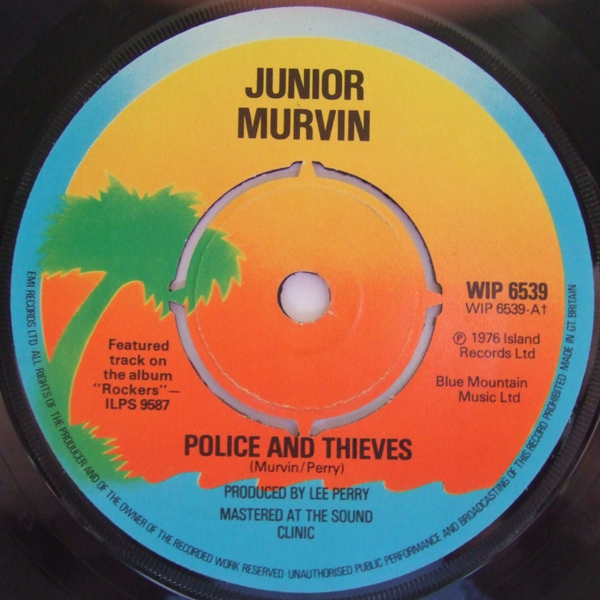
Junior Murvin – Police and Thieves

By , August 5, 2010 4:33 pm

Example

Junior Murvin

Example

Listen/Download – Junior Murvin – Police and Thieves


Greetings all.
How’s things on your end of the tin can and string device we know as the interwebs?
I’m feeling – in the words of the mighty Slim Gaillardmellow as a cello, so I figured I’d dip into the reggae box and whip something a tasty on you.

Way back in the olden days, when things were different (and they were, I assure you) a band called the Clash appeared on the scene, and as was my style of the time, I missed the boat.

The only guys I knew in school who dug the band were a couple of prize maroons, whose previous band worship was devoted to KISS (another band I couldn’t stand when I was in high school), and since they were knee deep in their suburban misunderstanding of ‘punk’ as it was, I trusted them not a whit.

My loss…

Anyhoo, a few years later, having been hipped to heavier sounds than the power pop that I thrived on by some cats whose taste I trusted implicitly, I gave the Clash a second chance, and thanks in large part to their reggae stylings, started to dig them, especially an energetic little number called ‘Police and Thieves’.
A few more years down the pike, another, hipper friend informed me that the song I dug was in fact a cover, and the original was by a dude named Junior Murvin.

As soon as I heard the original ‘Police and Thieves’ my mind was good and truly blown.

Where the Clash sounded like a heard of goons hurtling down a rutted street in a rusty city bus, Junior Murvin, ably assisted by the mighty Lee ‘Scratch’ Perry, delivered the cautionary tale of the legal yin and yang of street violence on a puffy cloud bank of ganja smoke.

I’ve gone into some detail in this space about my indoctrination into the world of Jamaican music, but one of things I don’t remember discussing, and this is relevant to many other ethnic sounds, is how one must in effect season their ears before some music can be fully appreciated.

Reggae is huge in that respect.

The first Jamaican sounds I heard, weren’t really from the island at all, but rather ska revival records from the US and the UK, which were generally delivered at a breakneck pace. The first time I picked up a copy of ’20 Reggae Classics’ it was like I was a strap-hanger in a subway that suddenly slammed on the brakes. The radical adjustment in tempo, not to mention hearing lyrics delivered in real Jamaican accents and patois was quite literally jarring.

Eventually, I found myself grooving on the real stuff, and while I still dug the Two Tone sound, I now preferred the originals.

Thanks to yet another hip dude, I found my way from ska directly to dub, which made the transition to pure reggae a lot easier, so when I finally heard Junior Murvin singing his original recording of ‘Police and Thieves’ it sounded ‘right’, if you know what I mean, and the Clash, despite all their good intentions, did not.

If you ever get the chance, grab the Lee Perry ‘Arkology’ boxed set that came out a while back, which – in addition to just packing a very substantial helping of his genius – also contains several versions of the ‘Police and Thieves’ riddim, some more dubbed out than others (including the flip side of this 45 ‘Soldier and Police War’ with toasting by Jah Lion).

No matter how groovy the riddim, the real feature here is the vocal by Murvin, who comes on like a Jamaican incarnation of Eddie Kendricks.

Murvin’s original, released in 1976 was a hit in both Jamaica and the UK (there’s a video out there somewhere of Murvin singing the tune on English TV). The Clash followed with their cover a year later, and though they rev it up a notch or two (or six or seven), they also strip away many, many layers of subtlety. Murvin wades into the song gently and his version is a lament, whereas the Clash stomp through the tune with a raised fist.
Reportedly, when Junior Murvin heard the Clash version, he said ‘They have destroyed Jah work!’

The liner notes to ‘Arkology’ include this passage about the creation of ‘Police and Thieves’:

“The vibe of Black Ark studio is like people gather ‘round, everyday it start like ten o’clock in the mornin’, a kerosene pan is on the fire bubblin’ with some dumplin’, an’ some dread over there pickin’ some ackee an’ ting. Everybody throw in a little much to buy whatever we need. A guy might be out there with his guitar, chantin’ and Scratch is inside smokin’ a spliff, tunin’ in to that guy, who doesn’t even know that Scratch is tunin’ in to him. All of a sudden Scratch jus’ come out an’ say ‘Come inside here’. He search an’ find a riddim an’ say: “I hear dat, an’ I hear it on dis riddim!’ That’s how we did ‘Police and Thieves’, Junior Murvin. He was jus’ playin’ it and Scratch immediately came out an’ say ‘Here’s a riddim, let’s do it!’ an’ he do it an’ that’s it.
We were jus’ messin’ around with lyrics and the melody. Scratch say ‘Sounds good.’ He come out an’ decided to record it right away. It was out on the street in a couple of days. That’s the vibe we had at Black Ark – you didn’t have to say tomorrow or nex’ week, you go right now, you sound good, let’s go. It was fun days.” – Max Romeo

Jah work, indeed!

See you next week.

Peace

Larry


Example

PS Make sure to hit up the Funky16Corners Radio Show on Viva internet radio Friday night at 9PM. Your ears will thank you.


Check out the Funky16Corners Store at Cafe Press

PS Head over to Iron Leg for some psychey bluesy garagey stuff.


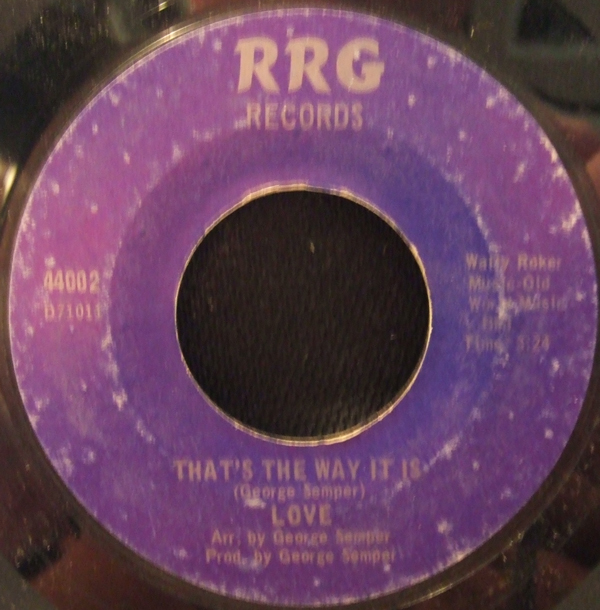
Love – That’s the Way It Is

By , August 3, 2010 7:05 pm

Example

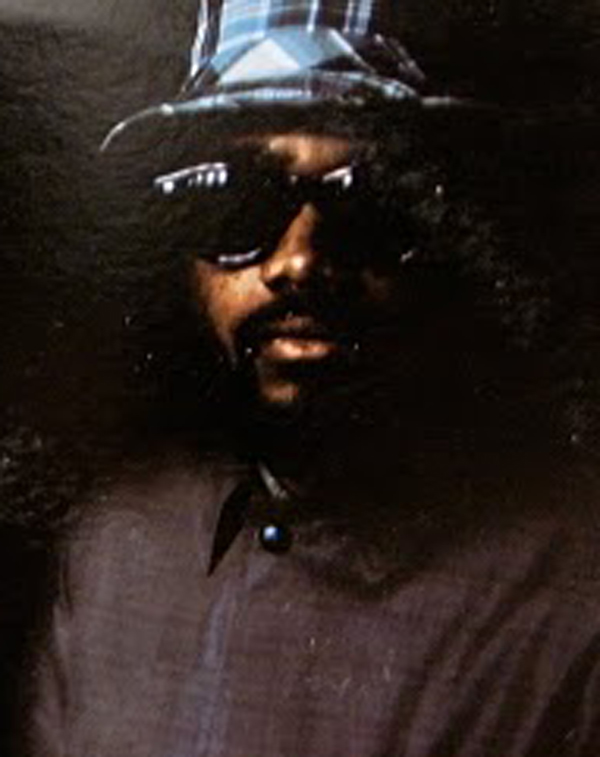
George Semper, from the cover of ‘Makin’ Waves’

Example

Listen/Download – Love – That’s the Way It Is


Greetings all.
I come to you midweek with a somewhat mysterious 45.
I can’t even recall how or when I picked this one up, but my suspicions suggest to me that it was procured at a record show.
I think I pulled it out of a box of 45s because I recognized the label (I already had a Jimmy Reed 45 on RRG), but I’m sure I decided to buy it when I noticed that both sides were written, arranged and produced by George Semper.
If that name is not familiar, head over to the podcast archive and search for his name, which appears in no less than four different mixes in his capacity as a creator of Hammond grooves, which until I found this 45 was the only thing I knew about him.
Hammond heads will already be hip to his ‘Makin’ Waves’ LP, and the funky 45 version of ‘It’s Your Thing’ by the George Semper Rhythm Committee.
I’ll only go as far as to state that Semper was a West Coast cat, since I’ve seen references that base him in both San Diego and Oakland and have no way to be sure which one (or both) is the correct location.
The fact that the band was called Love – though it was immediately obvious that it was not the Arthur Lee organization – is unusual, since this 45 likely dates from the late 60s or very early 70s (or at least that’s the way it sounds to me) and the LA/Arthur Lee band was still a going concern, on a major label.
Of course they had their only hit in 1966, so it’s entirely possible they didn’t pop up on Semper’s radar, but the name of the band is a minor issue that only stands in the way of Google-based research.
The sound of ‘That’s the Way It Is’  is interesting and funky, with some electric piano and clavinet (no doubt provided by Semper), restrained strings and a cool lead vocal. I don’t really know who the singer is, and I’m reluctant to suggest that it’s George Semper, since all of his other work (that I’m aware of) is instrumental in nature.
As far as the provenance of the RRG label, it seems to have been a Wally Roker led imprint that existed for a brief time after the demise of the Canyon label. Roker was also involved in the Roker and Soul Clock labels around the same time. They released a handful of 45s by Jimmy Reed (then in his decline and trying all kinds of things to stay relevant) and at least one by Doris Duke and of course the Love 45.
As far as I can tell the RRG 45 was the first and last thing that this ‘Love’ recorded. That’s too bad since the tune is memorable and the record definitely had (unfulfilled) commercial potential.
I hope you dig it, and if you have any more info to fill in the blanks, please drop me a line.

Peace

Larry


Example

NOTE: Thanks to commenter Piet who included a Popsike link to an issue of this same 45 on the Law-Ton label!


Check out the Funky16Corners Store at Cafe Press

PS Head over to Iron Leg for some Chicago garage punk.


Ralfi Pagan – Make It With You

By , August 1, 2010 3:37 pm

Example

Ralfi Pagan

Example

Listen/Download – Ralfi Pagan – Make It With You


Greetings all.
I hope everyone had themselves a sweet summer weekend.
Things were low key hereabouts, with my youngest son celebrating his fourth birthday, for which he got (and I assembled this morning) and old-school tricycle.
Right now, the sky is beginning to lighten after a torrential downpour, and Scooby Doo is on in the background, while my cup of iced coffee sweats next to the laptop…in other words, Sunday.
The tune I bring you today is another one of those records that I knew of for many, many years before I actually heard it, or owned a copy.
I am a big fan of Latin soul, especially mid-60s boogaloo, but every once in a while I get wind of something a little later in the game, maybe a little mellower, and it hits all the right pleasure centers in the brain (and then some), and Ralfi Pagan’s 1971 cover of ‘Make It With You’ is one of those records.
Pagan was a Bronx-born vocalist who recorded for Fania between 1969 and his untimely death in 1978*.
He specialized in ballads, delivered in a voice that sounded like a cross between Little Anthony and Smokey Robinson.
His version of Bread’s ‘Make It With You’, which was a Top 40 R&B hit in 1971 made Pagan a star with the Chicano audience, where the record remains something of a lowrider classic.
Though only three and a half minutes in length, ‘Make It With You’ manages to work as a minor epic. First and foremost is the arrangement (by Johnny Pacheco), which starts off sounding like an outtake from a Neil Young session, melts (with an odd key change) into a perfect bit of sweet soul.
Now, at the risk of sounding like a rube, I’ve always had a soft spot (how appropriate) for Bread’s early singles. David Gates had a real knack for crafting solid melodies. Unfortunately, he also had a real talent for matching them up with era-appropriate lyrics, thick with post-hippie, California sentimentality, always delivered with a completely straight face, which is probably why they were so successful.
Despite what any brigade of hipster douchebags might think, nobody was appreciating Bread, or the Carpenters ironically back when they first came out.
People loved those records because they took the earnest, heart-on-sleeve-ery of a Hallmark card and wrapped it up in just enough long hair and denim to make it palatable for “the kids”.
Ralfi Pagan took ‘Make It With You’ – which was Bread’s first hit (their only #1) in a long string of chart records that lasted until 1977 – and recast it, ever so slightly, arresting the tempo and delivering the lyrics in a soulful falsetto, that takes the ‘first wedding dance’ feel of the original and moves it into a back seat make out session.
The interesting thing is that the only real indicators that this is a ‘Latin’ record (aside from the Fania label** and its popularity with Latino audiences) is the very end of the record when Pagan starts singing in Spanish (echoed by the backing vocalists).
It’s a great record, and definitely worth a couple of close listens.
I hope you dig it, and I’ll be back on Wednesday.

Peace

Larry


Example

PS This week’s edition of the Funky16Corners Radio Show is now available for download. Just click on the Radio Show tab in the header.

*Pagan was killed while on tour in South America

**This record was also issued on Wand


Check out the Funky16Corners Store at Cafe Press

PS Head over to Iron Leg for some Chicago garage punk.


The Magictones – Good Old Music

By , July 29, 2010 4:30 pm

Example

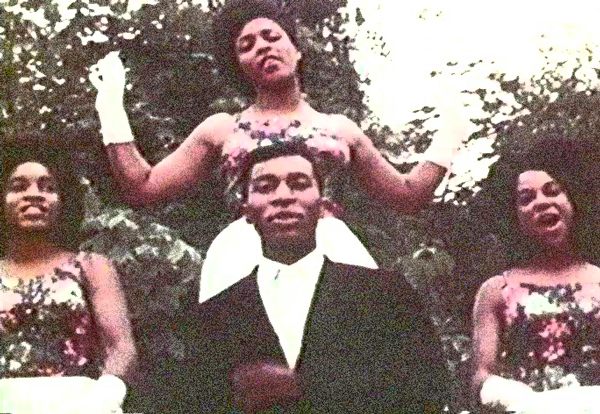
Whatcha smokin’ George??

Example

Listen/Download – The Magictones – Good Old Music


Greetings all.
The end of the week is here, and I just finished reading the autobiography of the mighty Grandmaster Flash, and I have breaks on my mind.
It might have something to do with the sad passing of Melvin Bliss, which has the Purdie break from ‘Synthetic Substitution’ running through my head in a loop, or reading how Flash and Kool Herc were cutting breaks way back when in the old school, or maybe because as an ex-drummer myself, I have those sounds ricocheting around my skull pretty much all the time.
Either way, there’s something undeniably magical about the isolated sounds of snares, rack toms and kick drums (and the occasional cymbal) whipped together in a syncopated stew that is really the heart and soul of funk, that secret ingredient that makes your head turn and your backbone slip and your eyes roll back in your head as you are compelled to say ‘UNH!’, the break – especially a really good one (on account of I have probably twice as many sloppy, poorly thought out breaks in my crates as I do the tight ones) is a mighty powerful thing.

So, how about a mighty powerful break?

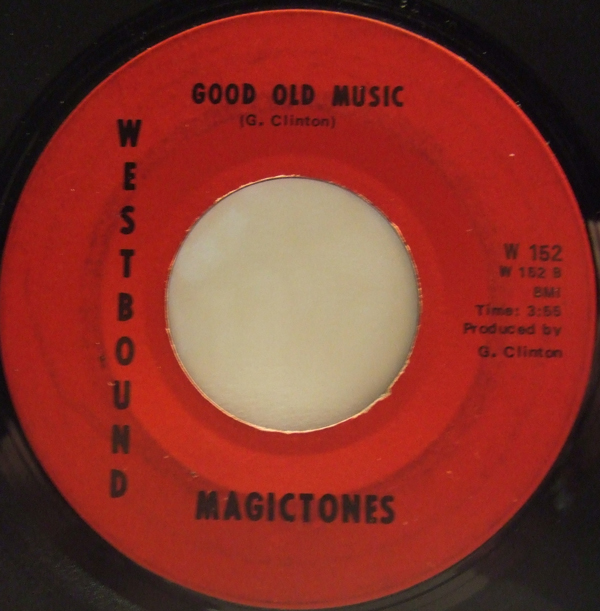
One of my favorite breaks for years was the one that starts out the Parliaments’ 1968 ‘Good Old Music’. Snappy, powerful and tasteful (but not wasteful), the ‘Good Old Music’ break was not only groovy all by its lonesome, but led into a whole big pile of psychedelic funk that had even the most restrained among us taking off their clothes and running out onto the front lawn to hoist the freak flag.

So, many years, and many records later I get hepped to the fact that there’s another Detroit-based, Clinton-produced version of the song by a group called the Magictones (from 1970), and I am assured that I need to hear it.

Now the OG is so good, I wasn’t exactly filled with anticipation that the cover was going to be anything special…until…yes, until I heard the break.

Holy fucking nutballs.

The break that opens the Magcitones’ version of ‘Good Old Music’ is about nineteen seconds of rock solid, laid back, ass-kick, seasoned with just a pinch of snapped fingers (with a couple of mumbled bits of encouragement) that is an absolute game changer. It goes on well past the pint when any sane person would expect the band to fall in, which is one of the reasons it rules.

When you go back in history, and take into account the greatest breaks of all, especially primordial, almost prehistoric jawns like Clyde Stubblefield’s break in James Brown’s ‘Cold Sweat’, you’re talking less about aggressive power, than you are about restraint and swing. This is not the sound of a hammer, but more the feeling of a series of deftly rendered brush strokes, engineered to make your head nod, while you try figure out if what you’re digging more are the drum hits or the space in between them.

The Magictones version of the song is not the same backing track as the Parliaments, though I’d venture a guess as to say that it’s almost definitely the same band (listen to the guitars and keys). The really cool thing is that the Magictones dial back the tempo just a hair, making the whole enterprise a little bit heavier, a little bit hippier, spreading it out like a swimming pool filled with molasses, into which you are invited to take a dive, off of the high board (in slow motion for the duration of the break) and into the funky goo, where you will proceed to roll, slowly, for just about three minutes and fifty seconds.

I mean honest to jumping Jiminy Jeebus, this is one motherfucking funky record in every possible sense of the word, and if you can get your bearings back after being knocked on your ass by those drums, you will surely have them unsettled in short order by the Magictones and what is undoubtedly a gang of Funkadelics getting down behind them.

I dare you not to listen to this over and over again, restarting the break in a loop, and them laying back and letting the whole thing wash over you a few times. How a record this good isn’t a major part of the funk 45 canon (on account of funk records don’t have to be fast, just funky) is an almost unspeakable omission, and I suggest that all you DJs out there that don’t already have one go out there and dig one up so that you can whip it on the people, wherein they will also be blown away and you will be hoisted upon their shoulders and paraded around the room, hands filled with free beer, like the god that you are.

Seriously.

Don’t forget to hit up the Funky16Corners Radio Show this Friday night over yonder at Viva Radio, 9PM EST for more of the good stuff you all know and love.

See you on Monday.

Peace

Larry


Example


Check out the Funky16Corners Store at Cafe Press

PS Head over to Iron Leg for some pop-psyche from an unexpected source.


The Exciters – Do Wah Diddy

By , July 27, 2010 6:07 pm

Example

The Exciters

Example

Listen/Download – The Exciters – Do Wah Diddy


Greetings all.
Is every one all up in the Simon and Garfunkel, i.e. feeling groovy?
The heat continues unabated, which wouldn’t bear mentioning, except for the fact that I went outside on Sunday to do yard work and ended up like one of those sweat-soaked, sun stroked chain gang fools in a Cool hand Luke stylee and ended up with just enough strength to crawl into bed, slap on my iPod and pass out about halfway into the first song.
Honest to jeebus it’s been a brutal summer hereabouts, and with me all pale and as sun-phobic as the next Morlock, I’m not digging it too much.
Don’t get me wrong…I like it when it’s hot, but like 85-ish. Once you break the 90 degree line, every time you set foot out of doors you can almost hear the cliched snippet of Delta blues slide guitar they always play when some poor slob is about to get run out of some dusty backwoods burgh (or vanish forever, depending on the movie).
That said, I’m lucky enough to be able to step back inside to the refrigerated (as they used to say in the olden days) air of the house, where my records sit safely, unwarped by the heat, and the beer chills in the fridge-o-manator so that I may do the same on the davenport.
That said, I was wondering what to post this fine day, and thought that something, summery, yet upbeat, with just a soupcon of history might fit the bill.
Wanna hear it? Here it is…
I’ve made mention – and demonstrated via example – that I am an absolute fiend when it comes to hunting down original versions of famous tunes in the soul, funk, blues and rock oeuvres. In fact, some day I’m gonna have to get my shnizzle together and whip them on y’all in podcast form, or maybe over at the old Funky16Corners Radio thing.
Hunting these things down, mainly via the heavy blues explosion of the late 60s led me down into the sounds of the Delta, the Piedmont and into Texas where many of these tunes were born.
Of course, not every OG harkens back to the 20s and 30s, many of them were more recent creations, i.e. first committed to wax during the 50s or even the early 60s, with the R&B and soul, and electric blues performers that exerted a much more significant influence on the British Invaders of ‘64 and beyond.
One of these artifacts, that I’d known about for decades, but only scored a copy of earlier this year is the track I bring you today.
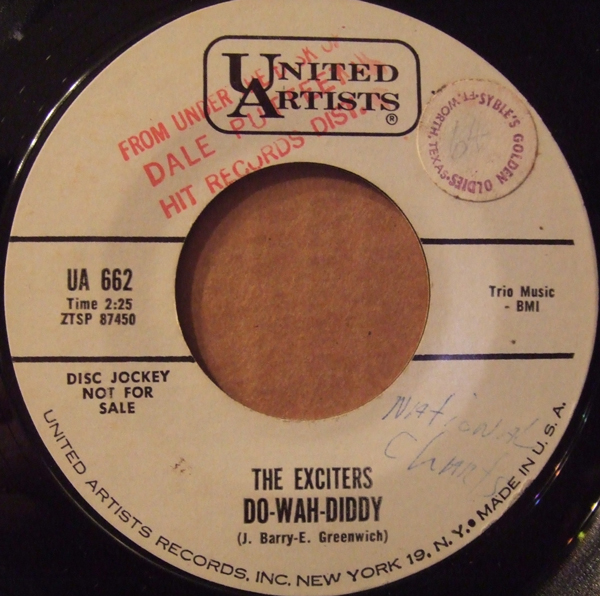
I’ll assume that literally everyone reading this has heard the version of ‘Do Wah Diddy Diddy’ by Manfred Mann, which was a huge hit in 1964, and has forever after been a staple of oldies radio. Featuring the voice of Paul Jones (one of the more soulful singers of his time) the Manfred’s version, like many of their storming covers of blues and soul material actually does justice to the original (and maybe exceeds it in some respects).
That original was recorded by the Exciters the year before. Their version only reached #78 on the Pop charts, quite a letdown after their biggest hit ‘Tell Him’ which was Top 20 earlier in 1963, and is also a cornerstone of oldies radio.
Written by Jeff Barry and Ellie Greenwich, the Exciters’ original is still a slamming slice of soulful group action, with pounding drums, and a wild lead vocal by Brenda Reid. The production by the geniuses (and my idols) Leiber and Stoller is spot on, and a little rawer than you might expect from a group often thought of as a ‘girl group’ (even though there was a guy – Herb Rooney –  in their ranks).
The instrumentation is pretty basic, with drums and piano backing the singers, followed by a horn section. Things get a little more ornate in the bridge, but you’d never mistake it for a Phil Spector production, though the chimes in the instrumental break lean in that direction a tiny bit.
Give it a close listen and you can almost imagine you’re there watching Leiber and Stoller building it bit by bit.
Though they’re known mainly as songwriters, they deserve a lot of credit for their work producing and arranging records as well, especially in an era where the best of the Brill Building-related writers were all making strides in that regard.
The Exciters remained together into the early 70s, though their last chart record was a 1966 cover of the Jarmels’ ‘Little Bit of Soap’. You should also be on the lookout for their Northern Soul stormer ‘Blowing Up My Mind’ from 1969 (I know I’m still looking for a copy…).
It’s a great cut, and I hope you dig it.

Peace

Larry


Example


Check out the Funky16Corners Store at Cafe Press

PS Head over to Iron Leg for some great instrumental pop.


Donnie Burks – The Gopher / Funky Funky Woman

By , July 25, 2010 1:57 pm

Example

Donnie Burks

Example

Listen/Download – Donnie Burks – The Gopher

Listen/Download – Donnie Burks – Funky Funky Woman


Greetings all.
I come to you, secure in the refrigerated Funky16Corners Record Vault and Podcast Nerve Center, where I’m currently hiding from the near 100 degree weather outside.
I’ve spent the afternoon, digimatizing vinyl, ripping old CDs onto the new iPod and trying to refile records.
I was going to write about something else today, but I decided to do a little more research on that particular selection, so today’s numbers moved to the front of the line.
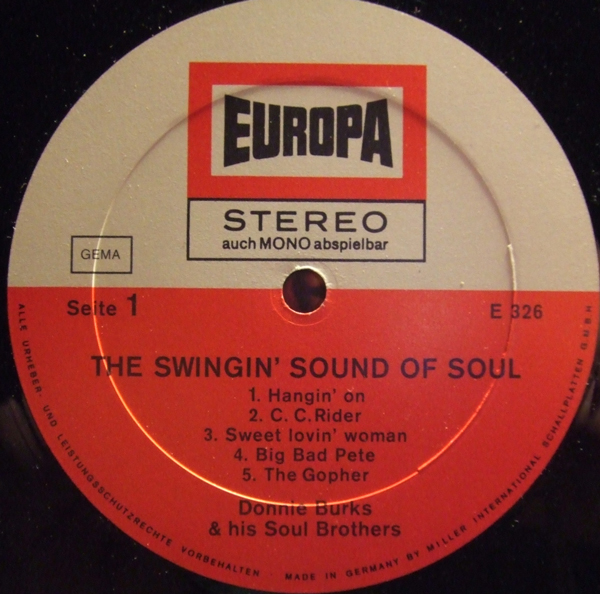
I found this record last Record Store Day in Asbury Park, and despite the fact that the artist was unknown to me, I grabbed it as it was both cheap, and intriguing.
I’d never heard of Donnie Burks before, but he looked vaguely familiar, and the record appeared to be American soul recorded (or at least released) in Europe, so I slapped a couple of semolians on the barrelhead and took the record home.
As soon as I set to Googling, I discovered a couple of very interesting things.
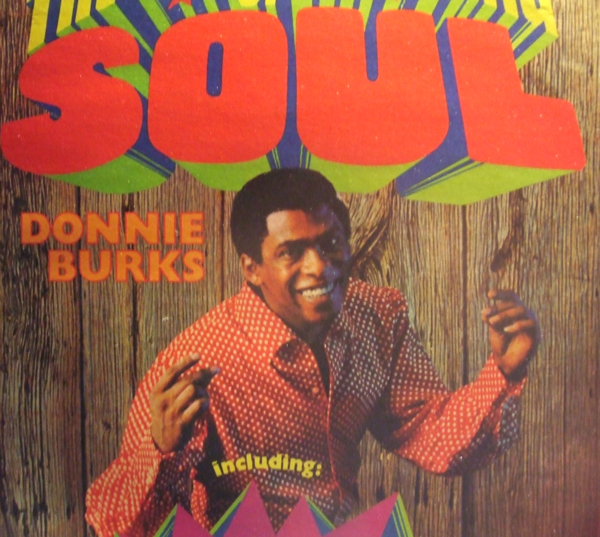
Donnie Burks, though fairly obscure as a singer, had a multi-layered career in his lifetime, starting out as a college basketball star, and moving on to appear in movies and on the Broadway stage.
When he passed away in 2008 at the age of 66, his glory days were long behind him.
It turns out that the reason he was familiar to me was that he had appeared as the grapes in a famous string of Fruit of the Loom underwear commercials (in which a group of dudes in fruit costumes touted the brand as a facsimile of the cornucopia in its logo).
Burks first came to prominence playing basketball for St John’s University in the late 50s and early 60s. He went on to appear in movies (The Pawnbroker, Shaft, Without a Trace*) and TV, as well as in a number of Broadway musicals (Hair, the Tap Dance Kid).
I have no idea how he came to record the album that gives us today’s track, but I have seen listings that suggest that he recorded at least two other 45s  for the Decca and Metromedia labels.
The tunes I bring you today, ‘The Gopher’ and ‘Funky Funky Woman’ come from the ‘Swingin’ Sounds of Soul’ LP. ‘The Gopher’ a cool, uptempo soul dancer. The production isn’t the best, but Burkes was a more than able singer and I’d be interested to hear his other 45s.
‘Funky Funky Woman’ carries the DNA of ‘Funky Broadway’, but it sounds as if it were strained through ‘Boogaloo Down Broadway’ first. Not terribly funky, but if I had a nickel for every record I’ve seen with ‘funky’ in the title, that isn’t (funky, that is), I’d have a huge, shiny pile of nickels.
I’d also love to know how Burks ended up recording (or at least releasing) an album in Germany. He was in the original Broadway cast of ‘Hair’ and the likely vintage of these recordings makes me wonder if he didn’t record it while overseas with a touring cast of the show. If anyone knows, please drop me a line.
I hope you dig the tunes, and I’ll see you all on Wednesday.

Peace

Larry


Example

*He’s a little hard to nail down via IMDB since he appears to be listed under a few different spellings of his name.


Check out the Funky16Corners Store at Cafe Press

PS Head over to Iron Leg for a groovy instrumental


Panorama Theme by Themocracy