

Which Way Two Way Poc A Way Say What Now?

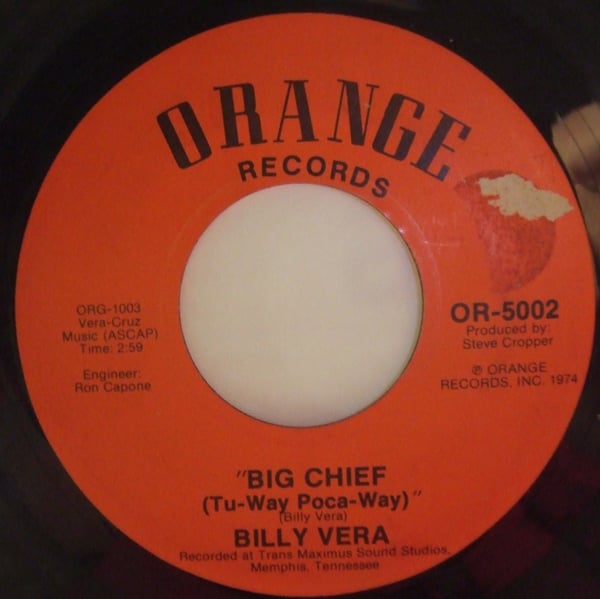
Dixie Cups (above) and Billy Vera (below)
Listen/Download – Dixie Cups – Two-Way-Poc-A-Way
Listen/Download – Billy Vera – Big Chief (Tu-Way Poca-Way)
NOTE: After you’re done reading, make sure to check out the comments for additional information on the roots of these songs.
Greetings all.
Here’s yet another unscheduled post, brought on by some deep thinking, spawned by a lack of same on my part, but ultimately remedied (at least I think so, but you’ll have to decide for yourself).
When I posted Billy Vera’s ‘Big Chief (Tu Way Poca Way)’ yesterday, preceded by a few weeks by the Dixie Cups record of the almost identical title, ‘Two-Way-Poc-A-Way’, it didn’t occur to me to think anything other than that both songs were drawing water from the same well, i.e. Mardi Gras Indian tradition.
The Indian Tribes are a New Orleans-based African American tradition that goes back to the mid-19th century, likely born out of the shared minority experience of blacks and native Americans.
The celebrations by these tribes are centered around several holidays climaxing with Mardi Gras, the final day of celebration prior to the Christian feast of Lent (which itself ends with Easter).
The tribes dress in fantastically ornate feathered costumes and parade through the city, doing symbolic battle for primacy.
If you are a big fan of New Orleans music, you have certainly heard, through countless versions of ‘Iko Iko’ (itself based on Sugarboy Crawford’s ‘Jock-A-Mo’, a situation that led to legal action which saw Crawford leave without gaining authorship of the later record, yet being given monetary rights to the Dixie Cups recording), as well as tunes like Professor Longhair’s ‘Big Chief’ words and phrases with a direct connection to the Wild Indian tribes, like ‘big chief’ ‘spy boy’ and ‘flag boy’, as well as a wide variety of seemingly meaningless, rhythmic phrases (check out Professor Longhair’s ‘Tipitina’ for a master class in same*).
When the Dixie Cups recorded ‘Two-Way-Poc-A-Way’ for ABC in 1965 (following their success with ‘Iko Iko’ on Leiber and Stoller’s Red Bird label) they were working with the same basic material, albeit in a much rawer way.
Billy Vera recorded ‘Big Chief (Tu-Way-Poca-Way)’ in 1974, creating his own bit of Mardi Gras funk, borrowing the main phrase from the Dixie Cups record or, and this is entirely likely considering the obscurity of the Dixie Cups recording, from a separate ‘third party’, i.e. Mardi Gras Indian tradition, or earlier R&B source itself.
When I posted the Vera 45 yesterday, a commenter stated that although he liked the record, it was merely an imitation of the Dixie Cups recording. I also had a brief exchange of e-mails on the subject with the mighty Dan Phillips of Home of the Groove.
I rolled this around in my head for a little while, and since I was out running errands when the comment came in, bounced back and forth between the two songs on the iPod, which in the car is a huge (and potentially dangerous) pain in the ass.
When I got home, I decided that the only way to get to the bottom (or at least close to the bottom of the situation) was to do my best to transcribe both songs and compare.
I’m not qualified to do this on a melodic level, but I do have enough of an ear to see that the Dixie Cups record is almost melody-free, more of a chant than a song. It has a sui generis feel that is both mysterious and extraordinary, where Vera’s record is straight ahead funk.
Lyrically, my assumption was that any similarities I was hearing were likely the result of, as I said before, both artists pulling phrases from the same tradition, which predated both recordings.
When I finally got both sets of lyrics typed out – and I hope you’ll forgive me if some of the words are incorrect – it would appear that aside from the title (which I can’t trace beyond the Dixie Cups record, which may in itself be a problem with countless spelling and punctuation variables) and a pair of common two-line phrases (placed in italics below), the songs are not the same.
There are certainly several common motifs, i.e. the Big Chief, spyboy (or spy), the second line and the battle fire (all of which appear in Professor Longhair’s ‘Big Chief’, which was itself written by Earl King) , but what you end up with is two songs about the same basic set of events (the meeting of the Indian tribes), which include many similar details.
Whether Vera lifted the repeated phrases (rhyming ‘on the bayou’ and ‘world on fire’ and then ‘tambourines ringing’ and ‘second line singing’) directly from the Dixie Cups record, or if they also arise from a third source that I am unaware of (which is also possible) I do not know.
If any of you do, please let me know and I will make note of it in this piece.
That said, there’s also the question of whether or not Vera, a California native, was engaging in a form of stylistic carpetbagging by drawing so heavily from these sources. If he’d recorded his record in 1966, I might say so, but ‘Big Chief (Tu Way Poca Way)’ was recorded in 1974.
Vera was an R&B/soul vet by this point, already familiar with the sounds of the Crescent City. As I mentioned in the previous piece, he is not only a musician with an almost 50 year long career, but also a historian.
As has been displayed in the space for the last six years (and in the web zine before that) the music and culture of New Orleans is brilliant, very deep, and very, very contagious.
My only visit there was as a teenager almost 35 years ago, but every time I put on a record by Professor Longhair, Eddie Bo, Dr John, the Meters, Huey Piano Smith and the Clowns, Irma Thomas, Eldridge Holmes, Roger and the Gypsies or any of the other NOLA artists that I hold so dear, I feel New Orleans in the room, and I can’t really think of any other American music that transports the listener to a region with as much ease.
I’d like to think that Billy Vera was trying to recreate that feeling when he wrote and recorded ‘Big Chief (Tu Way Poca Way)’.
Either way, he created a great 45.
The Lyrics: Note – I omitted repeated uses of the title since I’m not much of a typist, and I fear I may be approaching my lifetime quota on hyphens.
______________________________________________
Dixie Cups – Two-Way-Poc-A-Way
Early in the morning
Indians coming
Go and get the Big Chief
Big Chief ready
Down on the bayou
World on fire
Lord ain’t he pretty
Talkin’ bout big chief
Talkin’ bout big chief
Spy met a gang now
Spy went the signal
Big chief holla
Spy boy walla
Straight on to me
Go up fast now
Tell everybody
Goin on down
Down town
Spy boy leaving
Big chief holla
Second line follow
Tambourines ringing
Second line singing
Sun goin down
Sun going down
Jump all around now
All fall down
Goin’ on in now
Goin’ on in now
______________________________________________
Billy Vera – Big Chief (Tu-Way-Poca-Way)
Onda wondo wonda day
Onda wondo wonda day
Onda wondo wonda day
Onda wondo wonda day
Big Chief march out to the bayou
Dance around the battle fire
Say at night it can’t be done
Won’t come back ‘til battle is done
Goin on in now
Big chief leaders
Across the river
Where my spyboy Big Chief holla
Goes behind the second line follow
Enemy see your see turn tail
Tribes is fighting tooth and nail
Keep on fighting
Big chief leaders
On the bayou
World on fire
Battle is won we go downtown
Big parade when the sun go down
I want to paint my face turn green
Try to find my voodoo queen
Bayou bayou
World on fire
Big Chief holla
Second line follow
Tambourine ringing
Second line singing
See my queen now
Yours is green
Peace
Larry

*Much of this language has roots in Creole and what is referred to as Mobilian jargon
If you want one of the new Funky16Corners stickers (free, of course) click here for info.
Check out the Funky16Corners Store at Cafe Press
PS Head over to Iron Leg for some interesting late 60s pop.
 Funk, Funk 45, Funky16Corners, New Orleans Funk, Soul, Soul 45
|
Funk, Funk 45, Funky16Corners, New Orleans Funk, Soul, Soul 45
|  Funk, Funky16Corners, New Orleans, Soul


 Themocracy
Me, again, Larry –
I don’t think there is just one other source for Vera’s version, or the Dixie’s. Obviously (to me) he pulls one verse, “Big Chief holla, Second line follow. Tambourine ringing. Second line singing”, straight from the Dixie Cups’ version. Their chant-like rendition is how they heard the song in the streets for many years from the MG Indians as they passed, I’m sure. He also takes some of the Wild Magnolias’ song, “Handa Wanda”, from either their fist Crescent City 45 or from the later 1974 LP version. Also on that LP, is “Two Way Pak E Way”, funked up by Willie Tee and band, yet another version of this chant. To my knowledge, there were no recordings of this song by any Indians prior to the Wild Mags first LP. The collaboration between them and Tee’s group that Quint Davis got together and recorded was truly ground-breaking. So, unless Vera saw the Indians in the backstreets of New Orleans himself and transcribed their songs, which I guess is remotely possible, he took his inspiration from songs like King’s “Big Chief” as sung by Fess, and the Dixie Cups “Iko Iko” (based on Crawford’s “Jock-A-Mo”), and later “Two Way Poc A Way”. Billy, being a creative musician and a student of R&B, probably heard all these songs and probably did at least see the Indians at a Mardi Gras at some point. That would be inspiration enough to get on board when the Wild Magnolias and Tee brought that more or less hidden tradition of the New Orleans streets to commercial recording. I find Vera’s version derivative, but certainly in a good way. He wasn’t trying to rip them off, just celibate what they had going. As I told you earlier, strange that he chose to record it in Memphis, though. Why not go to the source?????
Thanks for posting all this very obsessive stuff! I done numerous posts on the backstory on these recordings. Feel free to search ’em out at HOTG. Peace and Happy Mardi Gras!
Dan
Thanks again for your input.
I didn’t know about the Wild Magnolia’s variation on the theme (I only have a 45 by them), and didn’t make the Meters connection (Hey Pocky A Way) until our previous e-mail.
I figured that the Dixie Cups probably heard it at the source, as they’ve been quoted as having picked up ‘Iko Iko’ at their grandmother’s knee (though that makes me wonder how well Grandma knew Sugarboy Crawford, but that’s another story).
I wish I knew of an in depth study of both the Indian Tribes and of the kind of Creole patois that makes it’s way into New Orleans R&B, soul and funk.
I’ve been listening for years and keep hearing these syllables pop up again and again (I forgot to mention Lee Dorsey as well).
I’m sure there must be a graduate thesis or two out there on the subject.
I’m wondering now if Vera heard the Wild Magnolias album before he wrote and recorded this, which would explain a lot. I guess without session notes or direct recollections (I e-mailed Billy about this a while back but never heard back) it would be impossible to line up/compare the dates.
Once again, I appreciate you’re sharing your first-hand expertise.
Larry
Happy Mardi Gras! De trucks are on dere way. I loaded up New Suit here for you and your readers: https://1001-songs.blogspot.com/2011/03/on-mardi-gras-day-in-nawlins-da-best.html
Here’s a couple of what are alleged to be the earliest recordings of the Indians, including one called “To-way-bac-a-way”:
https://desosquichante.blogspot.com/2011/03/got-golden-band.html
Oh, and in discussing “Iko Iko” and “Two-Way-Pock-A-Way” and their various cousins, one shouldn’t forget Huey “Piano” Smith’s “Don’t You Know Yockomo”, which is basically a rewrite of “Don’t You Just Know It”, (like so many of his songs– not that I mind!) but with different nonsense phrases, including “two way pock a way.”
Devlin
Thanks very much for the info. I have the Huey Smith 45 but had no recollection of it using the phrase but it’s right there on Youtube.
I’d never heard those Indian recordings either.
Larry
Hey, folk! Very thanks for this most interesting discussion. Thanks to Larry for the long comment and thanks to the other users for their interesting contributes. Particulary thanks to David, your report is very relevant! For me no doubt… “To-way-bac-a-way” is the inspiration for the Dixie Cups and the Vera’s versions. Mistery solved!
A discussion of great value on pop culture.
It would be fair to say this song is traditional and predates Mardi Gras Indians being recorded. This is a core chant, many people don’t know what it means, but it has a very specific meaning for the MG Indians in general. The first Mardi Gras in New Orleans is in 1699, there’s so much forgotten history there. In To-Way-Bac-A-Way from 1958 Smithsonian Folkways record Mardi Gras Indians they say “Ever since there was a carnival, Indians really began before the beginning of time” at the end they also sing the classic “Indian Red” that they call “Wild Man” also on the Wild Tchoupitoulas record, Dr. John and many other people keep this signifying classic alive. I read a dissertation on “Iko Iko” and a linguist identified 9 or so languages in the song. New Orleans itself reaches back in time and has the heights of the inebriated history archived for us, this is the unarchived street music of the absinthe era.