Booker T & the MGs – Plum Nellie (Stax)
Mark 3 Trio – Mr O (Downhill)
Louis Chachere – Shout Down (Central)
Robert Graham Organ Trio – Co Petiete (Amark)
Mohawks – Baby Hold On Pt2 (Cotillion)
Dave Lewis – Mmm Mmm Mmm (Panorama)
Soul Finders – Dead End Street (Camden)
Mad Hatters – Soul Sister (20th Cent)
Spencer Davis Group – Trampoline (Fontana)
Warm Excursion – Hang Up Pt2 (Pzazz)
Dave Baby Cortez – Hurricane (Clock)
Clarence Nelson – Good Times (MGM)
Freddie Scott & the Seven Steps – It’s Not Unusual (Marlin)
Gene Ludwig – Mr Fink Pt1 (La Vere)
Odell Brown – Sign of the Ram (Cadet)
Roger Coulam – Time Is Tight (Contour)
Toussaint McCall – Mary (Dore)
Rhoda Scott Trio – Watermelon Man (Tru Sound)
Hollis Floyd – Black Poncho Is Coming (Silloh)
This is being prepared in advance of my excursion to Washington, so any reporting on that trip will have to wait until later in the week.
Hopefully it was a gas and I found lots of groovy records.
That said, it’s been a while since the last organ mix (a live mix, back in January), and I can’t go very long without a Hammond infusion, so I figured it was time.
This mix is all over the map, with some hard driving R&B, soul, funk and even a little bit of soul jazz, but since we’re talking about the universe of the Hammond organ, that’s kind of how these things swing.
A couple of these tracks have seen the light of day here on Funky16Corners individually (none recently), but since two slices of bacon is always better than one, and organ records are the soulful and delicious equivalent of bacon in the musical food pyramid, it couldn’t possibly hurt to hear them again.
Anyhoo… this week might be a little light, since I’m one hundred and eleventy seven percent that I will be returning from DC exhausted, and then I have a little surgical type thingy on Tuesday which is sure to knock me on my ass for a few days, but it’s one of those ‘gotta do it when you gotta do it’ deals, so there.
I hope you dig the mix, and I’m sure I’ll make it back onto the scene by the end of the week (if not sooner).
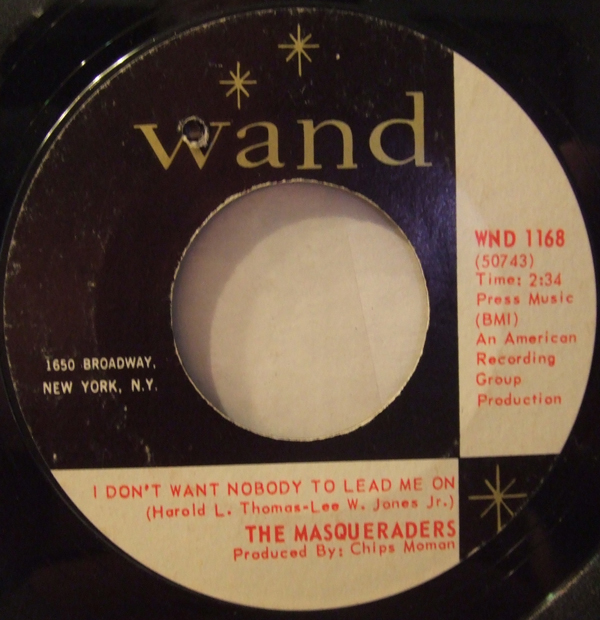
Listen/Download – Masqueraders – I Don’t Want Nobody To Lead Me On
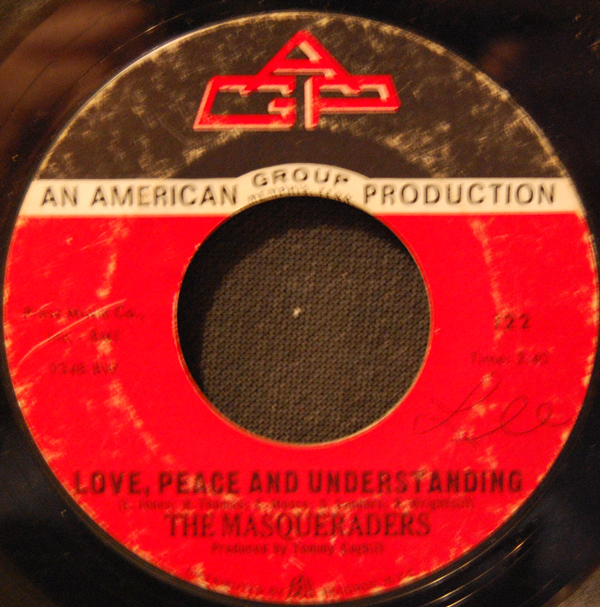
Listen/Download – Masqueraders – Love Peace and Understanding
Greetings all.
This is going to be a very busy week, with the real world moves mixed in with DJ gigs on Sunday in NYC (past) and next Sat and Sun in DC.
However, your intrepid blogger will not be stayed from the swift completion of his appointed rounds,
The two tunes I bring you today are by one of the more interesting soul groups that I’ve come across.
I first came to the Masqueraders in a rather roundabout way, after discovering that one of my favorite tunes on the Dynamics ‘First Landing’ album was in fact a cover of a Masqueraders tune.
This sent me a-Googling, and I discovered that the Masqueraders were the very definition of a journeyman soul group, having recorded for a wide variety of labels (under a few names) between the late 50s and the mid-70s, never having made a significant impact despite some very high quality records.
Finding out about the group via the Dynamics connection, I set out in search of their 45s, keeping their name filed in the back of my mind.
The basic framework of their story follows them from Texas, to Detroit, and then on to Memphis where they recorded a big chunk of their best stuff alongside the legendary Chips Moman and Tommy Cogbill (for a detailed look at their history check out these articles at The B-Side, Solid Hit Soul and SoulExpress).
Both of today’s tunes were recorded during their late-60s Memphis period, and were both written by the group.
‘I Don’t Want Nobody To Lead Me On’ (from 1967) was the Masqueraders tune I heard performed by the Dynamics. The tune was also covered by Rosey Grier (who also recorded for AGP) and a group called the Gentlemen Four. It’s a great piece of rough harmony soul, with some great guitar work. The Masqueraders’ version is (at least to my ears) far superior to the Dynamics (excellent) cover (I haven’t heard the other two versions).
1969’s ‘Love Peace and Understanding’ is a fantastic, upbeat number with era-specific lyrics that reinforces the group’s songwriting cred. Like ‘I’Don’t Want Nobody…’ it sounds like a rougher, groovier take on the Detroit group sound of the time, like a funkier, more aggressive Four Tops.
The Masqueraders hit the R&B charts a few times in the 60s, and again with a later version of the group in the 80s.
I hope you dig the tunes and I’ll be back on Wednesday.
Don’t forget, I’ll be heading down to Washington, DC for a weekend of fun. Saturday evening 9/25 I will be spinning at Marvin with my man DJ Birdman, bringing the finest in funk, soul and disco to perk up your ears and move your feet. The following day I will be spinning a set at the DC Record Fair. Fall by and say howdy if you’re in the area.
The end of the week is here, and I am happy to say that the Funky16Corners obit page is closed (for now).
Losing both Diamond Joe and King Coleman in the same week was a colossal drag, so I figured I close things out with something a little, how do they say, bad-ass.
But first, some news.
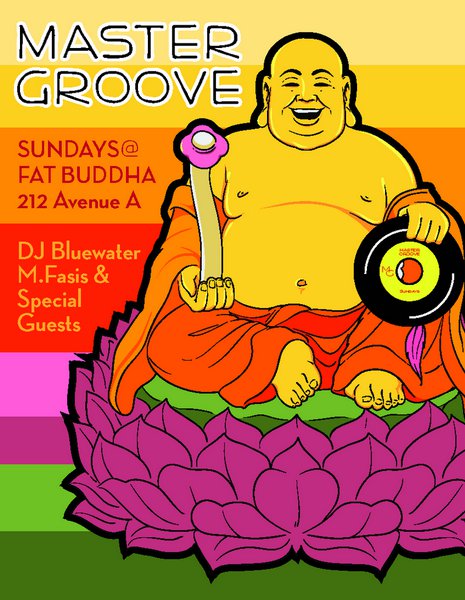
Should you be in New York City this Sunday evening and have developed a taste for the funk 45s, might I suggest you fall by Fat Buddha (formerly known as Forbidden City) 212 Ave A as I and my records will be making our return to Master Groove alongside residents DJ Bluewater and M-Fasis. I’ll be spending the next few days rifling through my crates to select only the finest funk that can be delivered via seven-inch platter, and I hope you can make it out to hear some of them, and perhaps, should the spirit take you, get off your ass and shake a tailfeather.
In even more exciting news, my records and I will be piling into the Funky16Corners-mobile and heading down to Washington, DC for a weekend of fun. Saturday evening 9/25 I will be spinning at Marvin with my man DJ Birdman, bringing the finest in funk, soul and disco to perk up your ears and move your feet. The following day I will be spinning a set at the DC Record Fair, as well as spending money on records (who among you didn’t see that coming?), after which I will be dragging my exhausted ass back to New Jersey.
You should also be hip (if you aren’t already) to the Funky16Corners Radio Show which drops every Friday night at 9PM on Viva internet radio, and is then archived for download (as an MP3) at this very blog the following day. I have lots of groovy stuff in store, so you should be real nice and feed your iPod something healthy.
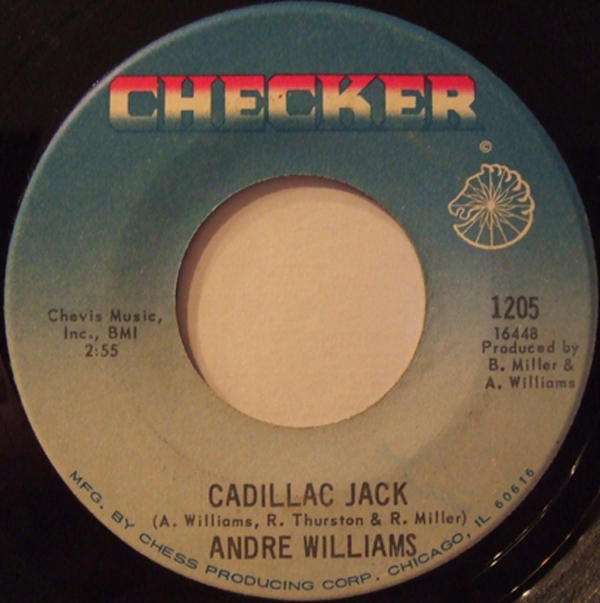
As I said a few graphs ago, I was in the mood for some funky bad-assery, so I dipped into the crates and whipped out a little number by Mr. Andre Williams.
I won’t go too deep into his history, which is long and convoluted, aside from letting you know that Mr. Williams, working in Detroit and Chicago had a hand in creating many, many great records during his day, including writing or co-writing tunes like ‘Shake a Tail Feather’ and ‘Twine Time’, and burning up the studios with his own brand of groove grease with tunes like ‘Bacon Fat’, ‘Jail Bait’, ‘Loose Juice’, ‘Rib Tips’ etc, and working behind the scenes on records like ‘Uhuru (African Twist)’ by Jomo and ‘Pig Snoots’ by the Natural Bridge Bunch. During the 50s and 6os he recorded for labels like Fortune, Avin, Sport, Ric-Tic, Checker, Chess Wingate and many more.
The tune I bring you today (from 1968) is a tale of a very heavy cat named ‘Cadillac Jack’ which is sung (narrated?) by Andre who gambles, fights and (of course) drives a big white Caddy, until he meets his end at the barrel of a gun, eventually trading his own Caddy for the long, black one from the funeral home.
As Mr Williams says, ‘He sure was a mack!’.
So was Andre, and despite hitting some very hard times a while back, he made a comeback and is still performing.
I hope you dig the tune, and I’ll be back on Monday.
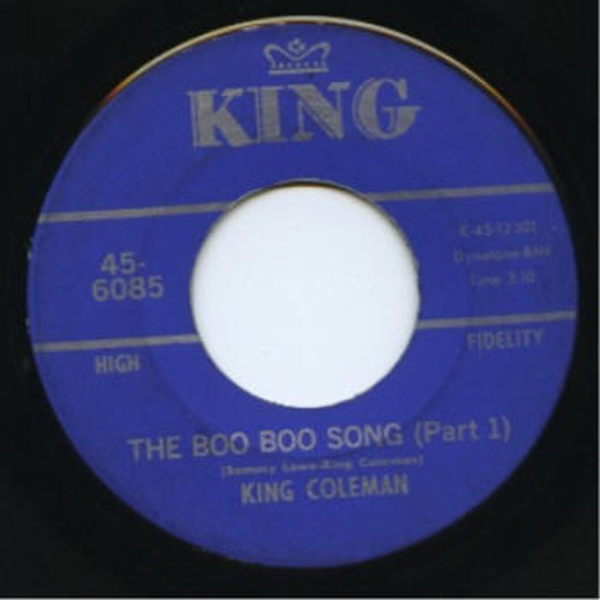
Listen/Download – King Coleman – The Boo Boo Song Pt1
Listen/Download – King Coleman – Freedom
Greetings all.
Welcome to the second – and hopefully the last – installment in the latest string of ‘in memorium’ posts here at Funky16Corners.
I heard of the passing of the mighty Rev. Carlton ‘King’ Coleman literally minutes after I found out about Diamond Joe.
Though I can’t say that I know a lot about King Coleman, what I do know cements his position as one of the great R&B/soul journeymen of the 60s.
He worked as a disc jockey, emcee, and vocalist (he debuted as the vocalist on Nat Kendrick and the Swans ‘(Do the) Mashed Potatoes’) going on to record a series of dynamite 45s.
The greatest of these (at least in my humble opinion) is the positively, unfuckwithable ‘Boo Boo Song’, as powerful and raucous a slab of party power as has ever been committed to vinyl.
The King eventually found his way to the Lord and continued to record religious music that was still soulful and funky, eventually returning to his radio roots hosting a gospel program on WMBM in his native Florida.
I’m going to repost both King Coleman tracks that have appeared here previously, the aforementioned ‘Boo Boo Song’ and the much more serious ‘Freedom’.
Separated from the ‘Boo Boo Song’ by barely a year, ‘Freedom’ (released on Philadelphia’s storied Fairmount label) is a spoken-word civil rights anthem, and quite a departure for the man that spent the previous decade shimmying, hully gullying, and engaging in all manner of madness.
I’m also going to repost the write-up I did about the ‘Boo Boo Song’ back in 2006. It pretty much says all I want to say about that amazing record.
So it’s the middle of 1967, and you just rolled into your job at the local six million watt AM radio powerhouse. You pour yourself a disgusting cup of lukewarm coffee and grab a box of new 45s, to see what might make it onto the air. You work your way through all manner of budding psychedelia, sunshine pop and middle-of-the-road instrumentals, when you reach into the box and pull out something called ‘The Boo Boo Song Pts 1&2’ by a cat calling himself King Coleman. Though you are unfamiliar with the artist, you decide to give it a spin anyway, knowing that despite the suspect title, anything is possible. You unsleeve the record, place it on the turntable and absentmindedly apply needle to wax. The next few second are a blur. All you can remember is that following seemingly innocent opening, female singers chanting;
A hunting we will go A hunting we will go We will catch that fox and put him in a box And will not let him go!
You momentarily figure you have a childrens record on your hands. And then, something happens that causes you to spit out your coffee and jump from your chair like your pants were on fire. There, booming out of the speakers is something that sounds like a bug-eyed madman on a caffeine bender.
Boo bo boo bo boo boo boo bo bo bo bo Bay bay buh baybay bay buh buh bay bay Bo bo bo bo bo bo bo (etc etc…)*
It sounds like the kind of guy, that if a certified lunatic like Screaming Jay Hawkins saw King Coleman coming up the sidewalk, he’d pull the bone from his nose, avert his eyes and cross to the other side of the street, murmuring to himself, “Omigod, omigod, omigod. It’s that King Coleman…PUH-leeze don’t let him see me….”
Suffice to say, that as far as you were concerned, things only got worse. The wild babbling emanating from the grooves builds to a crescendo, a mess of corrupted nursery rhymes, nonsense syllables and wild wailing. You rake the needle across the record, pull it off the turntable and break it into little pieces, run into the next room and tell your secretary that if she ever lets ANYTHING like that through again she’s going to be looking for work. You of course are a tasteless bastard, and this little memory goes a long way toward explaining why you currently live under a highway overpass, grilling pigeons over a campfire.
Now if it were me back then (I’d be 5 years old), I’d have immediately requested several extra copies of ‘The Boo Boo Song’ so I’d have some spares ready as I wore them out. That’s just the kind of kid I was (and am). You see, I think King Coleman was one of the great geniuses of his day, erupting like a rhythm and blues volcano, wrecking the joint with all manner of Mashed Potatoes, Hully Gullys, Loo-key Doo-keys, Alley Rats (and Soulful Mice) and Booga-Lous.
Between 1959, when he moved from his work as an emcee and disk jockey into the world of R&B as the voice on Nat Kendrick & The Swans ‘(Do The) Mashed Potatoes Pts 1&2’ – and the late 60’s, Carlton ‘King’ Coleman laid down some of the butt-shakingest, eye-rollingest, high-stepping soul and funk 45s to ever roll down the pike. Every last one of them** is a guaranteed party starter. ‘The Boo Boo Song Pts 1&2’ is possibly the finest of them all, because it manages to rope in (barely) his explosive vocalizing, pairing it with some booming drums, blaring horns and organ, all of which make it a storming slice of soul evangelism – guaran-freaking-teed to peel off the wallflowers and send those already dancing into a sweaty trance. If you haven’t done so already, I would suggest most vociferously that when you play this track, you loosen your tie, turn the volume way up and let it wail. I would also recommend that if you have any small kids around, you play it for them too. I played it for my two-year old son, and he thought it was a hoot.
* Yeah, I know that isn’t an exact transcription, but if you think I’m going to spend a half an hour, restarting the song 50 times so I can accurately count all the BOBO’s and BAYBAY’s, you my friend have another think coming…
** The only exception – and a track that was omitted (for obvious reasons) from the Norton comp is the fascinating ‘Freedom’, which came out on Fairmount in 1965 or 66. It’s a mostly spoken word, civil rights anthem that is an extreme departure from the rest of his oeuvre. I’ll post it here sometime in the future
I’m sitting here, and it’s early. No one (except the kids, natch) has had enough sleep, but it’s relatively quiet so I figured I’d better get some writing in before the day gets rolling.
The summer – bracketed by Memorial Day and Labor Day – is almost over, and that, surprisingly enough, is a good thing.
Labor Day is approaching, and with it comes the exodus of the tourists. This glorious occasion is followed by a month of great weather, a serious drop in traffic and crowds, and with it the gradual restoration of my peace of mind (which seems in constant danger of extinction).
The tune I bring you today is a kicking slice of New Orleans funk, with as solid a pedigree as these things ever have.
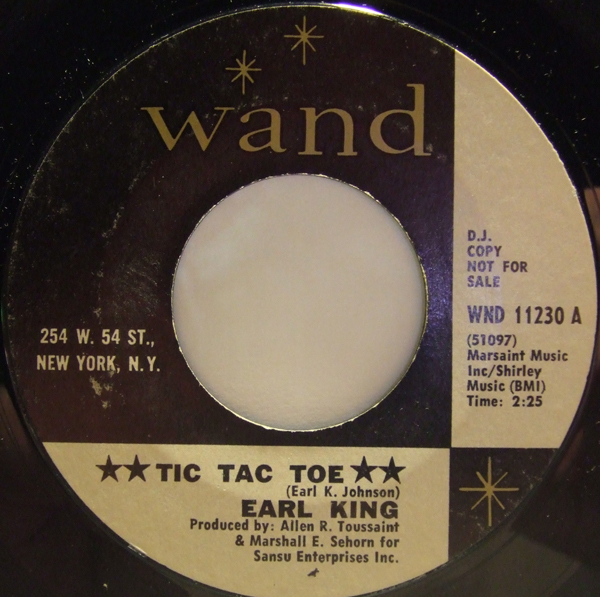
The artist in question is the mighty Earl King.
You do not know him?
I say ‘au contraire, mon frere!’, because while Earl King may not have had any big hits, he was directly or indirectly responsible for many great pieces of music, including Professor Longhair’s legendary ‘Big Chief’ (which King wrote and sang on), the blues/soul standards ‘Come On’ (which Jimi Hendrix covered on ‘Electric Ladyland’) and ‘Trick Bag’, in addition to being an indispensable part of New Orleans music in the 50s, 60s and 70s.
One need only dip into their New Orleans crates (you can substitute theoretical boxes of New Orleans 45s if you don’t have real ones) and see how many great records were either recorded by King, or bear the mark of his pen and/or performance (often under his real name, Earl Johnson).
The tune I bring you today is one of the few vinyl remnants of a 1970 King session, helmed by no less a light than Allen Toussaint and backed by a certain local combo called the Meters. This conglomeration recorded an album’s worth of material, but since a satisfactory deal never materialized, all that ever saw the light of day at the time was a few 45s.
One of these, ‘Street Parade’ (on the hard-to-find Kansu label) was featured in this space back in ought-seven. As Mardi Gras tributes go, they don’t get much better (or funkier) than ‘Street Parade’.
There’s a great, repeated bass guitar riff that kind of pushes the rhythm, Zig Modeliste’s snappy drums, and a nice horn chart riding in the background.
Despite the uninspired lyrics, it’s always great to hear King’s voice, and in the end what you are supposed be doing with this record is dancing, not parsing the meaning of the words, so take it all as a very groovy whole, and shake your thing a little bit.
I hope you dig it, and I’ll be back on Wednesday with something mellow.
Rahsaan Roland Kirk – Ain’t No Sunshine (Atlantic)
Paul Horn – Paramahansa (RCA)
Moe Koffman – Comin’ Home Baby (Jubilee)
Bobbi Humphrey – Sad Bag (Blue Note)
David Newman – The 13th Floor (Atlantic)
Keith Mansfield – Teenage Chase (KPM)
Hubert Laws – Bloodshot (Atlantic)
Jerome Richardson – Ode to Billie Joe (Verve)
Joe Thomas – Big Heart Giant Soul (Cobblestone)
Ernie Fields – Watch Your Step (Kent)
Herbie Mann – Push Push (Atlantic)
Jeremy Steig – Alias (Solid State)
Frank Wess – Signed Sealed and Delivered (Enterprise)
Tim Weisberg – Streak Out (A&M)
Jethro Tull – Serenade To a Cuckoo (Chrysalis)
How are the closing days of summer treating you?
I know we’ve got lots of good weather ahead, but it’s only a few weeks until the mass exodus of the tourists, when I will once again be able roam free amidst traffic that is just ‘bad’, not mind-bogglingly so.
The mix I bring you today is a continuation of a minor series of sorts, in which the Funky16Corners Radio thingy takes time out to focus on a specific instrument. We’ve already surveyed the vibes and the electric piano, and I’m sure that there are a few more such collections huddling in the crates awaiting release.
This time out we take a look (listen) to the much maligned, but very groovy sounds of the (mostly) jazz flute.
As I said when I wrote about the vibes, there are those among us for whom the sound of the flute is too ‘cool’, which naturally is why I dig it so much.
I love the sound of the flute in the hands of a great musician, and what you’re getting in this mix is 15 examples of that very thing.
Of course, not every single cut contains a virtuoso performance, on account of that would be boring and a few steps away from the prog sound of my teenage years that I have come to despise.
The vast majority of the players here (although one of them is anonymous) are at least tangentially connected to the world of jazz, with a few having crossed over into pop and rock and one (yes, you know the one…the one who’s name sent a shiver up your spine when you saw it, unfairly I might add) solidly camped out in rock and roll.
This one took a while to assemble, if only because a few of the artists in question have appeared in this space frequently (Koffman, Steig, Wess, Mann), their dulcet tones gracing other Funky16Corners Radio playlists.
Things get off to a serious start with Rahsaan Roland Kirk’s epic reading of Bill Withers’ ‘Ain’t No Sunshine’. Kirk, a master on many wind instruments – often simultaneously – had a pronounced influence on two of the other players in this mix, namely Jeremy Steig and Ian Anderson (more on him later). His frequent use of ‘overblowing’, and vocalizing through the flute make him one of the most dynamic stylists the instrument has ever produced. Paul Horn is best known for his pioneering new age recordings like ‘Inside’, but in the early to mid-60s he was still working a straight ahead jazz style. The Eastern-influenced ‘Paramahansa’ (which he re-recorded years later) appeared on his 1967 ‘Monday Monday’ LP, alongside a number of contemporary pop and rock covers. The tune sees Horn playing over a big band producing something that sounds like it’s from the soundtrack to a spy thriller. Moe Koffman, who has been featured here a number of time is one of those cats that started out as a pretty ‘straight’ jazz player and as the 60s progressed he got further out. In addition to the flute Koffman was a proponent of the electrified saxophone (like Eddie Harris and Sonny Stitt) and he made some very cool, au go go flavored stuff during the era. His take on Bob Dorough and Ben Tucker’s “Coming Home Baby’ has a relaxed swing to it, sounding once again like something lifted from era-specific TV or movie soundtrack. Bobbi Humphrey’s ‘Sad Bag’ has a mournful sound, with some very nice, reverbed flute. David ‘Fathead’ Newman is better known for his sax playing, especially in his association with the mighty Ray Charles. I first heard ‘The 13th Floor’ on an early-90s comp called ‘Heavy Flute’, shortly after which I grabbed myself a copy of the 45. The tune originally appeared on Newman’s 1968 ‘Bigger and Better’ LP and is a great illustration of that fact that he certainly knew his way around the flute.
‘Teenage Chase’ is a Keith Mansfield penned cut from the KPM sound library album ‘Beat Incidental’. Like many of the cuts it was intended to be used as a ‘theme’, and so it is relatively short. I have no idea who the flute player us, but it sure as hell sounds like the same cat blowing on the Hawkshaw/Parker tune ‘Hot Pants’ (also a KPM selection). Hubert Laws went on to great success with radio friendly R&B in the 70s with the CTI label, but in the mid-60s he was recording powerful soul jazz sessions for Atlantic. ‘Bloodshot’ is the opening track from his 1966 ‘Flute By Laws’ LP, and is driven by Laws’ flute, powerful brass and spot on Latin percussion. Jerome Richardson is best known as a prolific studio musician, but he spent decades playing bop and soul jazz. His take on Bobbie Gentry’s ‘Ode to Billie Joe’ is from his 1968 ‘Groove Merchant’ album, which features Richardson on a variety of wind instruments, including a few different kinds of flute (more than one on this track!). Aside from an odd, intermittent chime, this version of ‘Ode…’ is pretty cool, including some well placed harpsichord.
Like many of the players here, Joe Thomas doubled (tripled) on a variety of wind instruments. ‘Big Heart, Giant Soul’ from his 1970 Cobblestone album ‘Comin’ Home’ is indicative of the high quality of that funky soul jazz session. You get to hear Thomas (who also played in Rhoda Scott’s trio) vocalizing on what sounds like a Varitone (maybe attached to the flute), and then playing it straight. Thomas went on to record funkier stuff (even disco) in the 70s. Ernie Fields’ ‘Watch Your Step’ is one of my favorite 45s, period. I’ve never been able to find out much about Fields, but ‘Watch Your Step’ is so high-concept, so soulful yet psychedelic and well-arranged, that you can only hope that he did more stuff like this.
If you were to put together a list of cats with serious jazz chops who spent most of their career trying to reach a mass audience (and sometimes succeeding) Herbie Mann would have to be at the top of the list. Mann started out working in a Latin bag, but went on to record a serious grip of soul jazz and even pop through the 60s and 70s. The title track of his 1971 ‘Push Push’ album shows that Mann was very comfortable in a funky bag (where he spent most of the early 70s), eventually having his biggest hit with 1975’s ‘Hijack’. Jeremy Steig is beloved by crate diggers/beat heads for his track ‘Howling for Judy’ which was the main sample behind the Beastie Boys’ ‘Sure Shot’. Steig’s late 60s/early 70s stuff for Solid State and Blue Note is generally pretty far out, and skipping right along the border between funky and ‘out’. ‘Alias (ALi’as)’ (named for drummer Don Alias) features a wild performance by Steig over bass, drums and percussion., is from the same 1969 LP (‘Legwork’) as ‘Howling…’.
I’ve featured a number of very cool tunes from Frank Wess’s 1970 ‘Wess to Memphis’ LP on the Stax subsidiary Enterprise. Once again I must recommend this album highly, since it’s one of those great sessions where a jazz cat (Wess was well known as a tenor player as well as his work on the flute) really got into a more popular vibe with excellent results. The album, which includes a number of covers is well played and produced, and one I go back to frequently. He wails on his version of Stevie Wonder’s ‘Signed Sealed and Delivered’.
I can’t remember where I first heard of Tim Weisberg’s ‘Streak-Out’, but I know I was surprised because it was the very same Weisberg who had a mid-70s chart hit alongside Dan Fogelberg! ‘Streak-Out’ from 1974 (which he apparently performed on the ‘Midnight Special’, so it must have been a minor hit) is a nice bit of funky rock, with a little bit of a break at the beginning.
This edition of Funky16Corners Radio closes out with what no doubt seems like the oddest of artists, Jethro Tull. All 1970s prog/hobbit-isms aside, when Tull got started in the late 60s they were a jazz inflected heavy blues band, not unlike Cream. The song presented here is, to bring things full circle, a Rahsaan Roland Kirk tune called ‘Serenade to a Cuckoo’. It was reportedly the first song Ian Anderson learned on the flute (Kirk being by far his strongest influence), and he and the band acquit themselves nicely.
I hope you dig this little survey, and I’ll be back later in the week.
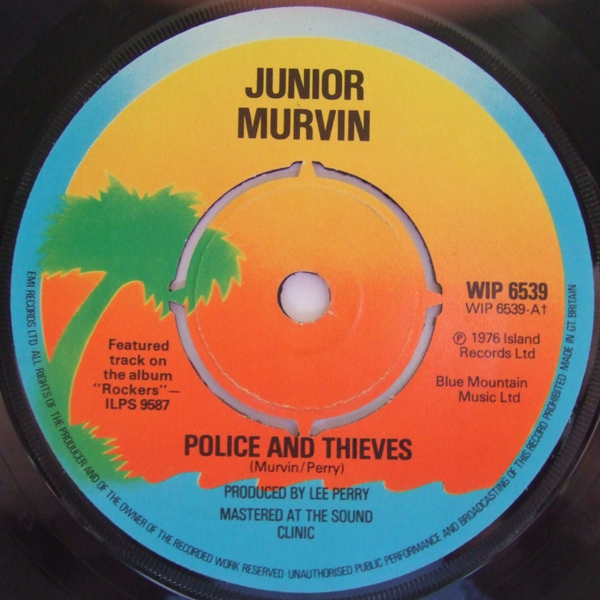
Listen/Download – Junior Murvin – Police and Thieves
Greetings all.
How’s things on your end of the tin can and string device we know as the interwebs?
I’m feeling – in the words of the mighty Slim Gaillard – mellow as a cello, so I figured I’d dip into the reggae box and whip something a tasty on you.
Way back in the olden days, when things were different (and they were, I assure you) a band called the Clash appeared on the scene, and as was my style of the time, I missed the boat.
The only guys I knew in school who dug the band were a couple of prize maroons, whose previous band worship was devoted to KISS (another band I couldn’t stand when I was in high school), and since they were knee deep in their suburban misunderstanding of ‘punk’ as it was, I trusted them not a whit.
My loss…
Anyhoo, a few years later, having been hipped to heavier sounds than the power pop that I thrived on by some cats whose taste I trusted implicitly, I gave the Clash a second chance, and thanks in large part to their reggae stylings, started to dig them, especially an energetic little number called ‘Police and Thieves’.
A few more years down the pike, another, hipper friend informed me that the song I dug was in fact a cover, and the original was by a dude named Junior Murvin.
As soon as I heard the original ‘Police and Thieves’ my mind was good and truly blown.
Where the Clash sounded like a heard of goons hurtling down a rutted street in a rusty city bus, Junior Murvin, ably assisted by the mighty Lee ‘Scratch’ Perry, delivered the cautionary tale of the legal yin and yang of street violence on a puffy cloud bank of ganja smoke.
I’ve gone into some detail in this space about my indoctrination into the world of Jamaican music, but one of things I don’t remember discussing, and this is relevant to many other ethnic sounds, is how one must in effect season their ears before some music can be fully appreciated.
Reggae is huge in that respect.
The first Jamaican sounds I heard, weren’t really from the island at all, but rather ska revival records from the US and the UK, which were generally delivered at a breakneck pace. The first time I picked up a copy of ’20 Reggae Classics’ it was like I was a strap-hanger in a subway that suddenly slammed on the brakes. The radical adjustment in tempo, not to mention hearing lyrics delivered in real Jamaican accents and patois was quite literally jarring.
Eventually, I found myself grooving on the real stuff, and while I still dug the Two Tone sound, I now preferred the originals.
Thanks to yet another hip dude, I found my way from ska directly to dub, which made the transition to pure reggae a lot easier, so when I finally heard Junior Murvin singing his original recording of ‘Police and Thieves’ it sounded ‘right’, if you know what I mean, and the Clash, despite all their good intentions, did not.
If you ever get the chance, grab the Lee Perry ‘Arkology’ boxed set that came out a while back, which – in addition to just packing a very substantial helping of his genius – also contains several versions of the ‘Police and Thieves’ riddim, some more dubbed out than others (including the flip side of this 45 ‘Soldier and Police War’ with toasting by Jah Lion).
No matter how groovy the riddim, the real feature here is the vocal by Murvin, who comes on like a Jamaican incarnation of Eddie Kendricks.
Murvin’s original, released in 1976 was a hit in both Jamaica and the UK (there’s a video out there somewhere of Murvin singing the tune on English TV). The Clash followed with their cover a year later, and though they rev it up a notch or two (or six or seven), they also strip away many, many layers of subtlety. Murvin wades into the song gently and his version is a lament, whereas the Clash stomp through the tune with a raised fist.
Reportedly, when Junior Murvin heard the Clash version, he said ‘They have destroyed Jah work!’
The liner notes to ‘Arkology’ include this passage about the creation of ‘Police and Thieves’:
“The vibe of Black Ark studio is like people gather ‘round, everyday it start like ten o’clock in the mornin’, a kerosene pan is on the fire bubblin’ with some dumplin’, an’ some dread over there pickin’ some ackee an’ ting. Everybody throw in a little much to buy whatever we need. A guy might be out there with his guitar, chantin’ and Scratch is inside smokin’ a spliff, tunin’ in to that guy, who doesn’t even know that Scratch is tunin’ in to him. All of a sudden Scratch jus’ come out an’ say ‘Come inside here’. He search an’ find a riddim an’ say: “I hear dat, an’ I hear it on dis riddim!’ That’s how we did ‘Police and Thieves’, Junior Murvin. He was jus’ playin’ it and Scratch immediately came out an’ say ‘Here’s a riddim, let’s do it!’ an’ he do it an’ that’s it.
We were jus’ messin’ around with lyrics and the melody. Scratch say ‘Sounds good.’ He come out an’ decided to record it right away. It was out on the street in a couple of days. That’s the vibe we had at Black Ark – you didn’t have to say tomorrow or nex’ week, you go right now, you sound good, let’s go. It was fun days.” – Max Romeo
Greetings all.
I come to you midweek with a somewhat mysterious 45.
I can’t even recall how or when I picked this one up, but my suspicions suggest to me that it was procured at a record show.
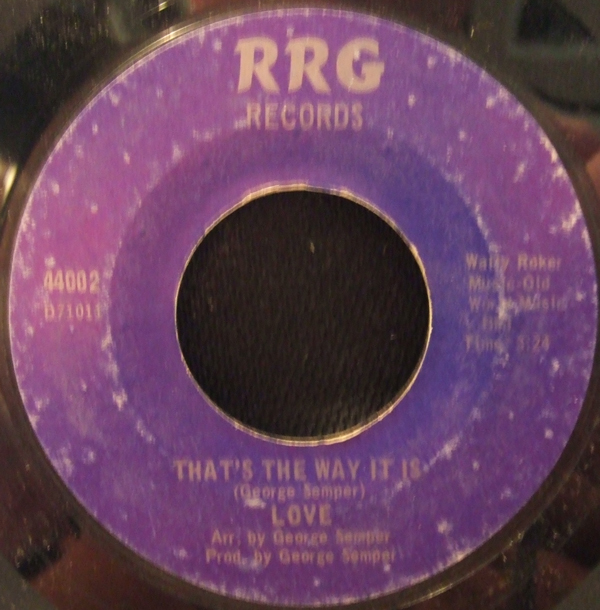
I think I pulled it out of a box of 45s because I recognized the label (I already had a Jimmy Reed 45 on RRG), but I’m sure I decided to buy it when I noticed that both sides were written, arranged and produced by George Semper.
If that name is not familiar, head over to the podcast archive and search for his name, which appears in no less than four different mixes in his capacity as a creator of Hammond grooves, which until I found this 45 was the only thing I knew about him.
Hammond heads will already be hip to his ‘Makin’ Waves’ LP, and the funky 45 version of ‘It’s Your Thing’ by the George Semper Rhythm Committee.
I’ll only go as far as to state that Semper was a West Coast cat, since I’ve seen references that base him in both San Diego and Oakland and have no way to be sure which one (or both) is the correct location.
The fact that the band was called Love – though it was immediately obvious that it was not the Arthur Lee organization – is unusual, since this 45 likely dates from the late 60s or very early 70s (or at least that’s the way it sounds to me) and the LA/Arthur Lee band was still a going concern, on a major label.
Of course they had their only hit in 1966, so it’s entirely possible they didn’t pop up on Semper’s radar, but the name of the band is a minor issue that only stands in the way of Google-based research.
The sound of ‘That’s the Way It Is’ is interesting and funky, with some electric piano and clavinet (no doubt provided by Semper), restrained strings and a cool lead vocal. I don’t really know who the singer is, and I’m reluctant to suggest that it’s George Semper, since all of his other work (that I’m aware of) is instrumental in nature.
As far as the provenance of the RRG label, it seems to have been a Wally Roker led imprint that existed for a brief time after the demise of the Canyon label. Roker was also involved in the Roker and Soul Clock labels around the same time. They released a handful of 45s by Jimmy Reed (then in his decline and trying all kinds of things to stay relevant) and at least one by Doris Duke and of course the Love 45.
As far as I can tell the RRG 45 was the first and last thing that this ‘Love’ recorded. That’s too bad since the tune is memorable and the record definitely had (unfulfilled) commercial potential.
I hope you dig it, and if you have any more info to fill in the blanks, please drop me a line.
Peace
Larry
NOTE: Thanks to commenter Piet who included a Popsike link to an issue of this same 45 on the Law-Ton label!
Greetings all.
I hope everyone had themselves a sweet summer weekend.
Things were low key hereabouts, with my youngest son celebrating his fourth birthday, for which he got (and I assembled this morning) and old-school tricycle.
Right now, the sky is beginning to lighten after a torrential downpour, and Scooby Doo is on in the background, while my cup of iced coffee sweats next to the laptop…in other words, Sunday.
The tune I bring you today is another one of those records that I knew of for many, many years before I actually heard it, or owned a copy.
I am a big fan of Latin soul, especially mid-60s boogaloo, but every once in a while I get wind of something a little later in the game, maybe a little mellower, and it hits all the right pleasure centers in the brain (and then some), and Ralfi Pagan’s 1971 cover of ‘Make It With You’ is one of those records.
Pagan was a Bronx-born vocalist who recorded for Fania between 1969 and his untimely death in 1978*.
He specialized in ballads, delivered in a voice that sounded like a cross between Little Anthony and Smokey Robinson.
His version of Bread’s ‘Make It With You’, which was a Top 40 R&B hit in 1971 made Pagan a star with the Chicano audience, where the record remains something of a lowrider classic.
Though only three and a half minutes in length, ‘Make It With You’ manages to work as a minor epic. First and foremost is the arrangement (by Johnny Pacheco), which starts off sounding like an outtake from a Neil Young session, melts (with an odd key change) into a perfect bit of sweet soul.
Now, at the risk of sounding like a rube, I’ve always had a soft spot (how appropriate) for Bread’s early singles. David Gates had a real knack for crafting solid melodies. Unfortunately, he also had a real talent for matching them up with era-appropriate lyrics, thick with post-hippie, California sentimentality, always delivered with a completely straight face, which is probably why they were so successful.
Despite what any brigade of hipster douchebags might think, nobody was appreciating Bread, or the Carpenters ironically back when they first came out.
People loved those records because they took the earnest, heart-on-sleeve-ery of a Hallmark card and wrapped it up in just enough long hair and denim to make it palatable for “the kids”.
Ralfi Pagan took ‘Make It With You’ – which was Bread’s first hit (their only #1) in a long string of chart records that lasted until 1977 – and recast it, ever so slightly, arresting the tempo and delivering the lyrics in a soulful falsetto, that takes the ‘first wedding dance’ feel of the original and moves it into a back seat make out session.
The interesting thing is that the only real indicators that this is a ‘Latin’ record (aside from the Fania label** and its popularity with Latino audiences) is the very end of the record when Pagan starts singing in Spanish (echoed by the backing vocalists).
It’s a great record, and definitely worth a couple of close listens.
I hope you dig it, and I’ll be back on Wednesday.
Peace
Larry
PS This week’s edition of the Funky16Corners Radio Show is now available for download. Just click on the Radio Show tab in the header.
Greetings all.
Is every one all up in the Simon and Garfunkel, i.e. feeling groovy?
The heat continues unabated, which wouldn’t bear mentioning, except for the fact that I went outside on Sunday to do yard work and ended up like one of those sweat-soaked, sun stroked chain gang fools in a Cool hand Luke stylee and ended up with just enough strength to crawl into bed, slap on my iPod and pass out about halfway into the first song.
Honest to jeebus it’s been a brutal summer hereabouts, and with me all pale and as sun-phobic as the next Morlock, I’m not digging it too much.
Don’t get me wrong…I like it when it’s hot, but like 85-ish. Once you break the 90 degree line, every time you set foot out of doors you can almost hear the cliched snippet of Delta blues slide guitar they always play when some poor slob is about to get run out of some dusty backwoods burgh (or vanish forever, depending on the movie).
That said, I’m lucky enough to be able to step back inside to the refrigerated (as they used to say in the olden days) air of the house, where my records sit safely, unwarped by the heat, and the beer chills in the fridge-o-manator so that I may do the same on the davenport.
That said, I was wondering what to post this fine day, and thought that something, summery, yet upbeat, with just a soupcon of history might fit the bill.
Wanna hear it? Here it is…
I’ve made mention – and demonstrated via example – that I am an absolute fiend when it comes to hunting down original versions of famous tunes in the soul, funk, blues and rock oeuvres. In fact, some day I’m gonna have to get my shnizzle together and whip them on y’all in podcast form, or maybe over at the old Funky16Corners Radio thing.
Hunting these things down, mainly via the heavy blues explosion of the late 60s led me down into the sounds of the Delta, the Piedmont and into Texas where many of these tunes were born.
Of course, not every OG harkens back to the 20s and 30s, many of them were more recent creations, i.e. first committed to wax during the 50s or even the early 60s, with the R&B and soul, and electric blues performers that exerted a much more significant influence on the British Invaders of ‘64 and beyond.
One of these artifacts, that I’d known about for decades, but only scored a copy of earlier this year is the track I bring you today.
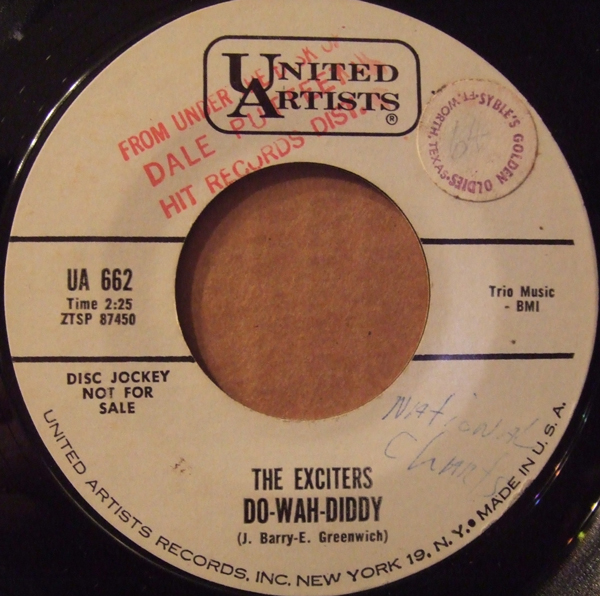
I’ll assume that literally everyone reading this has heard the version of ‘Do Wah Diddy Diddy’ by Manfred Mann, which was a huge hit in 1964, and has forever after been a staple of oldies radio. Featuring the voice of Paul Jones (one of the more soulful singers of his time) the Manfred’s version, like many of their storming covers of blues and soul material actually does justice to the original (and maybe exceeds it in some respects).
That original was recorded by the Exciters the year before. Their version only reached #78 on the Pop charts, quite a letdown after their biggest hit ‘Tell Him’ which was Top 20 earlier in 1963, and is also a cornerstone of oldies radio.
Written by Jeff Barry and Ellie Greenwich, the Exciters’ original is still a slamming slice of soulful group action, with pounding drums, and a wild lead vocal by Brenda Reid. The production by the geniuses (and my idols) Leiber and Stoller is spot on, and a little rawer than you might expect from a group often thought of as a ‘girl group’ (even though there was a guy – Herb Rooney – in their ranks).
The instrumentation is pretty basic, with drums and piano backing the singers, followed by a horn section. Things get a little more ornate in the bridge, but you’d never mistake it for a Phil Spector production, though the chimes in the instrumental break lean in that direction a tiny bit.
Give it a close listen and you can almost imagine you’re there watching Leiber and Stoller building it bit by bit.
Though they’re known mainly as songwriters, they deserve a lot of credit for their work producing and arranging records as well, especially in an era where the best of the Brill Building-related writers were all making strides in that regard.
The Exciters remained together into the early 70s, though their last chart record was a 1966 cover of the Jarmels’ ‘Little Bit of Soap’. You should also be on the lookout for their Northern Soul stormer ‘Blowing Up My Mind’ from 1969 (I know I’m still looking for a copy…).
It’s a great cut, and I hope you dig it.
Greetings all.
I come to you, secure in the refrigerated Funky16Corners Record Vault and Podcast Nerve Center, where I’m currently hiding from the near 100 degree weather outside.
I’ve spent the afternoon, digimatizing vinyl, ripping old CDs onto the new iPod and trying to refile records.
I was going to write about something else today, but I decided to do a little more research on that particular selection, so today’s numbers moved to the front of the line.
I found this record last Record Store Day in Asbury Park, and despite the fact that the artist was unknown to me, I grabbed it as it was both cheap, and intriguing.
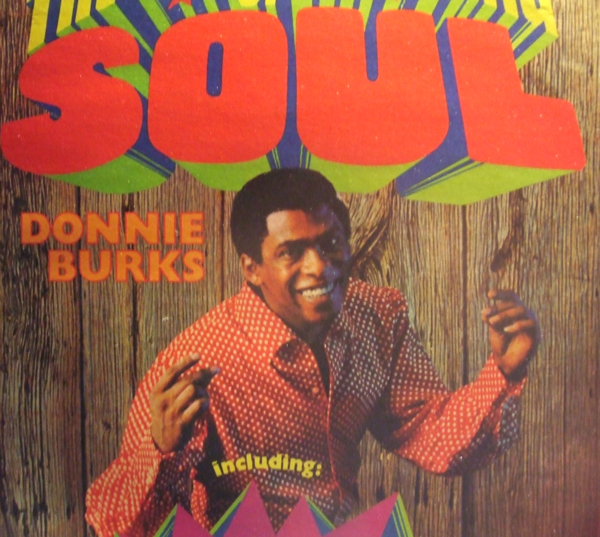
I’d never heard of Donnie Burks before, but he looked vaguely familiar, and the record appeared to be American soul recorded (or at least released) in Europe, so I slapped a couple of semolians on the barrelhead and took the record home.
As soon as I set to Googling, I discovered a couple of very interesting things.
Donnie Burks, though fairly obscure as a singer, had a multi-layered career in his lifetime, starting out as a college basketball star, and moving on to appear in movies and on the Broadway stage.
When he passed away in 2008 at the age of 66, his glory days were long behind him.
It turns out that the reason he was familiar to me was that he had appeared as the grapes in a famous string of Fruit of the Loom underwear commercials (in which a group of dudes in fruit costumes touted the brand as a facsimile of the cornucopia in its logo).
Burks first came to prominence playing basketball for St John’s University in the late 50s and early 60s. He went on to appear in movies (The Pawnbroker, Shaft, Without a Trace*) and TV, as well as in a number of Broadway musicals (Hair, the Tap Dance Kid).
I have no idea how he came to record the album that gives us today’s track, but I have seen listings that suggest that he recorded at least two other 45s for the Decca and Metromedia labels.
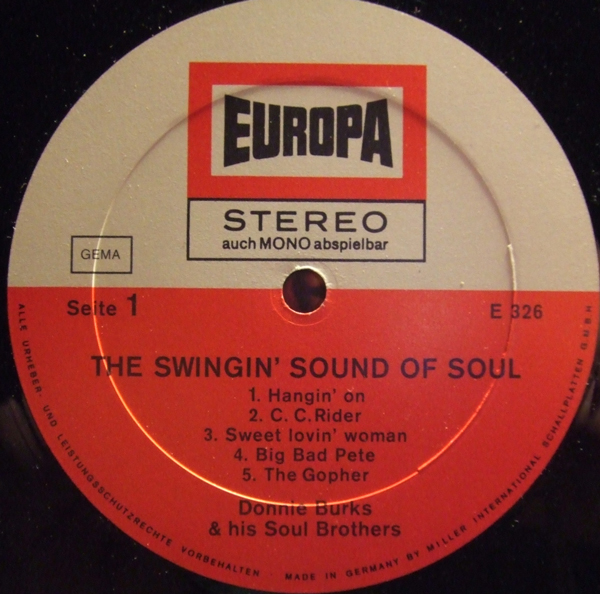
The tunes I bring you today, ‘The Gopher’ and ‘Funky Funky Woman’ come from the ‘Swingin’ Sounds of Soul’ LP. ‘The Gopher’ a cool, uptempo soul dancer. The production isn’t the best, but Burkes was a more than able singer and I’d be interested to hear his other 45s.
‘Funky Funky Woman’ carries the DNA of ‘Funky Broadway’, but it sounds as if it were strained through ‘Boogaloo Down Broadway’ first. Not terribly funky, but if I had a nickel for every record I’ve seen with ‘funky’ in the title, that isn’t (funky, that is), I’d have a huge, shiny pile of nickels.
I’d also love to know how Burks ended up recording (or at least releasing) an album in Germany. He was in the original Broadway cast of ‘Hair’ and the likely vintage of these recordings makes me wonder if he didn’t record it while overseas with a touring cast of the show. If anyone knows, please drop me a line.
I hope you dig the tunes, and I’ll see you all on Wednesday.
Peace
Larry
*He’s a little hard to nail down via IMDB since he appears to be listed under a few different spellings of his name.
The painting of Gene from the cover of ‘Organ Out Loud’ by Jack Lonshein
Gene Ludwig at the organ (Circa 1965)
Listen/Download – Gene Ludwig -Sticks and Stones
Listen/Download – Gene Ludwig – The Vamp
Listen/Download – Gene Ludwig – Blues For Mr Fink
Listen/Download – Gene Ludwig – House of the Rising Sun
Listen/Download – Gene Ludwig – Comin’ Home Baby
Listen/Download – Gene Ludwig – Moanin’
Greetings all.
As I mentioned in Friday’s post, I got the very sad news last week that Hammond master Gene Ludwig had passed away at the age of 72.
If you’re one of the rare few that’s been on the Funky16Corners tip since the web zine days, you know I ride for the Hammond organ in a big way, from the greasiest R&B, to pure soul, soul jazz and funk, I have never been able to get enough of the Hammond sound.
Gene Ludwig was one of the last of what I would call the accepted past masters of the jazz organ. He was a contemporary of Brother Jack McDuff, Jimmy McGriff, Dr Lonnie Smith, Seleno Clarke and pretty much everyone else that was part of the jazz organ explosion of the 50s and 60s.
What Gene was also a part of was the great – mostly unexplored – Pennsylvania organ tradition. One of the really interesting things I picked up out of years of collecting and researching Hammond records was how many great players hailed from the Keystone State (and not just Philly). The man that launched a thousand organ combos, the mighty Jimmy Smith as well as Jimmy McGriff, Charles Earland, Richie Varola, Greg Hatza, Papa John and Joey DeFrancesco, Shirley Scott and of course Gene Ludwig all got their start in the bars and nightclubs of Pennsylvania, in both the big cities and out in the hinterlands. Was it something in the water? An abundance of organs (or bars/lounges with organs in them)? In his obit Gene was quoted as saying that he turned on to R&B (and organ players) by listening to Pittsburgh radio legend Porky Chedwick. Pittsburgh has a long history as a kind of isolated Shangri La for R&B and soul fans where any number of brilliant but obscure records are worshipped by the locals because they were circulated on the radio and at dances.
Whether this had anything to do with spawning organists, as opposed to just fans of the sound, I have no idea, but it is intriguing.
Gene Ludwig – a native of the wester PA town of Twin Rocks started out as a pianist, and had his ‘road to Damascus’ moment when he saw Jimmy Smith perform at a Pittsburgh club called the Hurricane in 1957.
Ludwig went on to have a 50 year career as one of the great proponents of the Hammond, recording locally as well as on national labels like Mainstream and Atlantic.
He was really what I would consider (at least for my taste) the consummate organist in that he approached the instrument from a jazz perspective (with serious chops to match) yet was not afraid to cut loose and burn on the keyboard, expanding into the realms of R&B and soul.
I’ve consumed a lot of virtual ink rambling on about this or that ultra-raw organ 45, but the best Hammond players, no matter how soulful or funky all came to the instrument from the jazz roots.
Gene Ludwig was old enough to hear the early rumblings of the Hammond sound from the jazz/jump/R&B nexus of cats like Wild Bill Davis, Bill Doggett and Milt Buckner, and mastered the instrument in the wake of the mid-50s scene when Jimmy Smith rewrote the book on jazz organ.
The ensuing expansion of the electronic organ, as both a performance platform and recorded instrument was wide ranging on both established jazz labels like Blue Note, Prestige, Riverside and Atlantic, but as my crates will attest, on countless tiny local labels eager for a piece of the action. It’s not at all hard to imagine walking into a bar in 1965, strolling up to the jukebox and seeing the organ stylings of a regional favorite among records from out of town.
Gene Ludwig was both a regional player (probably half of his discography is rooted locally) and an internationally known master of his instrument who headlined and worked as a sideman (replacing Don Patterson in Sony Stitt’s late 60s band).
Gene remained devoted to the Hammond, and a glimpse at his web site will reveal that he was playing, recording and above all staying relevant right up until his unexpected and tragic passing.
He was a musician of great taste with an ear for that perfect soul jazz vibe, yet was also conversant in standards (which any organist working the clubs in the 60s would have had to have been) and was by all accounts an unfailingly generous soul when it came to mentoring younger players.
Though I never got to meet Gene or his wife Pattye in person, I was lucky enough to correspond with them over the years (Gene had no bigger booster than Pattye), including an interview I did with the master back in 2005.
The Gene Ludwig Trio in the 1960s (above) and reunited in 2004 (below)
The tunes I bring you today represent a cross-section of the sound of Gene Ludwig through the 1960s. As far as I can tell all of these cuts feature his classic 60s-era trio which featured Randy Gelispie (or Gillespie, I’ve seen it spelled both ways) on drums and Jerry Byrd on guitar.
A few of these cuts have been featured here in the past, but they deserve to be heard again.
The first track is the Ludwig’s trio’s smoking version of the Henry Glover/Titus Turner classic ‘Sticks and Stones’, which appeared as a two-part 45 in 1963 (I’ve spliced the two parts together). The trio’s playing is spot on, relaxed yet generating a considerable amount of heat, and Gene is in rare form. I’ve heard there’s at least one other unissued side from that date, a version of ‘High Heel Sneakers’.
Next up is a track discussed here in the past, the brilliant ‘The Vamp’, which appeared as a 45 and on the LP ‘The Educated Sound of Gene Ludwig’ in 1965. If you haven’t heard ‘The Vamp’ strap yourself in because it’s a killer. Improvised in the studio by the trio, it featured Gene on the organ, Byrd on guitar and Gelispie on tambourine only. It has the feeling of an after-hours session gone wild, and is probably my favorite moment in Gene’s discography.
‘Blues For Mr. Fink’ and ‘House of the Rising Sun’ are both culled from an oddball 1960s compilation called ‘The Keyboards’ on the Time label, which features Gene Ludwig, and five other players performing in a wide variety of disparate styles. None of the album’s 20 tracks are attributed to anyone specific, but I knew of the Ludwig tracks from other sources (which is why I picked it up).
My suspicion has always been that all of the Gene Ludwig material on that record came from his time with the Mainstream label, since Bob Shad is credited with A&R on the jacket, and a few of the tracks also appear on the 1964 Mainstream LP ‘Organ Out Loud’.
The last two tracks appeared on what I would consider to be one of the great soul jazz organ sessions of the classic era, the aforementioned ‘Organ Out Loud’. Here Gene and the trio work it out on two classics of the genre (the LP also included wonderful versions of Cannonball Adderley’s ‘Sermonette’ and Horace Silver’s ‘The Preacher’), Bob Dorough and Ben Tucker’s ‘Comin’ Home Baby’ and Bobby Timmons’ ‘Moanin’.
‘Comin’ Home Baby’ is taken at a touch more relaxed pace than you usually hear, but the group keeps it moving and grooving, and Gene takes a wild solo.
‘Moanin’ on the other hand takes off like a rocket and never slows down. It’s the kind of performance that makes me want to step into the WABAC machine and hear the group in some smoky lounge. Gene’s fingers fly over the keys while the rhythm section provides a rock solid bottom.
If you ever get a chance to get your hands on any of his 60s albums or 45s (and there’s still a couple of things I have yet to track down) do yourself a favor and do it. You still have the chance to hear his more recent recordings, which are uniformly excellent.
That all said, it’s so sad to have to talk about this great music in light of Gene’s passing.
He was a great musician, and by all accounts as solid a human being as has passed this way.
He will be missed.
My sincere condolences go out to his wife Pattye.
See you later in the week.


 Comments (8)











 Themocracy