Category: Instrumental

Funky16Corners Radio v.87 – Wind of Change

By , August 15, 2010 1:58 pm

Example

Funky16Corners Radio v.87 – Wind of Change

Playlist

Rahsaan Roland Kirk – Ain’t No Sunshine (Atlantic)
Paul Horn – Paramahansa (RCA)
Moe Koffman – Comin’ Home Baby (Jubilee)
Bobbi Humphrey – Sad Bag (Blue Note)
David Newman – The 13th Floor (Atlantic)
Keith Mansfield – Teenage Chase (KPM)
Hubert Laws – Bloodshot (Atlantic)
Jerome Richardson – Ode to Billie Joe (Verve)
Joe Thomas – Big Heart Giant Soul (Cobblestone)
Ernie Fields – Watch Your Step (Kent)
Herbie Mann – Push Push (Atlantic)
Jeremy Steig – Alias (Solid State)
Frank Wess – Signed Sealed and Delivered (Enterprise)
Tim Weisberg – Streak Out (A&M)
Jethro Tull – Serenade To a Cuckoo (Chrysalis)


You can check out this mix in the Funky16Corners Radio Podcast Archive


Greetings all.

How are the closing days of summer treating you?
I know we’ve got lots of good weather ahead, but it’s only a few weeks until the mass exodus of the tourists, when I will once again be able roam free amidst traffic that is just ‘bad’, not mind-bogglingly so.
The mix I bring you today is a continuation of a minor series of sorts, in which the Funky16Corners Radio thingy takes time out to focus on a specific instrument. We’ve already surveyed the vibes and the electric piano, and I’m sure that there are a few more such collections huddling in the crates awaiting release.
This time out we take a look (listen) to the much maligned, but very groovy sounds of the (mostly) jazz flute.
As I said when I wrote about the vibes, there are those among us for whom the sound of the flute is too ‘cool’, which naturally is why I dig it so much.
I love the sound of the flute in the hands of a great musician, and what you’re getting in this mix is 15 examples of that very thing.
Of course, not every single cut contains a virtuoso performance, on account of that would be boring and a few steps away from the prog sound of my teenage years that I have come to despise.
The vast majority of the players here (although one of them is anonymous) are at least tangentially connected to the world of jazz, with a few having crossed over into pop and rock and one (yes, you know the one…the one who’s name sent a shiver up your spine when you saw it, unfairly I might add) solidly camped out in rock and roll.
This one took a while to assemble, if only because a few of the artists in question have appeared in this space frequently (Koffman, Steig, Wess, Mann), their dulcet tones gracing other Funky16Corners Radio playlists.
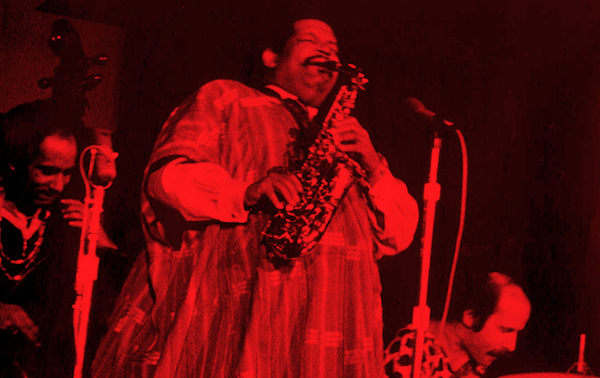
Things get off to a serious start with Rahsaan Roland Kirk’s epic reading of Bill Withers’ ‘Ain’t No Sunshine’. Kirk, a master on many wind instruments – often simultaneously – had a pronounced influence on two of the other players in this mix, namely Jeremy Steig and Ian Anderson (more on him later). His frequent use of ‘overblowing’, and vocalizing through the flute make him one of the most dynamic stylists the instrument has ever produced.
Paul Horn is best known for his pioneering new age recordings like ‘Inside’, but in the early to mid-60s he was still working a straight ahead jazz style. The Eastern-influenced ‘Paramahansa’ (which he re-recorded years later) appeared on his 1967 ‘Monday Monday’ LP, alongside a number of contemporary pop and rock covers. The tune sees Horn playing over a big band producing something that sounds like it’s from the soundtrack to a spy thriller.
Moe Koffman, who has been featured here a number of time is one of those cats that started out as a pretty ‘straight’ jazz player and as the 60s progressed he got further out. In addition to the flute Koffman was a proponent of the electrified saxophone (like Eddie Harris and Sonny Stitt) and he made some very cool, au go go flavored stuff during the era. His take on Bob Dorough and Ben Tucker’s “Coming Home Baby’ has a relaxed swing to it, sounding once again like something lifted from era-specific TV or movie soundtrack.
Bobbi Humphrey’s ‘Sad Bag’ has a mournful sound, with some very nice, reverbed flute.
David ‘Fathead’ Newman is better known for his sax playing, especially in his association with the mighty Ray Charles. I first heard ‘The 13th Floor’ on an early-90s comp called ‘Heavy Flute’, shortly after which I grabbed myself a copy of the 45. The tune originally appeared on Newman’s 1968 ‘Bigger and Better’ LP and is a great illustration of that fact that he certainly knew his way around the flute.
‘Teenage Chase’ is a Keith Mansfield penned cut from the KPM sound library album ‘Beat Incidental’. Like many of the cuts it was intended to be used as a ‘theme’, and so it is relatively short. I have no idea who the flute player us, but it sure as hell sounds like the same cat blowing on the Hawkshaw/Parker tune ‘Hot Pants’ (also a KPM selection).
Hubert Laws went on to great success with radio friendly R&B in the 70s with the CTI label, but in the mid-60s he was recording powerful soul jazz sessions for Atlantic. ‘Bloodshot’ is the opening track from his 1966 ‘Flute By Laws’ LP, and is driven by Laws’ flute, powerful brass and spot on Latin percussion.
Jerome Richardson is best known as a prolific studio musician, but he spent decades playing bop and soul jazz. His take on Bobbie Gentry’s ‘Ode to Billie Joe’ is from his 1968 ‘Groove Merchant’ album, which features Richardson on a variety of wind instruments, including a few different kinds of flute (more than one on this track!). Aside from an odd, intermittent chime, this version of ‘Ode…’ is pretty cool, including some well placed harpsichord.
Like many of the players here, Joe Thomas doubled (tripled) on a variety of wind instruments. ‘Big Heart, Giant Soul’ from his 1970 Cobblestone album ‘Comin’ Home’ is indicative of the high quality of that funky soul jazz session. You get to hear Thomas (who also played in Rhoda Scott’s trio) vocalizing on what sounds like a Varitone (maybe attached to the flute), and then playing it straight. Thomas went on to record funkier stuff (even disco) in the 70s.
Ernie Fields’ ‘Watch Your Step’ is one of my favorite 45s, period. I’ve never been able to find out much about Fields, but ‘Watch Your Step’ is so high-concept, so soulful yet psychedelic and well-arranged, that you can only hope that he did more stuff like this.
If you were to put together a list of cats with serious jazz chops who spent most of their career trying to reach a mass audience (and sometimes succeeding) Herbie Mann would have to be at the top of the list. Mann started out working in a Latin bag, but went on to record a serious grip of soul jazz and even pop through the 60s and 70s. The title track of his 1971 ‘Push Push’ album shows that Mann was very comfortable in a funky bag (where he spent most of the early 70s), eventually having his biggest hit with 1975’s ‘Hijack’.
Jeremy Steig is beloved by crate diggers/beat heads for his track ‘Howling for Judy’ which was the main sample behind the Beastie Boys’ ‘Sure Shot’. Steig’s late 60s/early 70s stuff for Solid State and Blue Note is generally pretty far out, and skipping right along the border between funky and ‘out’. ‘Alias (ALi’as)’ (named for drummer Don Alias) features a wild performance by Steig over bass, drums and percussion., is from the same 1969 LP (‘Legwork’) as ‘Howling…’.
I’ve featured a number of very cool tunes from Frank Wess’s 1970 ‘Wess to Memphis’ LP on the Stax subsidiary Enterprise. Once again I must recommend this album highly, since it’s one of those great sessions where a jazz cat (Wess was well known as a tenor player as well as his work on the flute) really got into a more popular vibe with excellent results. The album, which includes a number of covers is well played and produced, and one I go back to frequently. He wails on his version of Stevie Wonder’s ‘Signed Sealed and Delivered’.
I can’t remember where I first heard of Tim Weisberg’s ‘Streak-Out’, but I know I was surprised because it was the very same Weisberg who had a mid-70s chart hit alongside Dan Fogelberg! ‘Streak-Out’ from 1974 (which he apparently performed on the ‘Midnight Special’, so it must have been a minor hit) is a nice bit of funky rock, with a little bit of a break at the beginning.
This edition of Funky16Corners Radio closes out with what no doubt seems like the oddest of artists, Jethro Tull. All 1970s prog/hobbit-isms aside, when Tull got started in the late 60s they were a jazz inflected heavy blues band, not unlike Cream. The song presented here is, to bring things full circle, a Rahsaan Roland Kirk tune called ‘Serenade to a Cuckoo’. It was reportedly the first song Ian Anderson learned on the flute (Kirk being by far his strongest influence), and he and the band acquit themselves nicely.
I hope you dig this little survey, and I’ll be back later in the week.

Peace

Larry

Example

Check out the Funky16Corners Store at Cafe Press


PPS – Make sure to fall by Iron Leg for some freakbeat supreme!

PPPS Make sure to hit up Funky16Corners on Facebook

Classical Funk

By , August 12, 2010 11:28 am

Example

Woody Herman

Example

Example

Eumir Deodato

Example

Listen/Download – Woody Herman and the Herd – Fanfare for the Common Man

Listen/Download – Deodato – Also Sprach Zarathustra (2001)


Greetings all.
I hope week is coming to a satisfying close for you all.
My wife has to head out for a few days, and the spuds and myself are bumming, but since we plan to wreck the joint while she’s away, there is a (very) minor silver lining.
We’ll just see if three people can survive on corn chips, frankfurters and slurpees for five days.
If you haven’t already pulled down the ones and zeros for this weeks Funky16Corners Soul Club mix by my man Vincent the Soul Chef, do so now, on account of it’s full of the funk, and will – as the kids say – rock your world.
Also, don’t forget to tune in Friday night at 9PM for this week’s edition of the Funky16Corners Radio Show over at Viva internet radio. If you are not already hip/hep, you can click on the Radio Show link in the header and check out the fifteen (!?!) weekly shows that have already been mixed down and archived as MP3s for your listening pleasure.
Today’s post is one of those things that kind of fell together organically over the course of a few months, wherein I was holding something in storage, and then something else climbed over the transom and into the to-be-blogged folder that, how do they say, augmented the existing track in the stylistic and theoretical (figurative/symbolic) sense, and so they came together like beer and stout in a black and tan, blended ever so carefully so that once they pass over the lobes and into the brain the desired effect is one of jazzy, funky wonderfulness (and naturally, as is the style here at Funky16Corners, a tremendous run-on sentence).
Not too long ago one of my Friendface pals posted a video of the mighty Woody Herman and his Thundering Herd working it out on Aaron Copland’s 1942 masterpiece of 20th century classical music ‘Fanfare for the Common Man’. I dug the arrangement a LOT, so I went in search of the vinyl equivalent and found another live recording of a slightly later (I think) version of the Herd laying down the same arrangement at Montreaux.
Back in the olden days, when I was a long-haired, drum mangling stoner type, I had a copy of a certain Emerson, Lake and Palmer album that contained their version of the same piece of music. Having been brought up in a house full of classical music, but then stuffing my head with as much contemporary rock as possible, as well as being your standard teenaged rube, I thought that the ELP ‘Fanfare’ was of a deepness theretofore unheard, and blasted it at high volume many, many times until a seriously untrustworthy fellow bandmember (who, if memory serves was also a  pathological liar of singular talent) stole what was then a fairly expensive record (of course everything is expensive when you have no money).
In reflection, especially after hearing Woody Herman lay it down, the ELP version sounds like a meth-infused synthesizer orchestra trapped in an electrified mudslide. The Copland piece is both sublime and inspirational, and to hear it mangled so seems now to be something approaching a high crime.
Interestingly enough, Herman and his band were playing their Gary Anderson arrangement (recorded in 1974) of ‘Fanfare for the Common Man’ a few years before ELP got their hands on it, and as you might have already assumed, the touch is considerably lighter, using funky subtlety to finesse the brassy strains of Copland’s piece where ELP drove through it with a steamroller.
In addition to a hot band – Herman, a master of the original big band era made some serious moves in the fusion era, still with a big band – you get to hear the master working it out on the soprano sax.
If you get your hands on a copy of the ‘Herd at Montreux’ album, you also get to hear them play the Richard Evans arrangement of ‘I Can’t Get Next To You’ and a very tasty version of Billy Cobham’s ‘Crosswind’ that I’ll feature here in the future.
The second track featured today is something I’m sure a lot of you will be familiar with since it was a substantial hit in 1972. That tune is Eumir Deodato’s epic arrangement of Richard Strauss’s 1896 ‘Also Sprach Zarathustra’. Better known to one and all as the ‘2001’ music, Deodato’s take on the tune is in addition to being probably the biggest hit CTI ever had, a masterpiece of funky jazz.
Featuring Deodato on electric piano, Airto and Ray Barretto on percussion, Billy Cobham on drums, Stanley Clarke on bass and Jay Berliner on guitar, ‘Also Sprach Zarathustra’ goes on for nine minutes, and I’m here to tell you (though you should be able to hear it yourselves) that it never lags, never slips into fusion-y masturbation, never loses it’s kick.
The piece builds gradually, with a kind of amorphous tune-up, until the drums kick in at around 48 seconds, then the bass, guitar and of course Deodato’s electric piano (the heart and soul of the tune), followed by what has to be about the best known classical horn line in history, following the structure of the original until it settles down into a funky jam at around the two and a half minute mark. You know I love me some Fender Rhodes, and Deodato goes to town here. The coolest thing of all – and I hope you’ll agree – is that for what is basically a nine minute long jazz fusion interpretation of a piece of classical music (shades of Spinal Tap in Jazz Fantasy), ‘Also Sprach Zarathustra’ never gets cheesy or heavy handed, which is especially notable in an era when cheesy and heavy handed were the coin of the realm.
I hope you dig both of these cuts, and use them to get down with what the hipsters used to call ‘long hair’ music.
I’ll see you on Monday.

Peace

Larry


Example

PS Make sure to hit up the Funky16Corners Radio Show on Viva internet radio Friday night at 9PM. Your ears will thank you.


Check out the Funky16Corners Store at Cafe Press

PS Head over to Iron Leg for a tribute to the late Chris Dedrick of Free Design.


Gene Ludwig 1937-2010

By , July 18, 2010 2:03 pm

Example

The painting of Gene from the cover of ‘Organ Out Loud’ by Jack Lonshein

Example

Gene Ludwig at the organ (Circa 1965)

Listen/Download – Gene Ludwig -Sticks and Stones

Listen/Download – Gene Ludwig – The Vamp

Listen/Download – Gene Ludwig – Blues For Mr Fink

Listen/Download – Gene Ludwig – House of the Rising Sun

Listen/Download – Gene Ludwig – Comin’ Home Baby

Listen/Download – Gene Ludwig – Moanin’


Greetings all.
As I mentioned in Friday’s post, I got the very sad news last week that Hammond master Gene Ludwig had passed away at the age of 72.
If you’re one of the rare few that’s been on the Funky16Corners tip since the web zine days, you know I ride for the Hammond organ in a big way, from the greasiest R&B, to pure soul, soul jazz and funk, I have never been able to get enough of the Hammond sound.
Gene Ludwig was one of the last of what I would call the accepted past masters of the jazz organ. He was a contemporary of Brother Jack McDuff, Jimmy McGriff, Dr Lonnie Smith, Seleno Clarke and pretty much everyone else that was part of the jazz organ explosion of the 50s and 60s.
What Gene was also a part of was the great – mostly unexplored – Pennsylvania organ tradition. One of the really interesting things I picked up out of years of collecting and researching Hammond records was how many great players hailed from the Keystone State (and not just Philly). The man that launched a thousand organ combos, the mighty Jimmy Smith as well as Jimmy McGriff, Charles Earland, Richie Varola, Greg Hatza, Papa John and Joey DeFrancesco, Shirley Scott and of course Gene Ludwig all got their start in the bars and nightclubs of Pennsylvania, in both the big cities and out in the hinterlands. Was it something in the water? An abundance of organs (or bars/lounges with organs in them)?
In his obit Gene was quoted as saying that he turned on to R&B (and organ players) by listening to Pittsburgh radio legend Porky Chedwick. Pittsburgh has a long history as a kind of isolated Shangri La for R&B and soul fans where any number of brilliant but obscure records are worshipped by the locals because they were circulated on the radio and at dances.
Whether this had anything to do with spawning organists, as opposed to just fans of the sound, I have no idea, but it is intriguing.
Gene Ludwig – a native of the wester PA town of Twin Rocks started out as a pianist, and had his ‘road to Damascus’ moment when he saw Jimmy Smith perform at a Pittsburgh club called the Hurricane in 1957.
Ludwig went on to have a 50 year career as one of the great proponents of the Hammond, recording locally as well as on national labels like Mainstream and Atlantic.
He was really what I would consider (at least for my taste) the consummate organist in that he approached the instrument from a jazz perspective (with serious chops to match) yet was not afraid to cut loose and burn on the keyboard, expanding into the realms of R&B and soul.
I’ve consumed a lot of virtual ink rambling on about this or that ultra-raw organ 45, but the best Hammond players, no matter how soulful or funky all came to the instrument from the jazz roots.
Gene Ludwig was old enough to hear the early rumblings of the Hammond sound from the jazz/jump/R&B nexus of cats like Wild Bill Davis, Bill Doggett and Milt Buckner, and mastered the instrument in the wake of the mid-50s scene when Jimmy Smith rewrote the book on jazz organ.
The ensuing expansion of the electronic organ, as both a performance platform and recorded instrument was wide ranging on both established jazz labels like Blue Note, Prestige, Riverside and Atlantic, but as my crates will attest, on countless tiny local labels eager for a piece of the action. It’s not at all hard to imagine walking into a bar in 1965, strolling up to the jukebox and seeing the organ stylings of a regional favorite among records from out of town.
Gene Ludwig was both a regional player (probably half of his discography is rooted locally) and an internationally known master of his instrument who headlined and worked as a sideman (replacing Don Patterson in Sony Stitt’s late 60s band).
Gene remained devoted to the Hammond, and a glimpse at his web site will reveal that he was playing, recording and above all staying relevant right up until his unexpected and tragic passing.
He was a musician of great taste with an ear for that perfect soul jazz vibe, yet was also conversant in standards (which any organist working the clubs in the 60s would have had to have been) and was by all accounts an unfailingly generous soul when it came to mentoring younger players.
Though I never got to meet Gene or his wife Pattye in person, I was lucky enough to correspond with them over the years (Gene had no bigger booster than Pattye), including an interview I did with the master back in 2005.

Example

The Gene Ludwig Trio in the 1960s (above) and reunited in 2004 (below)

Example

The tunes I bring you today represent a cross-section of the sound of Gene Ludwig through the 1960s. As far as I can tell all of these cuts feature his classic 60s-era trio which featured Randy Gelispie (or Gillespie, I’ve seen it spelled both ways) on drums and Jerry Byrd on guitar.
A few of these cuts have been featured here in the past, but they deserve to be heard again.
The first track is the Ludwig’s trio’s smoking version of the Henry Glover/Titus Turner classic ‘Sticks and Stones’, which appeared as a two-part 45 in 1963 (I’ve spliced the two parts together). The trio’s playing is spot on, relaxed yet generating a considerable amount of heat, and Gene is in rare form. I’ve heard there’s at least one other unissued side from that date, a version of ‘High Heel Sneakers’.
Next up is a track discussed here in the past, the brilliant ‘The Vamp’, which appeared as a 45 and on the LP ‘The Educated Sound of Gene Ludwig’ in 1965. If you haven’t heard ‘The Vamp’ strap yourself in because it’s a killer. Improvised in the studio by the trio, it featured Gene on the organ, Byrd on guitar and Gelispie on tambourine only. It has the feeling of an after-hours session gone wild, and is probably my favorite moment in Gene’s discography.
‘Blues For Mr. Fink’ and ‘House of the Rising Sun’ are both culled from an oddball 1960s compilation called ‘The Keyboards’ on the Time label, which features Gene Ludwig, and five other players performing in a wide variety of disparate styles. None of the album’s 20 tracks are attributed to anyone specific, but I knew of the Ludwig tracks from other sources (which is why I picked it up).
My suspicion has always been that all of the Gene Ludwig material on that record came from his time with the Mainstream label, since Bob Shad is credited with A&R on the jacket, and a few of the tracks also appear on the 1964 Mainstream LP ‘Organ Out Loud’.
The last two tracks appeared on what I would consider to be one of the great soul jazz organ sessions of the classic era, the aforementioned ‘Organ Out Loud’. Here Gene and the trio work it out on two classics of the genre (the LP also included wonderful versions of Cannonball Adderley’s ‘Sermonette’ and Horace Silver’s ‘The Preacher’), Bob Dorough and Ben Tucker’s ‘Comin’ Home Baby’ and Bobby Timmons’ ‘Moanin’.
‘Comin’ Home Baby’ is taken at a touch more relaxed pace than you usually hear, but the group keeps it moving and grooving, and Gene takes a wild solo.
‘Moanin’ on the other hand takes off like a rocket and never slows down. It’s the kind of performance that makes me want to step into the WABAC machine and hear the group in some smoky lounge. Gene’s fingers fly over the keys while the rhythm section provides a rock solid bottom.
If you ever get a chance to get your hands on any of his 60s albums or 45s (and there’s still a couple of things I have yet to track down) do yourself a favor and do it.
You still have the chance to hear his more recent recordings, which are uniformly excellent.
That all said, it’s so sad to have to talk about this great music in light of Gene’s passing.
He was a great musician, and by all accounts as solid a human being as has passed this way.
He will be missed.
My sincere condolences go out to his wife Pattye.
See you later in the week.

Peace

Larry


Example


Check out the Funky16Corners Store at Cafe Press

PS Head over to Iron Leg for some classic British Beat


Sack(s) O’Woe…

By , July 13, 2010 4:18 pm

Example

The Mighty Julian ‘Cannonball’ Adderley


Greetings all.
I hope that the middle of the week finds you all in a soul jazz kind of mood.
I’ve spent a fair amount of time over the course of the life of this blog discussing, compiling, exploring and above all digging soul jazz.
One of the elements of that discussion (though if I’m doing all the talking is it really a discussion?) is the issue of pure soul jazz, that being music that meets the definition of soul(ful) jazz, blending R&B, soul and or funk with a post-hard-bop base in a manner that creates something new that displays, yet transcends the listed ingredients.
There are a number of artists for whom soul jazz was a specialty, and of those, a few who created enduring ‘standards’ of the genre like Bobby Timmons, Freddie McCoy, Eddie Harris and the man who composed the tune I bring you (served four different ways) today, the mighty Julian ‘Cannonball’ Adderley.
Adderley composed and first recorded the tune ‘Sack O’Woe’ in 1960. Of the countless soul jazz songs that I have collected over the years, ‘Sack O’ Woe’ is probably my favorite. It is propulsive enough to be danceable (Adderley was great at stuff like that) , soulful, spare but not too spare, and a great launching point for soloists.
It’s one of those songs that when I find a new version I try to add it to my stack because in hands of almost any competent musician it releases something special, and every once in a while I like to post multiple versions of a great song so you can get a feeling for the breadth of sounds that covers of a classic can yield.
The four versions of the song I bring you today date from the 60s, 70s and 90s (?!?)

Example

The Omega Men

Listen/Download – The Omega Men – Sack O’Woe (Live 1997)

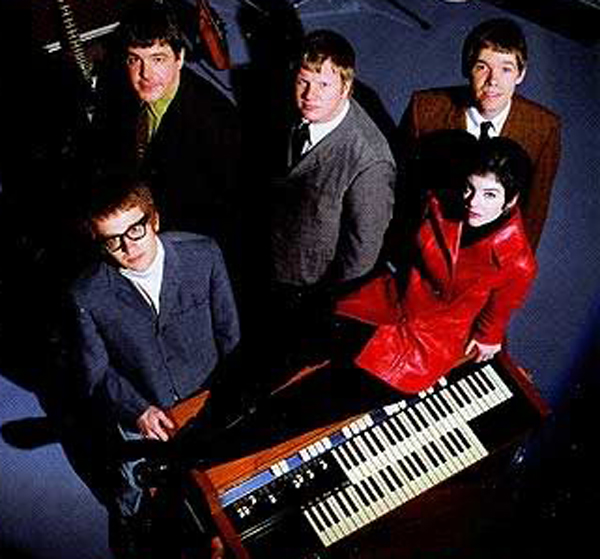
My all-time favorite version is by a band of fairly modern vintage called the Omega Men. Featuring a number of veterans of the Pennsylvania end of the garage/mod revival (from the Cellar Dwellars and Stump Wizards) , the Omega Men, featuring the organ work of the sole non-male member of the band Susan Mackey, really set fire to Adderly’s classic. You can catch it on iTunes as part of a comp called ‘Rock Don’t Run Vol 3’, or you can track down their 1997 CD ‘The Spy Fi Sound of the Omega Men’. The version included here has been digimatized from a video of the band performing live in 1997. The fidelity is pretty good and the playing is first-rate. It isn’t much of a stretch to imagine the sound of the Omega Men as a close approximation of what you might have heard on-stage in the UK circa 1965, where the organ combos of masters like Georgie Fame, Brian Auger and Graham Bond were re-imagining the US soul jazz and R&B that gave them inspiration.

Example

The Mar-Keys horn section (Packy Axton, right)

Example

Listen/Download – The Mar-Keys – Sack O’Woe (1961)

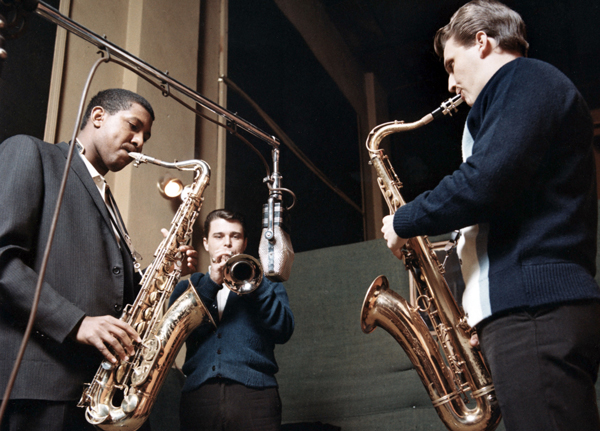
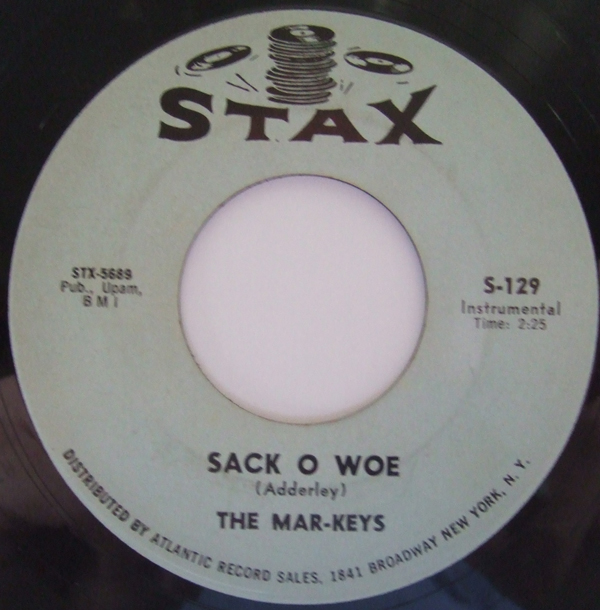
As I said before, Adderley’s original dated from 1960. The Mar-Key’s smoking Memphis version is from a year later. It has that solid Stax sound and I really dig the organ solo. If my chronology is correct this also features a pre-MGs Steve Cropper and Duck Dunn on guitar and bass, as well as Packy Axton, later of the many mysterious incarnations of the Packers on sax. Note the horn intro that approximates the band’s only hit, ‘Last Night’.

Example

The legendary Les McCann

Example

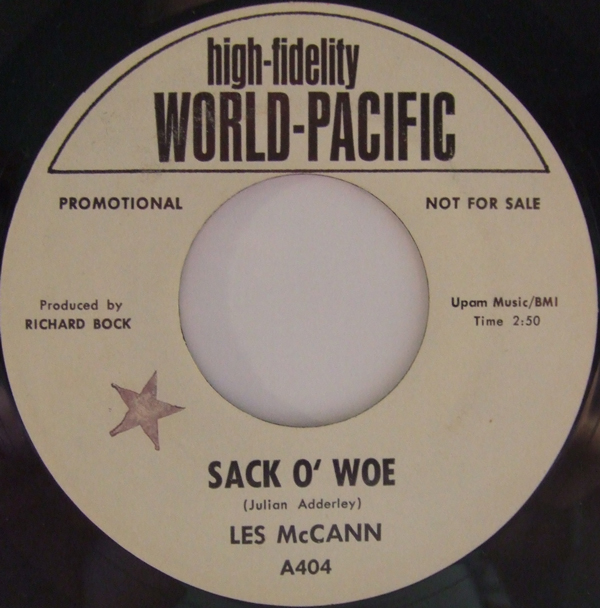
Listen/Download – Les McCann – Sack O’Woe (1963)

The version by the equally mighty Les McCann is from 1963, and features McCann on piano and a fantastic guitar solo by Joe Pass. It’s by far the jazziest version of the tune here. Les McCann is a true giant of the soul jazz genre, having had bona fide hits (like ‘Compared to What’ with Eddie Harris) and can be counted on to give this classic a righteous reading.

Example

Julian Tharpe

Example

Listen/Download – Julian Tharpe – Sack O’Woe (197?)

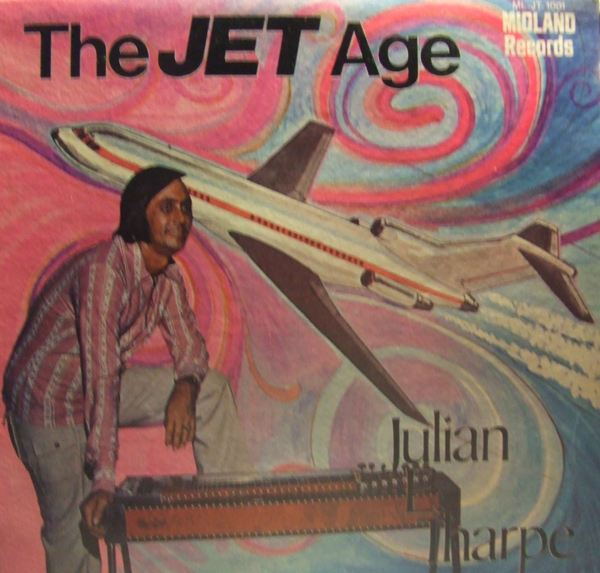
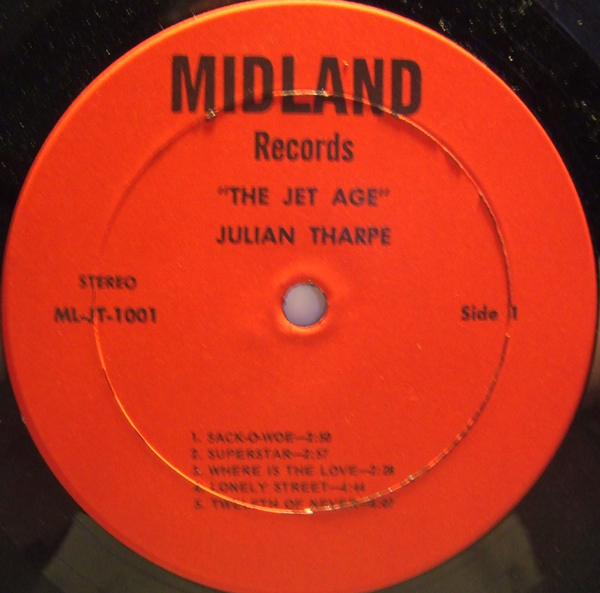
The fourth and last version of ‘Sack O’ Woe’ is (as far as I can tell) and early-to-mid 70s recording by a Nashville cat named Julian Tharpe.
Tharpe was a Music City sessioner and touring player who often worked with guitar legend Jimmy Bryant and was inducted into the Steel Guitar Hall of Fame in 2008. His LP ‘Jet Age’ featured Tharpe playing a variety of styles, covering pop, rock, country and the soul jazz of ‘Sack O’ Woe’. I picked up this album specifically for the version of today’s selection, and it proved to be an interesting one.
I always dig hearing pedal steel guitar used outside of a strictly country context, especially on soul records like Peggy Scott and Jo Jo Benson’s ‘Soulshake’, which featured another Nashville steel legend, Pete Drake.
Tharpe’s version of ‘Sack O’Woe’ is very cool, and it’s worth it if only to hear the Adderley classic interpreted on such an unusual instrument.
I hope you dig all four versions, and if you’re not familiar with Cannonball Adderley’s work, start looking because he laid down decades of fantastic music in straight jazz and funky sessions.
See you on Friday.

Peace

Larry


Example


Check out the Funky16Corners Store at Cafe Press

PS Head over to Iron Leg for a remembrance of the late Tuli Kupferberg of the Fugs and some Canadian sunshine pop


Panorama Theme by Themocracy