Posts tagged: Funky16Corners

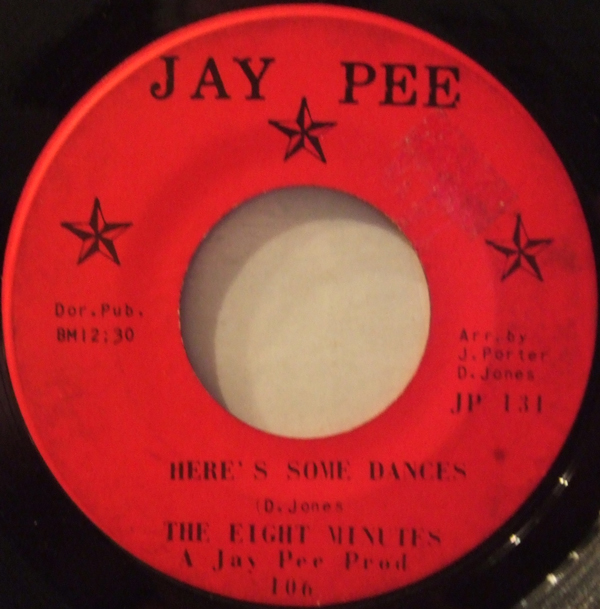
The Eight Minutes – Here’s Some Dances

By , March 7, 2010 7:00 pm

Example

The Eight Minutes

Example

Listen/Download – The Eight Minutes – Here’s Some Dances

Greetings all.
I hope everyone enjoyed Hammond Week 2010, and you’re good and ready to slip inside a couple of nice funk 45s.
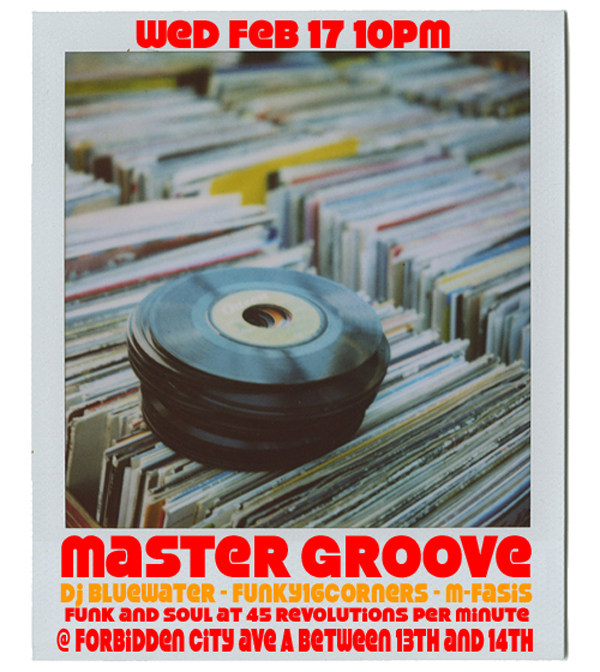
Before we get going I have a programming note, that being my return to Master Groove @ Forbidden City this Wednesday for some more of that good funk and soul spun at forty-five revolutions per minute. As always, I’ll be joining DJ Bluewater and M-Fasis, and if you’re going to be in the area (that being New York City, on Avenue A between 13th and 14th Streets) you should fall by, grab some cold beer and perhaps a steamed dumpling or two and soak up the sounds.

Example

As I said, this week we’ll be getting down to a couple of excellent funk 45s, all recent acquisitions. Consider it a middle course of sorts, cleansing the palate from the Hammond grooves of the previous week and in preparation of what will hopefully be another live mix from the decks at Forbidden City.
The first of the weeks 45s is something I grabbed off of a set sale list last year after a short sample convinced me that to do otherwise would be foolish. Good thing to, since ‘Here’s Some Dances’ by the Eight Minutes is a groover.
The Eight Minutes were what collector types now refer to as a ‘kiddie band’, i.e. their ranks were composed entirely of children and adolescents. While it would be tempting to see these acts as a reaction to the success of the Jackson Five, keep in mind that a lot of this stuff predates the successes of the brothers from Gary, Indiana. The Five Stairsteps were charting with their Windy C sides as early as 1966 and the Eight Minutes (also from the Chicago area) released their first single in 1968.
The Eight Minutes, composed of children from the Goggins (Hank, Ricky and Ronald) and Sudduth (Hedda, David and Wendel) families originally came together in 1967 as the Soul Impacts. They changed their name and started recording as the Eight Minutes (after adding Juwanna Glover and Carl Monroe, i.e. Minutes seven and eight) and released their first 45 on the S.I.M. label in 1968 (which included ‘Here’s Some Dances’) , and then signed with the Jay Pee label. They recorded four singles for Jay Pee, the third of which includes a re-recording of ‘Here’s Some Dances’. They eventually went on to record an album and a couple of 45s for the Perception label before breaking up in the early 70s.
‘Here’s Some Dances’ is an especially groovy side, working the time tested dance craze angle (with shout outs to the Push and Pull among other steps). The vibe has a rocked up, somewhat psychedelic edge to it, with some tasty wah wah guitar and wailing organ (as well as a drum break) that sounds as if the kids had been listening to Sly and the Family Stone.
The Jay Pee version of ‘Here’s Some Dances’ was comped a few years back by the good people at the Numero Group on “Home Schooled: The ABC’s of Kid Soul”.
It’s a very cool side, and I hope you dig it.
I’ll be back on Wednesday with something from New Orleans.

Peace

Larry

Example

Check out the Funky16Corners Store at Cafe Press

PS Head over to Iron Leg for some Midwest garage folk.


PSS Check out Paperback Rider too.

PSSS Don’t forget to hit up Funky16Corners on Facebook

You can also follow Funky16Corners on Twitter


Hammond Week 2010 #3 – Gene Ludwig – The Vamp / Well You Needn’t

By , March 4, 2010 4:38 pm

Example

Example

Gene and his porkpie hat contemplating the Hammond

Example

Listen/Download -Gene Ludwig – The Vamp

Listen/Download -Gene Ludwig – Well You Needn’t

Greetings all.

I hope the end of the week finds you well. I, on the other hand fell backwards through the front door of my house yesterday, landing flat on my back in a pile of toys. While my sons thought this was hilarious (I’m sure I would too if I’d observed it happening to someone else), I sit here feeling much like someone who fell backwards into a pile of toys, i.e. sore. I’m trying not to dwell on how much my own stupidity contributed to this accident. To do so would only make my back hurt more than it does.
I’ve decided to close out Hammond Week 2010 with an old favorite by one of the true masters of the instrument, Mr. Gene Ludwig.
I was lucky enough to interview Mr. Ludwig a few years back, and when you get a second you should pop on over to the old Funky16Corners web zine to read up on the read ups.
The tune I bring you today is the very first Gene Ludwig record I ever heard, courtesy of my man Haim. Back in the day, when he still lived on this side of the country, Haim – aware of my Hammond addiction –  had a record that he simply had to play for me, and that record was ‘The Vamp’.
You all know what a nut I am for organ records, and as soon as the needle hit the wax on the Travis 45 of ‘The Vamp’ my hair pretty much stood on end. A fantastic showcase for Ludwig’s keyboard skills, ‘The Vamp’ is also something much more.
There, in its two minutes and thirty six seconds resides a perfect encapsulation of the meaning of soul jazz. Featuring Ludwig on the organ, Jerry Byrd on guitar and Randy Gillespie leaving his drums for a turn on the tambourine, ‘The Vamp’ (so named since it was basically built on a riff in the studio) moves at a fairly brisk pace, yet, thanks to the absence of the full drum set, manages to generate an air of relaxed cool.
The tune opens with Ludwig’s fingers flying all over the keys, with short, rhythmic chops by Byrd as Gillespie pulls his tambourine out of the amen corner and goes to town. It’s at the minute mark that the organ and guitar switch places, with Gene comping on the organ as the guitarist solos at length until Ludwig comes back in to restate the main theme just before the fade out.
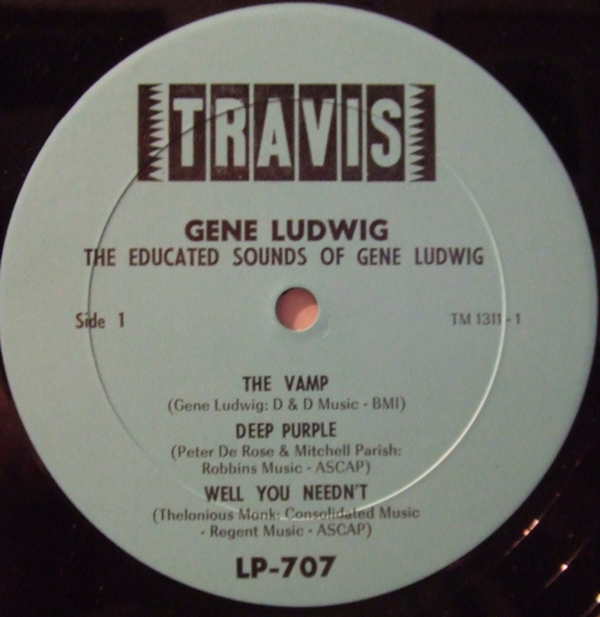
There, in well under three minutes resides pure, 1965, smokey night club, jukebox perfection. Back in 2007 I included ‘The Vamp’ (recorded from the 45, this somewhat cleaner version coming from the LP ‘The Educated Sound of Gene Ludwig’) in Funky16Corners Radio v.24.5 ‘Old School Hammond’, but since not everyone that follows the blog was around back then, and more importantly, it’s such an amazing record, I figured that I ought to bring it back for this year’s week long celebration of the instrument.
I’m also including – from the same album – Gene’s take on my idol Thelonious Monk’s (in his time, a survivor over the long haul, much like Mr. Ludwig) ‘Well You Needn’t’. It gives you a chance to hear the master’s jazz chops as he and the group dig in for six and a half minutes of pure, listening pleasure.
I’m happy to say that Gene Ludwig – 73 years young – is still working it out on the Hammond in 2010, with a full slate of dates. Make sure you check out his website for samples of his (excellent) recent recordings, as well as videos* some recent performances.
I hope you’ve enjoyed this week’s selections, and I’ll be back next week with some funk.
Have a great weekend.

Peace

Larry

Example

*There’s a great version of Gene and his group playing one of my favorite soul jazz standards, Percy Mayfield’s ‘River’s Invitation’

Check out the Funky16Corners Store at Cafe Press

PS Head over to Iron Leg for some UK psych

PSS Check out Paperback Rider too.

PSSS Don’t forget to hit up Funky16Corners on Facebook

You can also follow Funky16Corners on Twitter

Hammond Week 2010 #2 – Lonnie Smith – Stand/Mama Wailer

By , March 2, 2010 5:01 pm

Example

Example

Lonnie Smith makes with the smokestack lightning…

Example

Listen/Download -Lonnie Smith – Stand

Listen/Download -Lonnie Smith – Mama Wailer

Greetings all.

I hope the middle of the week finds you better than me, at least in regard to your general health and well being. I am currently afflicted with some kind of upper respiratory infection that has rendered my throat sore, my body weak and slightly feverish and my general outlook on life at least temporarily grim. I know that this too shall pass, but it’s interfering with my ability to pack in a good night’s sleep, which is something I live for. If I don’t get my six hours in, I am a seriously crabby bastard, unfit to walk among the general population. I guess it’s fair to say that in the grand scheme of things I’m doing well. At least I don’t have the flu, and the wife and kids are healthy, so the Funky16Corners compound hasn’t gone into epidemic lockdown (yet) so I shall cease my grousing and do what I have been told I do best, which is lay some groovy sounds at your doorstep, stand back and feel the love.

Example

But, before I do that, I should mention that I will be returning to Master Groove @ Forbidden City, Wednesday the next, that being March the 10th for another evening of funk and soul spun at 45 revolutions per minute, along with DJ Bluewater and M-Fasis. I haven’t decided what kind of set I’ll be dropping this time, but I assure you that no matter what, it’ll be worth hearing.
It is in that spirit that I bring you something extra nice this fine day. If you thought that Monday’s nine-minute burner from Rhoda Scott was long-form, wait until you stuff your ears full of seventeen minutes worth of the mighty Lonnie Smith.
The good Doctor (as he has been known for many a year), be-turbaned and masterful upon the Hammond, has laid down a mountain of grooves since he made his first album in 1967. Combining serious jazz chops with an ability to work soul and funk grooves, Smith is one of my favorites.
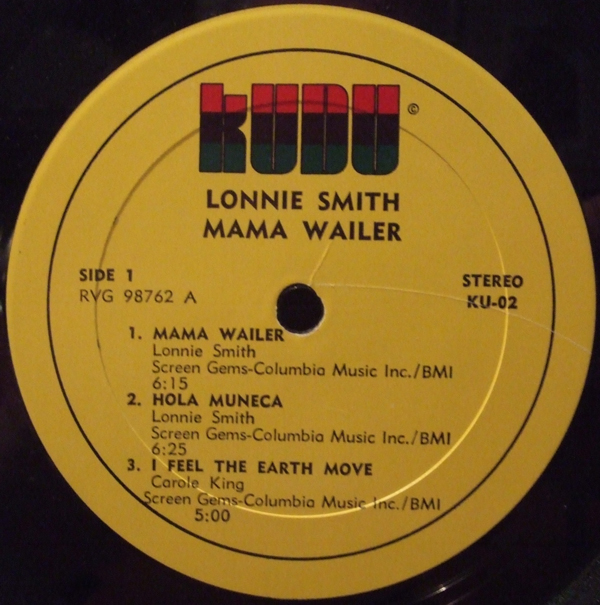
The track I bring you today is from his 1971 Kudu set ‘Mama Wailer’. I heard this record for the first time last year and when I did I set out to secure myself a copy post haste. While the whole album is worth hearing, the tracks I bring you today stand head and shoulders above the rest.
Sly and the Family Stone hit the charts with the original version of ‘Stand’ in 1969. One of their finest records, it was a perfect blend of funky soul and an era-specific, uplifting message. When Dr. Smith got his hands on the cut, he and his band (Ron Carter, Billy Cobham and Grover Washington Jr. among others) took the feeling of the original for the basic framework and then stepped off the edge of the world into a whole new, extremely far out place, located somewhere on the corner of Out and Psychedelic. The really interesting thing about Smith’s version of ‘Stand’ is that he steps outside of a standard presentation, flies off into the ether and never really comes back to earth. Things just get freakier and freakier, and the theme is never actually restated. By the time you get to the run of groove (the track occupies and entire LP side) it’s possible that you’ve forgotten what song you were listening to in the first place.
Though I often sing the praises of the power of a three-minute 45, there’s something to be said for musicians taking the time to stretch. Years back I was having a discussion with someone that should have known better, who was expressing his befuddlement about a jazz record (something fairly conventional, if memory serves) wherein most of the tracks sailed well past the eight-to-ten minute mark. He didn’t get how, or why someone would play for that long, i.e. what could they say in ten minutes that couldn’t be said just as well in three. At the time, I whipped out the eye-roll to beat all eye-rolls and tried to explain, but words failed me, and in the spirit of comity I decided to back off and fight again another day.
That day is here.
When you settle in and warm your ears up for a track as long as Lonnie Smith’s reading of ‘Stand’, it’s a whole different thing from getting the short, sharp blast of a 45. Though the form had been abused many a time by pretentious rockers (and jazzers of the same ilk), the longer track, when done well is a thing of beauty. Sometimes you get the standard modern jazz reading, with statement/restatement of the theme followed by each member of the band (piano, horns, bass, drums etc.) soloing in turn. Other times, like in today’s selection, you get a little of that, mixed in with a little of a freer feel. Smith’s cover of ‘Stand’ manages to do this, and – in the spirit of the original – edging over into a rockish vibe as well. No matter how jazzy, there’s no denying that things get a little psychedelic in the second half of the record.
If that’s too far out for even you adventurous types, I’m also including – as a bonus track of sorts – the title track of the LP. ‘Mama Wailer’ has a nice Latin groove, moving along at a very groovy pace. The Hammond takes a back seat, with Smith working mostly on clavinet and at just over six minutes, it’s a much easier to digest portion.
I hope you dig both tracks, and I’ll be back on Friday with some more of the good stuff.

Peace

Larry

Example

Check out the Funky16Corners Store at Cafe Press

PS Head over to Iron Leg for some interesting Millennium covers


PSS Check out Paperback Rider too.

PSSS Don’t forget to hit up Funky16Corners on Facebook

You can also follow Funky16Corners on Twitter


Hammond Week 2010 Pt1 – Rhoda Scott Trio – Sha Bazz

By , February 28, 2010 6:39 pm

Example

Example

Miss Rhoda Scott

Example

Listen/Download -Rhoda Scott Trio – Sha Bazz


Greetings all.

As I sit here, just having come in from dragging an overloaded garbage can through the slush to its appointed spot (in another pile of slush), in the hopes that the garbage man will grace us with his presence so we don’t have to resort to an unfortunate system of indoor composting and burning garbage in the fireplace, I am temporarily chilled to the bone. Though we were spared the threatened snow disaster, it’s cold like the devil’s underpants out there. This winter has gone from bad to worse, and we now have several strata of dirty snow covering another layer of frozen mud in our front yard. The winter wonderland has morphed into a post-apocalyptic wasteland in a few short months, and we, the helpless observers are reduced to huddling by the fire, praying for spring.
It is in that spirit, and the knowledge that many of you are so afflicted, that I attempt to warm the surrounding environment with an entire week of Hammond organ burners.
Before I get started, I’d like to send out good wishes and congratulations to DJ Birdman and his lovely wife, who are the proud parents of a bouncing baby boy! If I know one thing for sure, in addition to parents that love him, that kid will grow up in a house full of good music (much like my own children).
The last time I did this, a little over a year ago, I figured it would become an ongoing series. I didn’t know it’d take me an entire year to get back to it.
The good thing it, that in the ensuing time I have amassed quite a stack of heaters to choose from, so much so that picking only three of them proved to be a daunting task.
The tune I bring you today is a fairly recent acquisition, the result of a chance sighting on a set sale list.
One of my favorite Hammond 45s is ‘Hey Hey Hey’ by the Rhoda Scott Trio. Picked up years ago while digging, its deep in the club, party time spirit never fails to give me a lift. In the years since I found that 45, I’ve always kept my eyes peeled for other stuff by Miss Scott, and was thwarted until I found the album featuring today’s selection.
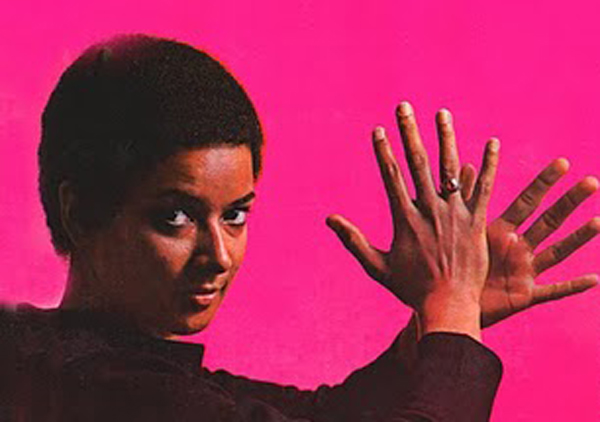
Rhoda Scott, a native of my home state of New Jersey is one of the leading lights of that very exclusive sorority of female Hammond organists, along with Shirley Scott (no relation) and Bu Pleasant. She got her start playing in and around New York and New Jersey, before relocating to France in the mid-1960s (where she continues to play today).
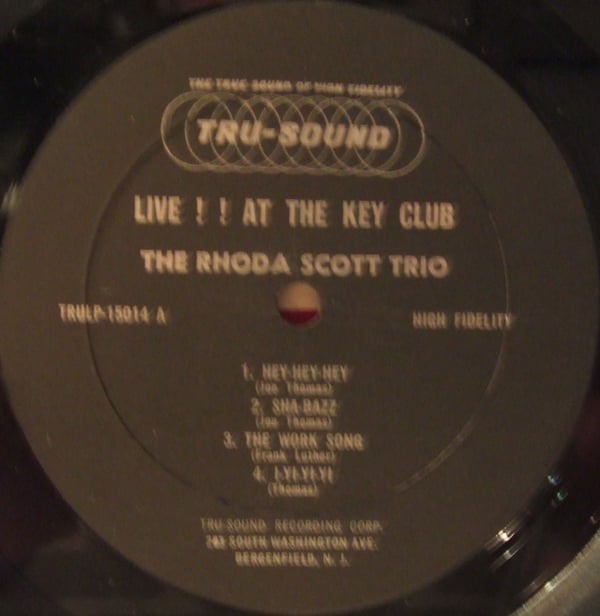
The tune I bring you today ‘Sha Bazz’ is from her 1963 LP ‘The Rhoda Scott Trio Live!!! at the Key Club’. I bought this album pretty much blind, mainly on the strength of the fact that it was on the same label as ‘Hey Hey Hey’. I had no idea – until I started to do some research – that Tru-Sound was in fact a subsidiary of the Prestige label.
When the record fell through the mail slot, and I had the opportunity to drop the needle on the wax, I was in a word (or two), blown away.
Scott’s trio at the time consisted of multi-instrumentalist Joe Thomas (who has appeared in the space before on his main axe, the flute) and drummer Bill Elliot. ‘Live at the Key Club’ is evidence that they were wholly capable of kicking ass.
‘Sha Bazz’, which starts out with a mix of drums and chanting quickly evolves into a showcase for Scott’s mastery of the Hammond, building into a nine-minute plus crash course on the power of the instrument. ‘Sha Bazz’ is pure heat, with Scott’s organ in overdrive and extended solos by Thomas and Elliot.
I know I’ve made this allusion before (and I probably will again) but it sounds like Scott is straining the ability of the board (or the tape) to contain the sound coming out of the Hammond. You listen to this record and imagine some unsuspecting person strolling into the club, seeing the petite woman at the organ, ordering some old school cocktail (Rusty Nail anyone?) and then, before you know what happened it’s all KA-BLAMMM! And your hair is all mussed, and your glasses are on crooked and your drink is all over your pants and you look like one of those astronauts in a rocket sled with your face all peeled back and your eyes all bugged out.

Know what I’m saying???
It’s records like this that make me wish I could step into the Wa-Bac machine (props to Mr Peabody and Sherman) and go back to any number of inner city bars in the 60s where players like Rhoda Scott were burning the joint up with small groups like this, perfectly bridging the gap between jazz, rhythm and blues and the oncoming freight train known as soul. The really groovy thing – especially for organ nuts like myself – is that Shirley Scott was (and is) adept at running bass lines on the Hammond’s foot pedals, making the trio sound like a much larger group.
I remember reading an interview with Jimmy Smith more than 20 years ago (maybe in Musician?) where he basically said, if you weren’t able to work those bass pedals, you weren’t really playing the Hammond. If you want to hear a great example of this – albeit in a much rawer context – check out Toussaint McCall’s ‘Shimmy’. There, in a 45 that is all but exploding with sound, you have only an organist and a drummer, where once again the organist is doing the work of two, operating the top and bottom ends of the Hammond. That’s musicianship.
Heavy stuff indeed, baby.
Dig it and I’ll be back on Wednesday with more of the same.

Peace

Larry

Example

Check out the Funky16Corners Store at Cafe Press

PS Head over to Iron Leg for some interesting Millennium covers


PSS Check out Paperback Rider too.

PSSS Don’t forget to hit up Funky16Corners on Facebook

You can also follow Funky16Corners on Twitter


Jerry Lee Lewis – Shotgun Man

By , February 25, 2010 6:54 pm

Example

The Killer, in a quiet moment…

Example

Listen/Download -Jerry Lee Lewis – Shotgun Man

Greetings all.

I hope every has spent the week ingesting Funky16Corners Radio v.82, on account of it’s packed from end to end with positively stellar soul 45s, each and every one deserving of close, individual scrutiny, but also groovy in a bunch (like bananas).
I’m already ruminating on the composition of my next Master Groove set, and a couple of recent acquisitions seem to be pointing me in a specific direction (yet to be revealed). Since it appears we’re going to spend the weekend buried in snow (again) I’ll have plenty of time to mull the subject over.
Also, a special word of thanks to Gregorious over at Ourstage for a very nice write-up on Funky16Corners!
Today’s selection is yet another in an ever growing string of tasty records, knowledge of which was imparted to me by the mighty Tony C over in the UK. Every once in a while Tony will drop me a line singing the praises of a record, and I know by now, if I’m not already familiar with it, I’d better find myself one because I’m going to dig it. That’s what they refer to as brand loyalty. Over the decades of my digging career (aren’t careers supposed to make you money??) I’ve been very fortunate in that any generosity I’ve given has come back to me tenfold.
This has a lot to do with hanging with other vinyl heads who know their stuff. If you head out on an expedition, and you have the benefit of another person’s digging skill set, shared information will always result in more cool records. My man Haim has been namechecked in this space countless times, because he has turned me on to an equal number of amazing records.
I’ve never had the opportunity to dig with Tony, but it is clear, via our correspondence that we dig the same kinds of music. Thanks to the fact that nobody knows all the great soul and funk records, and most people don’t know the same records, we are informed by one another when something cool comes along.
I’ve always thought that those in the collector/dj community who thrive on exclusivity – i.e. crate digger ‘secret squirrel’-isms* – were doing themselves, and the rest of us a huge disservice. There’s something unbelievably childish/selfish about things like that. Congratulations! You’ve found a wonderful piece of music and you’re going to keep it to yourself, so you, and only you can listen to it while locked in your mother’s basement, covered in potato chip crumbs and your own, special stink.
Kinda sad, n’est ce pas?
The record I bring you today is one of those 45s that I’d never come across until Tony brought it to my attention. I grabbed myself a copy, dug it a lot, and as a result I’m able to pass it along to you fine people this very day.
I have always been a fan of Jerry Lee Lewis. Of the giants that are blasted into rock’n’roll’s Mt Rushmore – Little Richard, Chuck Berry, Bo Diddley, Fats Domino, Buddy Holly, Elvis Presley – it has always been a close race between Mr Penniman and Mr Lewis (with Mr Diddley coming in a very close third) as to who should be placed at the top of the pantheon.
Despite a very uneven career, it has always been clear to me that the Killer is one of the realest of the real, and this is in spite of the fact that he is a world class reckless badass. Head over to YouTube and take a gander at the man in performance, wrestling with his piano (and his unraveling pompadour), shooting sparks out of every part of his being and generally rolling like a juggernaut through the teenagers of the late 1950s. Only Little Richard – like Jerry Lee with a caboose full of dynamite – rocked harder, crazier and badder, specially since he was doing it in a segregated society.
As I said before, for one of the true giants of his era Jerry Lee didn’t have a tremendous amount of success. He only had about a half dozen significant hits (mostly in 1957/58) and by the early 60s most of his chart appearance consisted of covers of other people’s material. By the mid-60s he had switched labels, leaving Sun for Smash, and was weaving in and out of his stylistic lane.
It’s important to note at this point that while Lewis spent much of the 60s jumping back and forth between rock, country and soul (yes, soul) this wasn’t really much of a change. All of those elements were present to varying extents from the very beginning of his career, and it’s likely that any point where one of those influences became more pronounced than the others, someone else (like his record company) were attempting to push him where they thought he’d sell some records.
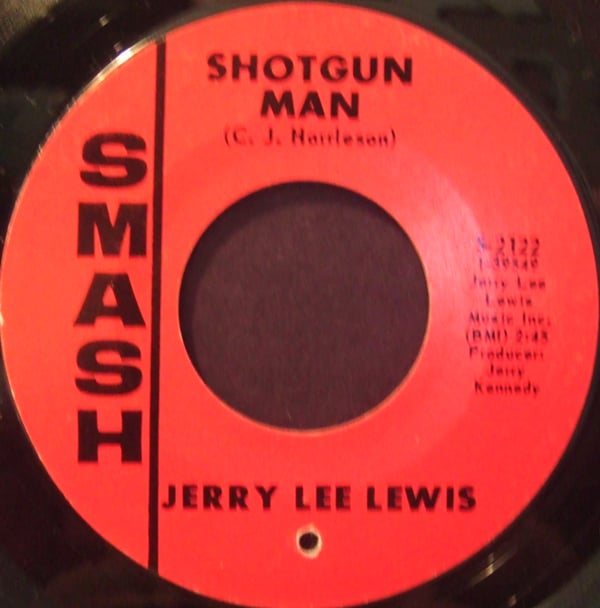
Today’s selection, ‘Shotgun Man’, which appeared on Lewis’s 1967 LP ‘Soul My Way’ – while unmistakably Jerry Lee Lewis – veers off into unusual directions. Those in the know might slap a ‘Mod soul’ label on this one, partly because of who the artist is, but also because it combines aspects of mainstream soul music (as it was in 1966/67) with older R&B roots and just a touch of propulsive rock’n’roll. I’d even go as far as to say that a little more emphasis on ‘the one’ would have nudged this into proto-funk territory (or at least hard edged sock soul). Penned by Jerry Lee’s road manager/brother-in-law Cecil Harrelson, ‘Shotgun Man’ makes references to a number of songs (‘Seventh Son’ ‘Agent 00 Soul’) and people (Howling Wolf, disc jockey John R) and at times sounds like James Brown pushed through a hillbilly strainer. There are points where it reminds me of some of his old labelmate Charlie Rich’s more soulful material.
I hope you dig it, and I’ll be back on Monday

Peace

Larry

Example

*In saying this, I don’t include the Northern Soul practice of ‘cover-ups’, or exclusive dubs in the world of reggae soundclash, which are more a part of the theatricality of the experience. There’s an element of competition, but it’s less about keeping it to yourself than it is about bringing something special to the night.

Check out the Funky16Corners Store at Cafe Press

PS Head over to Iron Leg for some proto-Velvet Underground

PSS Check out Paperback Rider too.

PSSS Don’t forget to hit up Funky16Corners on Facebook

You can also follow Funky16Corners on Twitter

Funky16Corners Radio v.82 – Groovin’ at the Go Go

By , February 21, 2010 5:12 pm

Example

Funky16Corners Radio v.82 – Groovin’ at the Go Go

Playlist

Harold Melvin and the Blue Notes – Get Out (and Let Me Cry) (Landa)
Pat Lewis – Look At What I Almost Missed (Solid Hit)
Maurice and the Radiants – Baby You’ve Got It (Chess)
Broadways – You Just Don’t Know (MGM)
Four Larks – Groovin’ at the Go Go (Tower)
Bob Brady and the Con Chords – Everybody’s Goin’ To the Love In (Chariot)
Volcanos – (It’s Against) The Laws of Love (Arctic)
Barbara Banks – River of Tears (Veep)
Bonnie and Lee – The Way I Feel About You (Fairmount)
Irma Thomas – What Are You Trying To Do (Imperial)
Olympics – Mine Exclusively (Mirwood)
Mary Wells – Can’t You See (You’re Losing Me)
Vontastics – Never Let Your Love Grow Cold (St Lawrence)
JJ Barnes – Chains of Love (Groovesville)
Marvelettes – I’ll Keep On Holding On (Tamla)
Sam and Bill – I’ll Try (Decca)
Fascinations – Girls Are Out To Get You (Mayfield)
Young-Holt Unlimited – California Montage (Brunswick)
Eddie Holman – Eddie’s My Name (Parkway)
Ethics – Look at Me Now (Vent)
Intruders – (You Better) Check Yourself (Gamble)
Just Brothers – Sliced Tomatoes (Music Merchant)
Lorraine Ellison – Call Me Anytime You Need Some Lovin’ (Mercury)
Marvin Gaye – Baby Don’t You Do It (Tamla)
Len Barry – I Struck It Rich (Decca)

To hear this mix, head over to the Funky16Corners Radio Podcast Archive


Greetings all.

Welcome to something unusual, that being the second consecutive week in a row starting with a new Funky16Corners Radio mix. While I normally wouldn’t stack them so close together, the circumstances are unusual.
Last week – as you already know – I returned to DJ Bluewater’s Master Groove night with a promised all-Northern Soul set. One of the great things for me about spinning at Master Groove is that I have a certain amount of flexibility in what I can spin, the only real constraints being those of the genres funk and soul (and there’s even a bit of wiggle room therein), and the format of the seven-inch, 45RPM single. Outside of those rather expansive guidelines, pretty much anything (assuming that the attendees dig it) goes.
The last time I brought my record box to Forbidden City, the sounds therein were entirely organ driven. It was on that night that I was rapping about the scene with my man Bluewater, when I said that I’d been thinking about working on a Northern (style) set, to which my esteemed host said ‘Why not?’.
Early last week I strode into the Funky16Corners record vault – which is in a seemingly constant state of chaos – and set upon the crates in search of my favorite Northern Soul 45s.
I should take a second here to mention that the definition of ‘Northern Soul’ that I’m using here is strictly a stylistic one, i.e. not every record I played is necessarily an accepted part of the Northern canon (though some are long standing faves on the scene), but rather hew fairly close to the ‘sound’ in question.
I pulled every single 45 box off of the shelves in search of the best and brightest (necessary since at least five of these records were in the very last box) and pulled out enough 45s for at least three hours worth of play. I spent the next few days at the turntable, working out which records I wanted to play, revising the set more than a few times until I was happy with the chosen sides. I’m happy to say that with one exception (the very last record on the playlist) I stayed with all the 45s I had originally selected.
As I’ve stated here many times before, while I’m no expert on the subject of Northern Soul, I am a huge fan of the sound, and the playlist above represents several of my very favorite soul records. And when I say ‘favorite’ I’m not referring to some passing affection. I’m talking about the kinds of 45s that set my hair on end and shivers up and down my spine. Heavy, heavy stuff. There are 45s here that combine propulsive, soulful power with pop hooks and brilliant performances in ways that very few records can approach. Getting to play them for people over a nice sound system is (as it is with any great record) an absolute blast.
My plan was – as I had done on my previous visit – to bring my digital recorder, hook it into the board and record the set as I laid the records on the turntables. Murphy’s Law being what it is, I drove all the way into the city without the necessary cable with which to make the connection. This was a huge drag, but I decided there and then that although I would be unable to present the “live” mix as promised, (since I was so happy with the results) I would record the set at home and bring it to you anyway, thus the new mix.
The mix features a lot of Philly sides, selections from Chicago, Detroit (natch) and even a couple of New Jersey sides, one hailing from my home turf on the Jersey Shore.
Things get started with a classic by Harold Melvin and the Bluenotes. ‘Get Out (and Let Me Cry)’ is probably unfamiliar to folks who’s concept of the group starts with the Teddy Pendergrass era, but by the time ‘Get Out…’ was released in 1965 the group had been together for almost a decade. It has a deceptively mellow opening, but once things get going it evolves into a hard charging dance number.
The original recording of ‘Look at What I Almost Missed’ by Miss Pat Lewis was the first tune to appear on the latest incarnation of the Funky16Corners blog. Though it’s better known via the version by its author George Clinton with his group the Parliaments, the Solid Hit version by Lewis is sweet.
Maurice (McCallister) and the Radiants are one of the greatest Chicago groups of the 60s. They recorded a number of classics, including ‘Voice Your Choice’. The selection included in this set, the epic ‘Baby You’ve Got It’ first made its way into my ears via the cover by the Action.
The Jersey Shore record I mentioned above is ‘You Just Don’t Know’ by the mighty Broadways. Hailing from Asbury Park and Long Branch, and featuring members that would go on to join the Moments, the Broadways recorded two outstanding 45s for MGM. ‘You Just Don’t Know’ is a soaring, hook-filled masterpiece.
Of the many Philadelphia records revered by the Northern Soulies, my favorite (out of the remarkable Harthon stable) is the Four Larks ‘Groovin’ at the Go Go’. Having found almost every other45 by the group, I chased this record for years, ultimately convinced that I would never find – or be able to afford – a copy of my own. Until, that is, a reader of the blog, in one of the greatest recorded acts of vinyl-related altruism, found a mint copy at a New York City stoop sale and sent it to me. To say that I was pole-axed when I opened the package and saw that it contained one of my all-time white whales is an understatement. One of the many records in this mix that might be described as ‘anthemic’, ‘Groovin’ at the Go Go’ – penned by Thom Bell – has it all, and is justifiably considered a classic.
Possessor of the greatest faux-Smokey Robinson voice in soul history, Baltimore’s Bob Brady (and the Con Chords) recorded a number of excellent sides for the Chariot label, but none of them is as flat-out amazing as ‘Everybody’s Goin’ to the Love In’, with its pounding piano line, blaring horns and era-specific lyrics. I dare you to stay in your seat when this one starts playing.
Heading back to Philly – and one of my all-time fave soul groups – we hear the Volcanos and ‘(It’s Against) the Laws of Love’. When I packed my record box for the night it contained no less that four Volcanos 45s, from both their Arctic and Harthon periods. Though ‘Storm Warning’ is still my fave, I decided to go a little deeper and drop ‘(It’s Against) The Laws of Love’ instead. Written by Carl Fisher (who also wrote ‘Storm Warning’), the tune features Vince Montana’s vibes and a typically excellent Gene Faith vocal.
I’ve gone on at length in this space before about my love for Barbara Banks’ ‘River of Tears’ (as well as the Royalettes’ cover of same). It’s simply a brilliant record.
Though Bonnie and Lee’s storming ‘The Way I Feel About You’ was released on Philadelphia’s Fairmount label, I’ve never been able to nail down any info on the duo. It opens with a jangling guitar line, and then the rest of the band falls in like a ton of bricks. It was – as far as I can tell – the last 45 to be released on the label, which would place it somewhere in 1965/66.
Irma Thomas has long been known as the Soul Queen of New Orleans for good reason. Her discography is packed with winners, from soaring ballads like ‘I Wish Someone Would Care’, to uptempo dancefloor killers like her cover of Jackie DeShannon’s ‘Breakaway’, and the song included in this mix, the amazing ‘What Are You Trying To Do’. Unusual in her Imperial discography in that it was written and produced by the master Allen Toussaint ‘What Are You Trying To Do’ sounds a lot more Detroit than New Orleans.
Oddly enough, the first time I heard the Olympics’ ‘Mine Exclusively’ was in an unjustly forgotten, period/teen film called ‘The In Crowd’. A barely disguised retelling of the story of Jerry Blavat’s Philly dance party TV show, the movie features a great soundtrack and some wonderful production numbers. ‘Mine Exclusively’ is one of the finest late-period numbers in the Olympics discography.
I have to admit that I only heard Mary Wells powerful ‘Can’t You See (You’re Losing Me)’ a few months ago, via a tip by Atlanta’s finest, Agent 45. This was another one of those ‘where has this record been all my life’ numbers which knocked my flat on my ass the first time I heard it. I wasted no time in tracking down a copy.
When I mentioned that some of these records sent chills up my spine, I was referring specifically to the Vontastics’ “Never Let Your Love Grow Cold’. One of my fave Chitown 45s, it has a fantastic arrangement which builds excitement from the first guitar riff all the way to the run off groove. If you find any of their 45s in the field, do not sleep!
JJ Barnes made some of the greatest Detroit soul 45s, and is justly revered as a kind of patron saint of the Northern scene. ‘Chains Of Love’ is one of his harder 45s, and features my favorite vocal by Barnes.
I mentioned being turned on to the Radiants ‘Baby You’ve Got It’ by UK mod gods the Action, and such is also the case with the Marvelettes ‘I’ll Keep On Holding On’. Though this mix features a lot of favorites, this is probably – for me – the very top of the heap. It’s not only a great dancer, but the chorus builds into one of the great soul anthems of all time. I remember sweating this record heavily for years until I scored a copy (at a premium) many, many years ago. Oddly enough I found a second, mint copy about a month ago for a pittance. I plan on keeping it in cold storage in case anything untoward happens to my original.
We return to New Jersey with the great ‘I’ll Try’ by Sam and Bill. This is another one of those 45s that I pulled out a huge, multi-thousand record haul some years back, and it sat, unlistened to for a good, long time until it finally blew me away. It’s records like this that remind me that I need to be more thorough when I’m reviewing my finds.
It wouldn’t be very cool if I put a set like this together and didn’t include anything from the pen of the brilliant Curtis Mayfield. The Fascinations 1967 ‘Girls Are Out To Get You’ (one of their six 45s for the Mayfield label, almost half of its entire discography) is a classic.
When I mentioned accepted numbers from the Northern Soul canon, I was referring to 45s like Young-Holt Unlimited’s ‘California Montage’. Actually a piece of film music (from the movie ‘Winning’), ‘California Montage’ is a classy instrumental, with a strong dancers beat and layer upon layer of strings and horns.
Eddie Holman is best known for his late 60s ABC sides like ‘Hey There Lonely Girl’, but I’m here to tell you that unless you’ve heard his Cameo/Parkway 45s, you’re missing a big part of the picture. Holman worked as both a performer and songwriter attached to Philadelphia’s Harthon organization for a few years before he hit it big, and made some really brilliant 45s. ‘Eddie’s My Name’ – featuring Holman’s soaring tenor – is my personal fave, and it makes me happy that after a long search, I dug up my own copy inside the Philadelphia city limits.
Another great Philly side is the Ethics’ ‘Look at Me Now’, which should have been a huge hit (they did have a couple of R&B chart placements, but this wasn’t one of them), instead of the local sensation that it was.
The most successful of the classic Philly soul groups, the Intruders had no less that twenty-four (?!?) R&B chart hits between 1966 and 1975, including 1968’s Number One hit ‘Cowboys to Girls’. The storming ‘(You Better) Check Yourself’, from 1966 is proof that they were capable of more than the sweet soul they were best known for.
Another Northern classic (a fave at the UK – Stoke On Trent – venue the Golden Torch) ‘Sliced Tomatoes’ by Just Brothers is actually a later record, having been released in 1972. I always enjoy dropping this one since most people, if they’re unfamiliar with the OG, recognize it as the song Fatboy Slim sampled for ‘Rockafella Skank’.
If you follow the Funky16Corners blog, you already know that I verily worship at the altar of the mighty Lou Courtney. He penned (and produced) Lorraine Ellison’s stratospheric ‘Call Me Anytime You Need Some Loving’. Featuring a propulsive verse and a positively explosive chorus, ‘Call Me…’ is a great illustration of Ellison’s amazing range.
Marvin Gaye’s oft covered ‘Baby Don’t You Do It’ is yet another great tune that I first heard via a performance by a UK 60s mod band, in this case the mighty Small Faces. Though their version is very cool, Gaye’s original snaps, crackles and pops on a whole ‘nother level. Listen to how those drums explode from the speakers as Marvin winds his smooth way in and out of that powerful Motown sound. Solid, solid stuff.
This edition of the Funky16Corners Radio Podcast comes to a conclusion with a killer song by Len Barry. I knew (and loved) ‘I Struck It Rich’ in the version by Billy Harner, but only found the original (written by Barry with Kenny Gamble and Leon Huff) late last year. While it lacks the power of Harner’s cover, it has a certain stylish, polished vibe that I dig a lot. I’ve always considered Barry to be an underrated singer, and ‘I Struck It Rich’ is proof as to why.
I hope you dig the mix, and hopefully the next time I hit the decks at Master Groove, I’ll have all my technical ducks in a row.
See you later in the week.

Peace

Larry

Example

PS – One of the benefits of running the blog out of my own web space, is the opportunity for better statistical tracking. One of the benefits of that is seeing where all of you fine folks are visiting from, which has been a sobering experience. If you take a look at the list below the Funky16Corners blog is bringing folks in from all over the world. In addition to almost every one of the United States (especially one person in Atlanta who seems to be the biggest fan this blog has ever had), people are falling by from all corners of the world.

I drive my wife nuts every day as I check the visitor stats to see if I can find a flag I haven’t seen before.

I’d just like to say thanks to the folks in…

Peru

Chile

Italy

Sri Lanka

India

Tahiti (French Polynesia)

Reunion Island

Madagascar

Ukraine

Russia

Hungary

Sweden

Denmark

Germany

Jordan

Dubai

Argentina

Bulgaria

Netherlands

Belgium

Yemen

Israel

England

China

Thailand

Hong Kong

Austria

France

Greece

Spain

Japan

Portugal

Brazil

Switzerland

Czech Republic

Slovenia

Croatia

Australia

Finland

South Africa

Mexico

South Korea

Iran

Poland

Latvia

Estonia

Malaysia

Serbia

Puerto Rico

Canada

New Zealand

Malta

England

Ireland

Scotland

Wales

Just added 2/26 ! Venezuela, Cambodia and Bulgaria!!!

Added on 2/28 – Moldova and Pakistan!!!

Added 4/4 Nigeria, Ivory Coast, Senegal, Libya!!!

Check out the Funky16Corners Store at Cafe Press

PPS – Make sure to fall by Iron Leg for some tracks by the late Doug Feiger’s first band.

PPPS Make sure to hit up Funky16Corners on Facebook

Average White Band – Person to Person

By , February 18, 2010 6:04 pm

Example

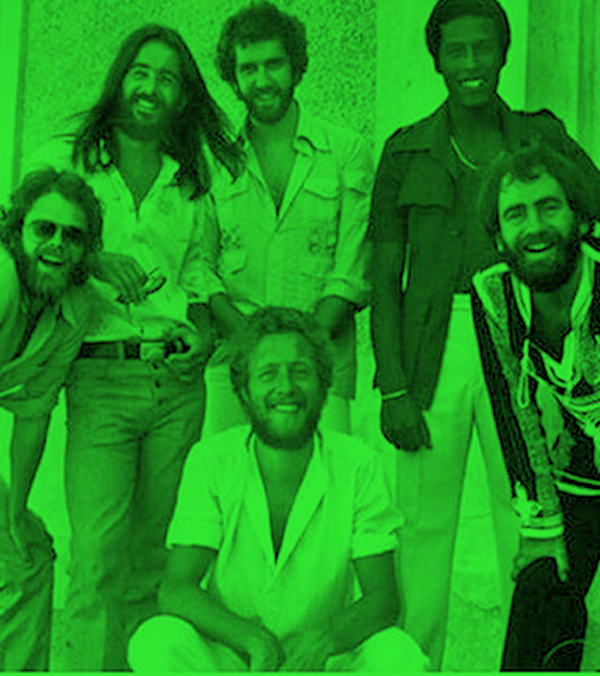
The Average White Band

Example

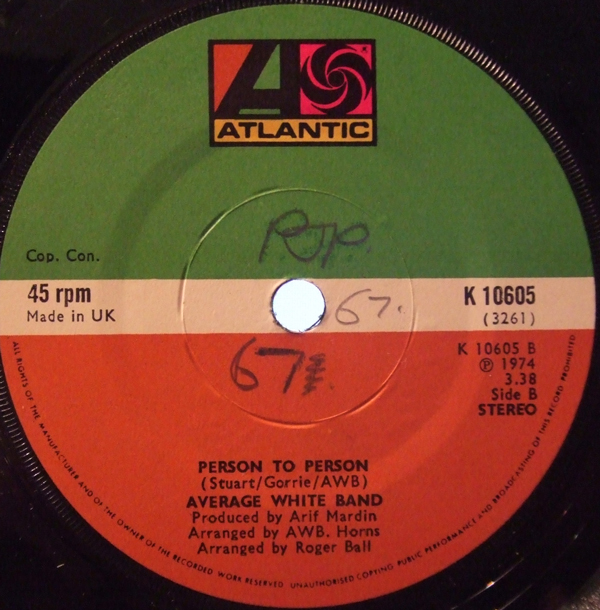
Listen/Download -Average White Band – Person to Person

Greetings all.

I come to you at the end of the week on the brink of exhaustion.
In addition to my regular fatherly, husbandly and bloggerish duties, I spent last night in New York City, meeting some groovy people, and most importantly, spinning some soul 45s.
It was another excellent evening at Master Groove @ Forbidden City with my cohorts DJ Bluewater and M-Fasis, both of whom laid down very tasty sets of funk and soul.
I put together an all Northern Soul set, and was planning on recording it live, but as luck would have it, I left the house without the proper cable to attach the recorder to the board, so the live recording was not to be.
However, as we speak, despite the fact that any sane person would be in bed, catching up on lost sleep, I’m sitting here recording that set at home, so that I can bring it to you on Monday.
As a result, I’m going to make this entry short, sweet and Master Groove-related.
The last time I did a set at Forbidden City, my man M-Fasis, who always drops something that blows my mind, whipped a familiar disc on the turntable that made my head turn. Way back in the day, when I had my first copy of the Average White Band’s ‘AWB’ album, the song that really blew my mind (aside from ‘Pick Up the Pieces’) was a a little number called ‘Person to Person’. Back in January, when M-Fasis played this very record, two things occurred to me.
First, why was I sleeping on this most excellent 45?
Second, why hadn’t someone sampled that very tasty guitar lick?

The answer to the first question is one of those basic ‘forest for the trees’ conundrums, in which your’s truly is surrounded by mountains of vinyl, and sometimes I get preoccupied and forget stuff.
The answer to the second question is, but of course the song has been sampled, at least twenty times by folks like Big Daddy Kane and Public Enemy.
So, there you go.
So how about some of that tasty Scottish funk to get your weekend started?
I’ll get back to work on that mix, and I’ll see you on Monday.

Peace

Larry

Example

Check out the Funky16Corners Store at Cafe Press

PSS Check out Paperback Rider too.

PSSS Don’t forget to hit up Funky16Corners on Facebook

You can also follow Funky16Corners on Twitter

Funky16Corners Returns to Master Groove Tonight 2/17

By , February 17, 2010 8:10 am

Example

That’s right kids. I’m heading back into NYC tonight for another set with DJ Bluewater and M-Fasis at Master Groove @ Forbidden City, Ave A between 13th and 14th Streets.

I’ve dipped into the crates and will be spinning a set of classic, upbeat Northern Soul that you will not want to miss. Things get going at 10PM, so fall by Forbidden City and get you drink (and eat, the food is excellent) on while letting your tired ears be massaged by the best in funk and soul, all spun at 45 revolutions per minute.

See you there.

Peace

Larry

Funky16Corners Radio v.81 – The Piano Electrified

By , February 14, 2010 3:55 pm

Example

Funky16Corners Radio v.81 – The Piano Electrified

Playlist

Eddie Harris – Listen Here (Atlantic)
Herbie Hancock – Fat Albert Rotunda (WB)
Art Jerry Miller – Finger Lickin’ Good (Enterprise)
Pete Jolly – Prairie Road (A&M)
Mose Allison – Meadows (Atlantic)
Lonnie Liston Smith & the Cosmic Echoes – Voodoo Woman (Flying Dutchman)
Hampton Hawes – J.B.’s Mind (Prestige)
Bob James – Nautilus (CTI)
Larry Willis – 153rd St Theme (Groove Merchant)
Neal Creque – D Train (Cobblestone)
Deodato – September 13 (CTI)
Les McCann and Eddie Harris – Shorty Rides Again (Atlantic)
Ramsey Lewis – Living For the City (CBS)


To hear this mix, head over to the Funky16Corners Radio Podcast Archive


Greetings all.

I hope reentry into the seven day cycle finds you all well.
I have just about recovered from all the snow-related exertion, and if we get another storm anytime soon I’m going to hunt down Mother Nature and kick her in the ass.
It is in the spirit of relaxation (though not too relaxed) that I bring you another in the recently mounted series of instrumental focus mixes, this time out a very tasty hour-long (plus) excursion into the world of the electric piano.
The electric piano – specifically the Fender Rhodes, though there are a couple of different brands/models represented here – is, like the vibes in F16Rv.79, one of my all time favorite sounds. Say what you want about the structure/genre of any kind of music, but when you boil it down, there’s something about the way a specific instrument sounds, whether it’s the vibes, electric piano, string bass, oud, flute, what have you, that gets deep inside my head and drills down into my pleasure centers on a primal, vibrational level, to the point where an immersive exercise like the one you see before you is the only prescription.
This has a lot to do with growing up around the piano. My Pop plays, and it was his second job for all of my childhood. If my love of music has a specific source, it’s because I grew up with a pianist/singer in the house. Whether it was on the out of tune upright at my Grandma’s house, the baby grand he entertained on at my wedding, or the electric keyboard he has now, my Dad has always instilled the value of a good (great) song in all of his children (which is why most of them play instruments).
I’ve been wanting to get down to working on this particular mix for a long time, but it was only in the last couple of weeks that I set foot in the record room – which is starting to outgrow its current location – and set to digging out the prime electric piano specimens in my crates.
While there is a funky edge to the majority of the selections herein, there are a couple of mellower things where you really get to hear the dreamy, chiming side of the instrument.
Things get underway with a song that is both a certifiable soul jazz standard, but also an oddity of sorts. Eddie Harris, who appears twice in this mix, but just once on the piano, is best known as a sax man, primarily as the number one proponent of another favorite sound of mine, that being the Varitone electric saxophone. The 1966 album ‘Mean Greens’, from which ‘Listen Here’ originates, is unusual because it includes an entire side on which Harris puts down the sax and works it out on electric piano and organ. Though Harris wasn’t giving any of the past masters of the keyboard anything to worry about, he acquits himself nicely on ‘Listen Here’, building a nice groove against a percussion base.
Herbie Hancock lays down a serious groove on the title track from 1969’s ‘Fat Albert Rotunda’. Featuring Hancock and a band of serious jazz heads (like Joe Henderson and Albert ‘Tootie’ Heath) ‘Fat Albert Rotunda’ (the song and the album) is a landmark of sorts, with the pianist settling into the funk for the first time.
Art Jerry Miller is one of those cats where I wish I could get more than a few, tantalizing clues about his story. He was Memphis-based, wrote for an played with Willie Mitchell, and recorded one very groovy album for the Stax subsidiary Enterprise Records in 1969. ‘Finger Lickin’ Good’ is a classic of the three o’clock in the morning mood, and sounds like a distant cousin of King Curtis’ ‘Soul Serenade’.
Pete Jolly was a serious West Coast jazz pianist and studio musician who recorded steadily from the 50s to the 90s. ‘Prairie Road’ is a cut from his 1970 album ‘Seasons’, which was improvised and recorded in a single four-hour session. The album is sought out for the sample on ‘Plummer Park’, but I’m here to tell you that in addition to ‘Prairie Road’ – which is included here – you really need to get your hands on the entire album (in OG or reissue) because it is one sweet listen.
Mose Allison has long been a favorite of mine, but it wasn’t until last summer, when I was down in DC digging, that DJ Birdman hepped me to the album ‘Western Man’, the only one on which the mighty Mose ever played the electric piano. I finally found myself a copy last month, and it’s both amazing, and a little bit sad that Allison didn’t spend more time working in a similar groove. The mellow tune ‘Meadows’ is included here.
I remember a time when I didn’t know that Lonnie Smith (the Hammond cat) and Lonnie Liston Smith were two different people. It wasn’t until I picked up a couple of his early 70s Flying Dutchman albums that I got hip. Lonnie Liston Smith was a busy sideman (with Miles Davis among others) who broke off in the early 70s to make his own brand of spiritual fusion. ‘Voodoo Woman’ is from his 1974 ‘Expansion’ album, and while it gets off to a funky start, it quickly settles into a late night, quiet storm groove.
Hampton Hawes first made his mark as a hard bop pianist in 1950s Los Angeles. By the early 70s he had moved on to electric piano, and a funkier sound. ‘J.B.’s Mind’ is from his 1972 album ‘Universe’, and manages to whip a little bit of funk into the mix, alongside some serious jazz sounds from Oscar Brashear and Harold Land.
Bob James is known to most people as the man behind the theme to ‘Taxi’, but ask any crate digger, and they’ll let you in on the breakbeats that make his early 70s albums on CTI/Tappan Zee favorites. The most prominent of these comes toward the end of the tune included in this mix, ‘Nautilus’ from 1974’s ‘One’ album (break courtesy of Idris Muhammad).
Larry Willis is a journeyman jazz keyboardist who has played in a wide variety of settings since the 60s (including an early 70s stint in Blood Sweat and Tears!). ‘153rd St Theme’ is a cut from his 1973 Groove Merchant album ‘Inner Crisis’.
Neal Creque has appeared in this space before, in his capacity as sideman for both Grant Green (he wrote Green’s epic ‘Cease the Bombing’) and Mongo Santamaria. He was a versatile keyboardist, working on both piano and organ. His 1972 ‘Contrast’ LP for Cobblestone is a lost classic, with funk, jazz and just a touch of his roots in the Virgin Islands. ‘D Train’ is one of the funkier numbers on the album.
Eumir Deodato, one of Brazil’s most successful musical exports is responsible for the biggest hit CTI records ever had, his reworking of ‘Also Sprach Zarathustra’ aka ‘2001’ which was a Top 10 hit around the world in 1973. The heavily sampled ‘September 13’ is another cut from the ‘Prelude’ album.
Les McCann and Eddie Harris were both jazz veterans when they hit the charts with their live, 1969 recording of Gene McDaniel’s ‘Compared To What’ which appeared on the ‘Swiss Movement’ LP. They reunited in 1971 for the album ‘Second Movement’, which featured the tune included in this mix, the funky, oft sampled ‘Shorty Rides Again’.
No mix focusing on the electric piano would be complete without a contribution from the mighty Ramsey Lewis. Lewis verily wrote the book on soul jazz piano in the 60s, and carrid on making huge contributions to jazz funk in the 70s. His 1974 ‘Sun Goddess’ album was one of his biggest hits, and in addition to his regular trio members (including Cadet house drummer Morris Jennings), the album also featured contributions from several members of Earth Wind and Fire. We close out this edition of the Funky16Corners Radio thang with his extremely cool cover of Stevie Wonder’s ‘Living For the City’.
I hope you dig the mix, and I’ll be back later in the week.
Also, if you’re in or around NYC this Wednesday, I’ll be back spinning with DJ Bluewater and M-Fasis at Master Groove @ Forbidden City, Ave A between 13th and 14th Sts. If I can get my shit (and records) together it’ll be an all Northern Soul set, so fall by if you’re in the area (things get underway at 10PM).

Example

Peace

Larry

Example

Check out the Funky16Corners Store at Cafe Press


PPS – Make sure to fall by Iron Leg for an Easy Zombies cover.

PPPS Make sure to hit up Funky16Corners on Facebook

Disco/Not Disco Pt3 – Cymande – Bra

By , February 11, 2010 6:57 pm

Example

Example

Cymande

Example

Listen/Download – Cymande – Bra

Greetings all.
The end of the week is here, and so is the final installment in the ‘Disco/Not Disco’ series.
It’s been interesting – at least for me – in that this is something that I’d been wanting to do for a long time, and kept putting it off until I had enough time to give it the thought it deserved.
The original intent was to present a couple of what I considered to be representative tracks from David Mancuso’s Loft repertoire, so that those of you reading, who may not have heard of him before might go a little bit further and as they say, read up on your read ups. Check any and all of the books I mentioned: Tim Lawrence’s book “Love Saves the Day: A History of American Dance Music Culture, 1970-1979”. Lawrence’s tome, along with Peter Shapiro’s ‘Turn the Beat Around: The Secret History of Disco’ (since retitled) and Bill Brewster and Frank Broughton’s ‘Last Night a DJ Saved My Life’ for a comprehensive history of club DJs, including Mancuso and his NY scene contemporaries.
The third and last song of the week is perhaps the most challenging of the three selections.
I’ve written about Cymande (a band I love a lot) in this space before.
Though they never rose to the prominence of either Booker T & the MGs or Eddie Kendricks, Cymande did hit the charts here in the US, twice in 1973. First with ‘The Message’, a Top 20 R&B hit, and then again (and for the last time) with today’s selection ‘Bra’ which hovered outside the R&B Top 50. They did make it onto the outer reaches of the Pop charts, but nothing significant, which is shame because they definitely had crossover potential.
Earlier I suggested that ‘Bra’ was the most challenging of this weeks selections. I don’t mean to suggest that it was in any way far out, but rather that its off-center groove, with stop time interplay between the percussion and the bass, with a less than ‘straight ahead’ rhythm. It’s not that I can’t imagine people getting down to ‘Bra’, but it’s definitely the kind of record that dancers might have to warm to, gradually, as opposed to a stereotypical floor-filler.
And therein lies the rub my friends, because that’s precisely the kind of chance that Mancuso would take, i.e. pulling an LP out of the crates and dropping a track – like ‘Bra’ – that while unquestionably danceable, is as valuable a listening experience as it is for dancing.
Co-written by guitarist Pat Patterson and bassist Steve Scipio, ‘Bra’ does open with rhythmically unusual riff – backed up by the song’s signature horn riff – but by the time the chorus comes in, the addition of a strong rhythm guitar propels the beat, rounding its sharp edges and settling into a more conventional groove. This is not to say that the tune loses any of its complexity, but rather, like any dozen James Brown records, the polyrythms are woven together so tightly that even someone with two left feet would be compelled to move.
The first time I had a chance to listen to Cymande’s three album discography in depth (via an old CD comp) what I got out of the experience – aside from lots of quality music – was the impression that despite the group’s marginal chart success, the listening public really missed the boat. The old saw is to indicate that an artist was ‘ahead of their time’ but in the case of Cymande I wouldn’t say that this was entirely true. This is how I described their music when writing about this track almost exactly three years ago:

“Their music was a sophisticated mixture of American soul and funk, African pop, Latin sounds, rock and all of the various and sundry intersections of those sounds. A close listen to their first LP is like a drive through Harlem in the early 70’s with your car windows down, letting snatches of Curtis Mayfield, Jimi Hendrix, Miles Davis, Stevie Wonder, Santana and a thousand lesser groups (woven securely into the fabric, but essentially lost to the ages) drift through the windows and into your ears.
There are elements of early-70’s prog-cum-stoner rock guitar, hard drums, jazzy bass and horns as well as a bedrock of polyrhythmic percussion.”

If my approximation of their sound is accurate, the conclusion you would reach is that they were very much of their time, and looking back, it seems amazing to me that they weren’t more popular. There were plenty of black acts incorporating elements of rock music into their sound, and by and large, though there are Jamaican influences (which had been popping in and out of radio playlists for much of the previous decade), they never overpower the band’s funky groove. While it’s understandable that a pop audience might not get too far into their sound, I’m puzzled that they didn’t make more inroads with the more progressive rock audience.
That said, placed against the other tracks in this week’s series, it’s ot hard at all to see why ‘Bra’ was so popular at the Loft. Earlier this week one of the readers requested that I post a Mancuso set list, so I pulled out ‘Love Saves the Day’ an retyped the list below, which doesn’t seem to represent any one night, but rather an amalgam of Loft favorites for the years 1970 to 1973. There are a fair amount of what one might consider to be ‘obvious’ dance records (James Brown, Beginning of the End, Manu Dibango*), a couple of less obvious tunes for the trainspotters, including jazz rock like Traffic’s ‘Glad’ and Brian Auger and the Trinity’s version of Eddie Harris’ soul jazz classic ‘Listen Here’, the breakbeat fave ‘The Mexican’ by Babe Ruth, as well as unusual (likely transitional, mood pieces) like the Beatles’ ‘Here Comes the Sun’ and Exuma’s ‘Exuma the Obeah Man’. While there’s a fair amount of info out there listing individual records as ‘Loft favorites’ I was unable to find any specific playlists from the venue’s early 70s heyday.
Interestingly enough, Mancuso has kept some version of his Loft going (at a number of different locations) continuously (though with decreasing frequency) right on through the disco and house music eras. He still travels internationally, putting on Loft parties around the world.
If reading in-depth studies of dance music culture isn’t your bag, see if you can track down the 2003 documentary ‘Maestro’, that follows the development of New York DJ culture from Francis Grasso in the late 60s, all the way through to the end of the Paradise Garage (with Larry Levan) in 1987. It manages to touch on most of the major players, and there are lots of interviews with people that witnessed the development of DJ/club culture while it happened.
I hope that this week’s series has been enlightening (at least musically).
I’m going to see if a hot shower will soothe the muscles and tendons I wore down shoveling snow.
Have a great weekend, and I’ll see you all on Monday.

Peace

Larry

The Loft – Selected Discography 1970 – 1973
From ‘Love Saves the Day’ by Tim Lawrence
Brian Auger & the Trinity – Listen Here
Babe Ruth – The Mexican
Barrabas – Wild Safari
Barrabas – Woman
The Beatles – Here Comes the Sun
Beginning of the End – Funky Nassau
Booker T & the MGs – Melting Pot
James Brown – Get Up I Feel Like Being a Sex Machine Pt1&2
James Brown – Give It Up Or Turnit a Loose
Chakachas – Jungle Fever
Cymande – Bra
Manu Dibango – Soul Makossa
Equals – Black Skinned Blue Eyed Boys
Exuma – Exuma the Obeah Man
Aretha Franklin – Ain’t No Way
Al Green – Love and Happiness
Willie Hutch – Brother’s Gonna Work It Out
Intruders – I’ll Always Love My Mama
JBs – Gimme Some More
Eddie Kendricks – Girl You Need a Change of Mind
Morgana King – A Taste of Honey
Gladys Knight & the Pips – It’s Time To Go Now
Little Sister – You’re the One
Curtis Mayfield – Move On Up
Dorothy Morrison – Rain
Van Morrison – Astral Weeks
O’Jays – Love Train
Olatunji – Drums of Passion
Osibisa – Survival
Edwin Starr – War
Traffic – Glad
Tribe – Koke
Troubadours du Roi Baudouin – Missa Luba
War – City, Country, City
War – The World Is a Ghetto

Example

*The story goes that it was the NY club DJs that made Manu Dibango’s ‘Soul Makossa’ a hit before it was widely available in the US, which explains the many covers/rip-offs of the tune that flooded the market before Atlantic released the song domestically

Check out the Funky16Corners Store at Cafe Press


PS Head over to Iron Leg for some country rock

PSS Check out Paperback Rider too.

PSSS Don’t forget to hit up Funky16Corners on Facebook

You can also follow Funky16Corners on Twitter

Disco/Not Disco Pt2 – Eddie Kendricks – Girl You Need A Change of Mind

By , February 9, 2010 5:47 pm

Example

Example

Eddie Kendricks

Example

Listen/Download – Eddie Kendricks – Girl You Need a Change of Mind

Greetings all.
As I write this, I still can’t feel the lower right side of my face, having spent the morning with the dentist and her assistant rummaging in my mouth like it was an old sofa and they’d lost a hundred dollar bill. I even got soup for lunch and STILL managed to bite my lip. Fortunately, the good doctor informs me that aside from an extraction, my dental worries for the year are at an end (until next year and the insurance starts paying again).
A look out the window at the foot or so of snow on the lawn is bad enough, but the weatherman is now forecasting another foot or so for tonight into tomorrow. Once again I ask, WTF? I don’t mind the weather as much as I’m terrified of venturing out onto the roads, alongside the large number of New Jersey residents who have no idea how to drive in the snow. Half of them are going way too slow, and the other half, cruising around in their gas sucking luxury behemoths are going way too fast, thus making the NJ highways – already a gauntlet of sorts – into a veritable death trap. With any luck, the wife and kids will have the day off, so we can stay home and sit beside the fire.
That said, it’s time to continue our week long tribute to David Mancuso and the records he played at the Loft.
Earlier this week, not long after I finished writing the post about Booker T & the MGs, it occurred to me that the vibe I got when reading about Mancuso, and his work as a DJ reminded me of a phrase I learned from a friend many years ago.
Back in the day, though (wisely) I never set foot on a surfboard, I became fascinated with the history of the sport – especially the big wave riders – and I had a couple of friends (thanks to living and working by the beach) who actually surfed. Now, the “waves” (quotes added for sarcasm) at the Jersey Shore rarely rise above a height considered safe for small children and old ladies (aside from those whipped up by the occasional Nor’Easter or hurricane). Despite this fact, no matter what time of year it is, if I take a ride along the beach –especially in the morning – there are surfers out there, making the best of what the ocean has to offer.
Why do I mention this? Because, (also) back in the day, my buddy Joe introduced me to the concept of the ‘soul surfer’. Obvious puns aside, what this refers to is an individual who is technically adept enough to compete with the big dogs, yet rides the waves solely for the sheer pleasure of it, making it into a spiritual endeavor. The more I thought about Mancuso, the Loft and the ideas he brought to the game (and how he inspired me) the more it occurred to me that it made sense to apply that term to Mancuso and those that follow(ed) in his footsteps.
I realize that there are all kinds of DJs out there, separated not only by genre, but also by their approach to spinning (though god knows the cats that actually use records are becoming an endangered species). Ideally, when you enter the DJ booth, your ultimate goal ought to be that the folks dancing, listening or both, have a good time. How good a time they have is dependent on a number of factors, the most important being the quality of the music, and the way you (the DJ) present it to the crowd.
The corner of the musical universe I tend to kick around in is generally concerned with soul and funk, of the vintage persuasion. The folks that come to hear and dance to this music are usually a mix of aficionados, i.e. your Mods and soulies that know their way around and are probably already acquainted with some of the rarer discs in my record box, and regular folks who just want to hear something they can dance to.
It probably goes without saying (but I’ll say it anyway) that the vast majority of DJs in this field are – like myself – what our friends in the UK refer to as anoraks and trainspotters, i.e. detail-oriented obsessives with an eye turned to the rare an obscure. The duty of this type of DJ is to balance their own love for the obscure against the true quality of the records in question (on account of the rarity of a record often- not always – has an inverse relation to the quality), and to offer up a playlist that is interesting, but ultimately satisfying to the largest possible number of people. Finding this balance isn’t always easy. I’ve seen people with incredible record collections step up to the tables and drop one ultra-rare stinkbomb after another. I’ve also seen people with less impressive crates (but spectacular taste) light up a dancefloor with dollar bin wonders.
Today’s selection from the Loft, Eddie Kendricks’ mighty ‘Girl You Need a Change of Mind’ is from the less-obscure end of the spectrum. The song appeared on Kendricks’ landmark 1972 LP ‘People Hold On’, and though it wasn’t a hit*, he was well known from his years in the Temptations, and had scored a chart hit with that album’s opening track ‘If You Let Me’. Like Monday’s tune ‘Melting Pot’, I first heard ‘Girl You Need a Change of Mind’ as a 45 edit. Unlike ‘Melting Pot’, ‘Girl…’ made an impact on me, even in its shortened version.
Written by Motown legend Frank Wilson and Anita Poree (though the 45 credits it to Poree and ex-Radiant Leonard Caston, who co-wrote a number of other songs on ‘People Hold On’), ‘Girl You Need a Change of Mind’ is the ultimate illustration of the ‘disco/not disco’ tag.
Eddie Kendricks is unquestionably one of the fathers of what came to be known as disco. The two years after ‘People Hold On’ saw him have big hits with two of the genre’s important early songs, ‘Keep On Truckin’ and ‘Boogie Down’. While ‘Girl…’ isn’t quite as explicitly “disco” as either of those tracks, all of the stylistic cues are present, albeit not fully formed. Like ‘Melting Pot’, ‘Girl…’ contains multitudes in its seven and a half minute span. Though it works wonders as a three and a half minute soul single, it passes over into the realm of dance floor epic in the album version.
The opening riff, with a simple piano riff over spare percussion – soon joined by snare drum and horn flourishes, opens up into a relatively slow (yet danceable) verse. It’s around the two and a half minute mark, with Kendricks repeated ‘What you say to that?’ refrain, that the tempo escalates, backed by a muscular rhythm guitar (right about where the 45 version fades out). Things change again around 3:45, where everything except the lead guitar and tambourine drop out, the band gradually coming back in (the piano and rhythm guitar are especially sweet here) until the drums come in strong at about 5:10. It’s at this point where the picture of ‘Girl You Need a Change of Mind’ as dance floor epic comes into full focus. Unlike many 12” singles that would drop in the coming years, ‘Girl…’ is both song enough for the radio, and (in it’s LP form) long enough for the dancers.
Things change yet again at 5:55 – and again this must have been absolutely magical over the Loft’s sound system – as we’re left with just the congas and Kendrick’s falsetto, followed in short order by the band returning to full power by the end of the record (sounding – at this stage – several years ahead of its time).
Interestingly enough, as proto-disco goes, it’s another ‘People Hold On’ track, ‘Date With the Rain’ – another big hit in the clubs that failed to score on the radio – a remarkable (but tragically short, at 2:40) dance record, that more closely fits the mold. It is also available (but much rarer) on 45.
I hope you dig the track(s), and I’ll be back on Friday with another great record.

Peace

Larry

Example

*CORRECTION – I just dug out my Billboard R&B Chart book, and discovered that ‘Girl You Need a Change of Mind Pt1’ (the 45 edit)  was in fact a Top 20 R&B hit.

PS: Don’t forget this Wed 2/10 at Master Groove @ Forbidden City – DJ BlueWater, DJ Prime Mundo, DJ Prestige

Check out the Funky16Corners Store at Cafe Press


PS Head over to Iron Leg for something by the Beach Boys

PSS Check out Paperback Rider too.

PSSS Don’t forget to hit up Funky16Corners on Facebook

You can also follow Funky16Corners on Twitter

Disco/Not Disco Pt1 – Booker T & the MGs – Melting Pot

By , February 7, 2010 6:24 pm

Example

Example

Booker T and the MGs

Example

Listen/Download – Booker T & the MGs – Melting Pot

Greetings all.
I hope that those of you located in the path of the big snowstorm are well, shoveled out and warm. Unlike the last time storm, during which my snowblower was locked in the tool shed, its get up and go having got up and went, the most crucial of snow battling machines was up and running this time, making for a much neater, much less labor intensive experience. There’s still a shit-stack of the white stuff surrounding the Funky16Corners compound, but ingress and egress are assured.
This week is another one of those Funky16Corners ‘theme’ extravaganzas, in which I dip into the vault and run a Sesame Street – ‘How are these things like one another’ – game on you, but provide you with the answers (or at least my version thereof).
Last year, one of my major reading experiences was Tim Lawrence’s book “Love Saves the Day: A History of American Dance Music Culture, 1970-1979”. Lawrence’s tome, along with Peter Shapiro’s ‘Turn the Beat Around: The Secret History of Disco’ (since retitled) and Bill Brewster and Frank Broughton’s ‘Last Night a DJ Saved My Life’ when taken together form a de fact encyclopedia of modern DJ culture. All three are well written and deeply informative, but more than that, they introduce you to a couple of seminal personalities without whom DJ-ing (and dance music) would not exist as it does today.
Because of these three books, I came away with a deep and abiding respect (bordering on idolatry) for the work of David Mancuso. It was Mancuso (pictured above), who in 1970 threw the first dance party in his loft (which became The Loft), calling it Love Saves the Day (get it? Nudge, nudge say no more…). Though there were many other important figures in DJ culture (especially Francis Grasso who paved the way for Mancuso in New York City), for me, Mancuso rises above all others.
From the very first time I entered a DJ booth, I’ve endeavored to create an experience for the people on the dance floor turning solely on the gears of good music. Some of it was rare, some of it extremely common, but the idea was to drop the needle on something that the dancers would dig, and do my best to lift the room. Years later, when I became aware of Mancuso through the books listed above I realized that he was in many ways the ur-DJ.
If you’ve spun records for a crowd, you already know (or should) that nothing feels better than laying down some quality sounds and feeling the energy on the dance floor build, incrementally, layering record on top of record, shifting the tempo up (most of the time anyway) but always attempting to build on that increase with a parallel increase in the quality of the music coming out of the speakers. There’s something to be said for the idea that on a perfect night, a DJ is something akin to the ancient cats drumming around the fire, whipping their fellow tribesmen into a lather, drumming harder as they dance faster until the lot of them were participants in a musical hive mind of sorts, connected by the beat. When you’re spinning records, sometimes it only comes together for a couple of songs, sometimes not at all, but when it does there’s nothing better. Certainly the vast majority of people in a dance club are there first and foremost to have a good time, but there’s no reason in the best of all possible worlds that it can’t also be elevated to the spiritual level.
Before you can get to that specific place, a DJ has to do two fundamental things.
First and foremost, keep your ears (and your mind) open. The more you listen to, and the more time you spend among others that really know and seek out good music the larger your internal repertoire/reference library is going to be.
Second, and if you’ve spent any time following the going on here at Funky16Corners you probably picked up on this one: keep digging. The more time you spend actively seeking out new music in the field, the more likely it is that when the time comes to pull some heat out of your crates and drop it on the ones and twos that you’ll be making a good choice.
Certainly there’s the issue of taste, but even that can be improved with enough study.
That all said, what I came away from all three of those books knowing about David Mancuso, was that his tastes were expansive. A look at his playlists reveals that alongside many accepted classics (many of those placed in the canon by Mancuso and his contemporaries) there were a lot of – for lack of a better term – ‘unusual’ choices. Half a decade before guys like Kool Herc and Flash were cutting rock breaks in the Bronx, Mancuso was playing all manner of rock, jazz, world music and pop sounds at the Loft, alongside a healthy portion of what are now considered ‘consensus’ dance records.
Remember, we’re talking about an era where the large majority of genres that rule the dance club world today hadn’t yet been codified. ‘Disco’ was years away from common usage and 12” singles – with their dance floor specific extended versions – did not yet exist. Though there were some records on his playlists that are now considered part of the vanguard of what would come to be known as disco (especially some Eddie Kendricks jams, one of which will be featured later this week), Mancuso mixed in just about anything else that made sense in the context of his sets.
The Loft parties, though conceived on an intimate scale, were hugely influential, with regular attendees/devotees including Nicky Siano (the Gallery), Larry Levan (Paradise Garage) and Frankie Knuckles (the Warehouse, from which ‘house’ music got its name) all of whom went on to marks on dance music culture in their own ways.
The first track I’m going to bring you this week is a perfect (capsule) example of all that was great about the Loft. Oddly enough, the first time I heard Booker T and the MGs doing ‘Melting Pot’ it was on a 45, with the vast majority of its power stripped away. After reading about its place of honor at the Loft, I sought out the 1971 LP of the same name. I finally scored a copy when I was DJing down in DC last year. Once I got it home and had a chance to drop the needle on the LP version of the title song, it became obvious why Mancuso used it at the Loft.
‘Melting Pot’ is, inside of its eight minute playing time, a microcosm of an entire set. The song opens with rimshots by Al Jackson, but it’s Steve Cropper’s pulsing rhythm guitar that sets the pace. When Booker T’s organ and Jackson’s drums come in the groove is locked down. The band – one of the tightest of the classic soul era – only really works up a full head of steam at the three minute mark, which explains why the 45 lacks the punch of the LP version.
It’s important to note the atmosphere in which the ‘Melting Pot’ album was created. It was the last album by the classic MGs lineup. Booker T Jones was fed up with the new regime at Stax and was on the verge of leaving the group. He refused to record in Memphis, so the album was recorded on the road in NYC. The sound of the album is a serious departure from the band’s earlier work, revealing a more expansive, more progressive Booker T and the MGs. While tracks like ‘Chicken Pox’ – with the MGs channeling the Meters – show that they might not have been leading the pack anymore, a cut like ‘Melting Pot’ shows that had they stayed together, they might very well have moved to the front once again.
As I mentioned before, ‘Melting Pot’ is almost like a small, self-contained DJ set. The song has several distinct sections in which the MGs bring up the tempo gradually, hit a peak and then chill out, only to re-state the groove again and again, bringing the dancers along for the ride. Listen at around 4:15 where Jones and Duck Dunn fall back, leaving Jackson and Cropper to rebuild the song from the opening statement. Dunn drops back in with a repeated, almost circular bass line, and Jones solos over the top of it all. I can only imagine what Al Jackson’s punchy bass drum accents sounded like pouring out of the Loft’s sound system. While ‘Melting Pot’ is clearly not ‘disco’ as it came to be known, the second half of the song is definitely a prototype for extended dance mixes to come. The temptation, as the song fades out just past the eight minute mark, is to cue up a second copy and keep the groove going.
‘Melting Pot’ which was the last 45 by the classic Booker T and the MGs line up, and strangely enough the flip side is another drastically truncated long jam,’Kinda Easy Like’ which also runs over eight minutes on the LP. It grazed the Pop Top 40 and hit the R&B Top 20. Following the ‘Melting Pot’ album, Booker T Jones would leave the group and relocate to California where he would work with artists like Bill Withers. Cropper would also leave the fold, with Dunn and Jackson reconstituting the MGs with a new organist and guitarist.
All in all, ‘Melting Pot’ is – at least for those that haven’t heard it – a revelation, and a great way to start a week of Loft tracks.
I hope you dig it, and I’ll be back on Wednesday with something cool.

Peace

Larry

Example

PS: Don’t forget this Wed 2/10 at Master Groove @ Forbidden City – DJ BlueWater, DJ Prime Mundo, DJ Prestige

Check out the Funky16Corners Store at Cafe Press


PS Head over to Iron Leg for something by the Beach Boys

PSS Check out Paperback Rider too.

PSSS Don’t forget to hit up Funky16Corners on Facebook

You can also follow Funky16Corners on Twitter

Panorama Theme by Themocracy