As promised, I have returned to continue our tribute to Weldon McDougal III and the Harthon sound. I was originally planning to take it through to the end of the week, but then I looked at the calendar and realized that I had to do some shuffling.
I’ll be posting the election-themed mix that I mentioned a little while back later this week (and it will stay posted until the middle of next week).
If you are one of the regular readers who doesn’t dig it when I down-shift (up-shift?) into political/rant mode, you might want to give this one a pass because it is – as they used to say in the days of raccoon coats and rumble seats – a doozy.
I will certainly return to the Harthon theme on the blog in the next few months, but I will devote the entirety of next weeks (11/5) Funky16Corners Radio Show on Viva internet radio to the Harthon sound, so make sure you fall by for that. It’ll be a good one.
That said, over the last few days I’ve been giving Weldon McDougal III’s legacy, at least as it applies to the records he helped to make while at Harthon, a great deal of thought.
There are times here when I have to catch myself, and remember that not everyone that stops by the Funky16Corners blog to soak up the soul is a collector, and might not be as interested in the historical minutiae as they are in just soaking their ears in some good music.
Taking that into consideration, it pays to remember that Harthon, as both a free standing label, as as a production entity that leased recordings to other labels, is almost completely unknown to most people, including a lot of soul fans.
This, in and of itself is not unusual, since most of what gets posted here fits the description of ‘obscure’, or at the very least under-appreciated.
I’m not deluded in believing that everything that is obscure is also good, or at least good enough for most people to dig. However, a lot of it is good, and often enough great, which is why Funky16Corners came about.
The more I dug for, listened to, and (where possible) read about soul music, the more I realized that it was quite literally a treasure trove, that once unearthed had to be passed on, record by record, so that it might live the life it deserved.
This isn’t the musical equivalent of ‘outsider art’ either. I have certainly known (and still know) people that collect music created on the technical or emotional fringe, but the sounds created by Weldon McDougal III, Luther Randolph and Johnny Stiles, and their many collaborators during the few years that Harthon was in operation meets, and often exceeds the definition of the word extraordinary.
That most of these records went largely unheard outside of the Philadelphia area when they were first released is a painful truth, but diminishes their quality not a whit. The fact that many of these records are as good, or in some cases far better than what hit the charts at the time is both mind boggling and infuriating, bringing us all back to the starting point where I have to dip back into the crates and share what I have with the folks that read the blog.
Now, it bears mentioning that not everyone was ignorant of Harthon. The devoted people of the Northern Soul scene in the UK consider Harthon to be one of the truly great soul labels of the 60s, to the point where there was a fairly brisk trade in bootleg repressings of the label’s best and often rarest productions.
If not for the soulies and their enthusiasm I might never have heard so many of the records that I searched diligently for, and now consider to be the prizes of my collection.
But outside of that scene, the stark reality is that Harthon records, in the tangible 45RPM form, are extremely hard to come by.
Take a stroll over to Popsike.com and plug in Harthon as a search term, and after the realization that these records are often expensive (though not in the multi-thousand dollar way that so many Northern Soul sides are), they don’t seem to be that many of them changing hands.
This is probably due to a combination of actual scarcity, and that once obtained, these records rarely re-enter the marketplace. That, and the fact that I’ve never seen a complete Harthon discography compiled anywhere has made it difficult to track these records down.
The selections I’m featuring today are all from the ballad side of the label.
The first of these is a 45 I picked up near the beginning of my interest in Philly soul which I only associated with Harthon a few years later. That it is also one of the most unusual soul records I own makes it all the more intriguing.
I’ve never been able to track down any information on the Twilights. They recorded two 45s for Harthon, one released on the label, and the other (today’s selection) on Parkway. ‘Shipwreck’ is a deeply atmospheric record that sounds like a darker ‘answer’ to records like ‘What Time Is It’ by the Jive Five.
It’s taken at a slow pace (almost plodding), with a funereal horn chart (which sounds like it’s playing at too slow a speed), and a weird sound effect that sounds like someone is striking the reverb chamber (or a steel drum) in the studio. It’s a hypnotic tune, but just as you’re absorbed into the sound, the lead vocalist quite literally starts screaming. I don’t mean soul shouting either, but rather screaming of the padded cell variety. It’s both unsettling and provocative, making me want to track down Luther Randolph – who is credited with the arrangement – and asking him what was up.
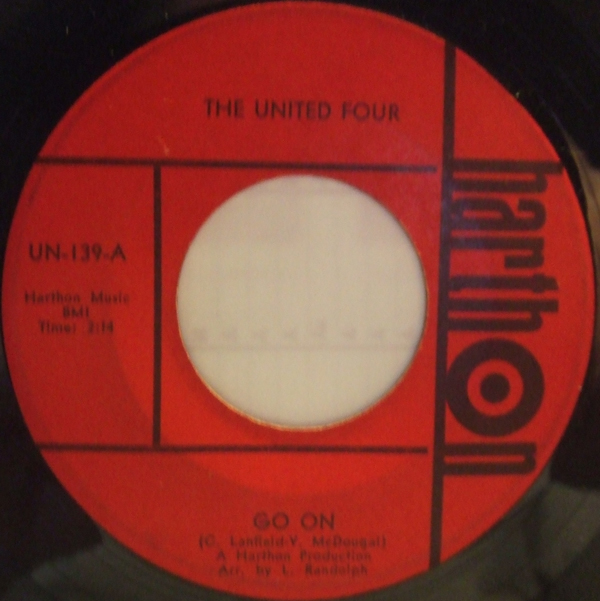
The second of today’s records is ‘Go On’ by the United Four, the flipside of the Northern fave ‘She’s Putting You On’. If ever a record predicted the sweet ballad sound that would come to be associated with Philadephia a few years later, this is it. The lead vocal is delivered in a dramatic falsetto, with harmony assistance from the rest of the group. The power of the vocals is juxtaposed with a fairly austere instrumental base, with drums, organ, spare guitar and glockenspiel accents. The song is co-written by Vivian McDougal (Weldon’s wife), as is the flip.
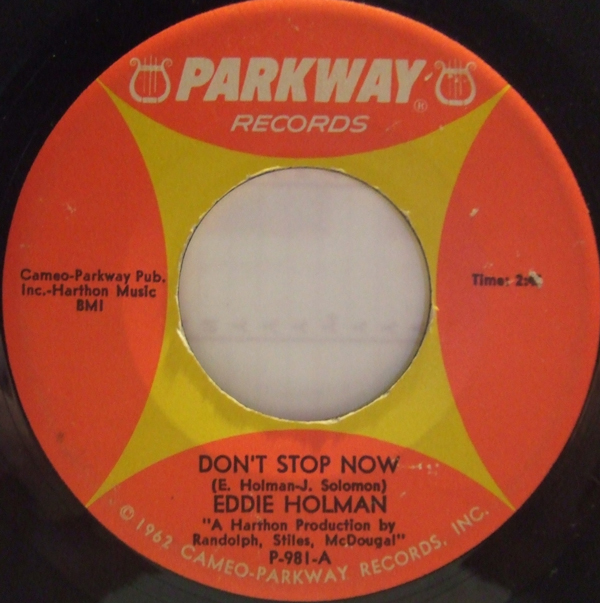
The last tune today is a fantastic b-side by the man who was in many ways Harthon’s brightest star, Mr. Eddie Holman. Taking into consideration his work as performer and songwriter, Holman is almost elevated to an equal spoke in the Harthon wheel.
‘Don’t Stop Now’, the flipside to ‘Eddie’s My Name’ showcases the falsetto that would bring Holman acclaim a few years later with ‘Hey There Lonely Girl’, and a wonderful, stylish arrangement with strings, unusual guitar accents and woodwinds. Written, like so many of his Harthon-related sides, by Holman and James Solomon, and with production credited as ‘A Harthon Production by Randolph, Stiles, McDougal’, ‘Don’t Stop Now’ didn’t make a dent upon its original release in 1966, but charted for Holman when he rerecorded it for ABC in 1970.
Listen/Download – Four Larks – Groovin’ at the Go Go
Listen/Download – Cooperettes – Shingaling
Listen/Download – Lee Garrett – I Can’t Break the Habit
Listen/Download – Bernard Williams and the Blue Notes – It’s Needless to Say
Listen/Download – Volcanos – It’s Gotta Be a False Alarm
Listen/Download – Eddie Holman – Stay Mine for Heaven’s Sake
Listen/Download – Eddie Holman – Eddie’s My Name
Listen/Download – Eddie Holman – I’ll Cry 1,000 Tears
Greetings all.
I hope all is well on your end.
Over the weekend I found out via Colin Dilnot of In Dangerous Rhythm that the legendary producer, performer, songwriter and promoter Weldon McDougal III had passed away.
If the name isn’t familiar, the music he helped create in Philadelphia during the 1960s should be.
McDougal was one of the co-founders (with Luther Randolph and Johnny Stiles) of the legendary Harthon production house.
In addition to the Harthon label, home to many brilliant (and rare) soul 45s, they created, and farmed out to a number of other labels, many equally excellent sides.
If memory serves, I first became aware of Harthon via an old comp of their best stuff (issued and unissued) that turned me on to a wide variety of records that I would hunt breathlessly for the next decade.
The tough thing is, for all the undeniable greatness of the records that McDougal made with Harthon, very little has been published about the label’s history.
Randolph (an organist) and Stiles (sometimes listed as ‘Styles’, guitar) had worked in and around Philadelphia before joining together and recording what would be the first Harthon 45s (one being released on Cameo).
They eventually joined up with McDougal, who was performing with his group the Larks (no relation to the Don Julian group on the West Coast) and the Harthon powerhouse was soon up to full speed.
They eventually brought local group Jo-Ann Jackson and the Dreams into the studio and recorded ‘Georgie Porgie’ (no doubt aimed at garnering airplay from local radio giant Georgie Woods), the first 45 on the label that wasn’t a Randolph/Styles instrumental.
In Tony Cummings rare – and indispensable – tome The Sound of Philadelphia (the source for most of what I know about the partnership), Stiles was quoted as to the source of the Harthon sound:
“The sound we were trying to get was that Motown sound. The Detroit thing was what was happening so we just tried to get as near to it as we could. Our things were done in a small time kinda studio but we got the sound we wanted.”
Stiles was basically getting to the root of the Northern Soul equation, i.e. reaching back to the Motor City and trying to recreate/expand on the sound in places like Philadelphia, Chicago, New York and Los Angeles.
The music that McDougal, Randolph and Stiles would create over the next few years, with the help of the famed Philly rhythm section (Bobby Eli, Norman Harris, Earl Young, Ronnie Baker), writers and producers like Thom Bell, Eddie Holman and many others, created a number of records that are worshiped to this day on the Northern scene, and have also become some of my favorites, making Harthon my all-time favorite soul label.
Over the years I’ve been tracking down Harthon records (It was years before I scored an OG with the famous black and orange logo see above) I ended up following all kinds of leads and discovering a number of things I hadn’t expected.
The tunes I’m featuring today – I’ll be posting Harthon stuff all week – are in many ways the cream of the Harthon crop (at least to my ears) all bearing the marks of the label’s sound, i.e. solid, hook-laden songwriting, sparkling production and most important of all, fantastic singers.
The first of these is what is probably the best known of all Harthon productions, the Four Larks (McDougal’s group with a ‘Four’ added to distinguish them with the LA group) ‘Groovin’ at the Go Go. Written and arranged by Thom Bell, ‘Groovin’ at the Go Go’ is a record that I chased for a long time, often being outbid (when it showed up for auction) and bemoaning my failure to procure it – in this very space – often.
Then, in what must surely be one of the great moments of vinyl related altruism, a reader found a copy and sent it to me, gratis.
Needless to say my mind was good and truly blown (this is not a cheap record) and the 45 has held a place of honor in my record box ever since then.
Leased to the Capitol Records subsidiary Tower, ‘Groovin’ at the Go Go’ is one of those records that in a just world would have been a huge hit.
The record featured Irma Jackson on lead vocals, and has a great repeated riff played on piano and vibes, backed by a throbbing bass and drums, as well as wonderful, atmospheric backing vocals and a horn chart that won’t quit.
I don’t know much about the Cooperettes other than the music I’ve heard on their Brunswick and ABC 45s. They were a Philly-based girl group, and their ‘Shingaling’ is an absolutely stunning Northern-styled pounder. This track would later be recycled as the unreleased (but heavily bootlegged) ‘You Need Love’ by Irma and the Fascinators. I’ll post a recording of my bootleg 45 later this week.
The next two cuts were also lifted from bootleg 45s (there was a brisk trade in bootlegs on the Northern Soul scene in the 70s) , and are among the finest things to come out of Harthon (if only I’d been able to score original copies, but alas…).
The first is by Lee Garrett, who would later move to Detroit, recording his own records as well as co-writing the Spinners hit ‘It’s a Shame’. ‘I Can’t Break the Habit’ is a killer with a great vocal by Garrett and a very cool piano interlude in the second half of the record.
The other bootleg-sourced cut is in my Top 3 Harthon sides, Bernard Williams and the Blue Notes ‘It’s Needless To Say’. I know I’m repeating myself, but this record really, REALLY should have been a hit. It has it all, great songwriting, performance, production and arrangement. This is the group that was formed when the original Blue Notes split up, with Williams forming his group and Harold Melvin forming the other.
The next cut is the A-side from one of the two 45s the mighty Volcanos recorded during their brief sojourn with Harthon. Aside from a typically solid lead vocal by Gene Faith, the record features a pounding instrumental backing, which would later be bootlegged in the UK with the vocals stripped off (credited to the Body Motions). I’ve never been able to nail down the chronology of the Volcanos time with Harthon, but a number of clues (including the funkier b-sides on the 45s) lead me to believe that they were recorded after the group’s Arctic period but before the sides released on Virtue, which are basically Gene Faith solo records (the remainder of the group moving on to record as the Moods and the Trammps).
Eddie Holman
The last three cuts are two of the finest soul sides produced by any label, let alone Harthon.
If you mention the name Eddie Holman to most people, the record that comes to mind is ‘Hey There Lonely Girl’ the Ruby and the Romantics* cover that Holman took into the Top 10 in 1970. However, one of my earliest Philly soul related obsessions was tracking down and reveling in the spectacular nature of the 45s that Holman recorded with Harthon for Cameo/Parkway and Bell during the mid-60s.
Often working with his writing partner James Solomon, Holman, possessor of one of the mightiest singing voices ever committed to vinyl, recorded several remarkable 45s that were largely ignored by radio. Aside from 1966s ‘This Can’t Be True’ (to be posted later this week) Holman was absent from the Top 40 until he hit with ‘Lonely Girl’.
The first of these is ‘Stay Mine for Heaven’s Sake’. Written by Holman and Solomon, and arranged by Luther Randolph, ‘Stay Mine…’ is yet another record that seemingly had every prerequisite for chart success, pop hooks, solid arrangement and above all Holman’s voice.
The second of the Holman sides featured today is the Northern Soul favorite (and a record I’m proud to say I scored digging within the Philadelphia city limits) ‘Eddie’s My Name’. Propelled by a speedy dancers beat, handclaps and sharp snare drum shots, ‘Eddie’s My Name’, with production credited to ‘Randolph, Stiles and McDougal’ is a big fave with the soulies and has been comped a bunch of times.
The final record for today is Holman’s epic ballad performance ‘I’ll Cry 1,000 Tears’. Released on the Bell label, this is the Eddie Holman 45 that eluded me the longest. With a melody that occasionally touches on Jimmy Ruffin’s ‘What Becomes of the Broken Hearted’, ‘I’ll Cry…’ is really Holman’s vocal tour de force. The chorus sees him soaring to almost operatic heights against an amazing arrangement. This was his last 45 with Harthon (in 1968), before moving to ABC.
The end of Holman’s tenure with Harthon coincided with the end of the partnership. McDougal would leave Philadelphia to go work in promotions for Motown, where he stayed until returning to Philly in 1972 to work with Gamble and Huff at Philly International.
The news of McDougal’s unfortunate passing led me back into the crates where I dug out a couple of Harthon rarities, which I’ll be posting later in the week.
Listen/Download – Mary Wells – Can’t You See (You’re Losing Me)
Greetings all.
Once again I’m neck deep in a busy week, but what better time for an invigorating and restorative shot of soul?
Like anyone who tuned into an oldies station in the 1970s (or 80s, 90s or 00s) Motown looms large.
Unfortunately – and I’ve spoken on this issue at length in the past – what you basically get in that format is the same dozen of so songs by the label’s biggest artists, repeated ad infinitum to the point of nausea.
It was just such a situation that turned me off to the wonders of Motown for a long time, until many years later, when the sounds of Northern Soul came into my life.
Though the phrase Northern Soul, used as a descriptive can be unbelievably wide-ranging, were you to approach it from the broadest possible angle, what you’re hearing is musicians and singers, in and out of Detroit making an effort to duplicate the soul sounds coming out of that city, in and out of Motown (and I say in and out because so many Motor City records on other labels were played by the same general group of musicians creating the magic for Berry Gordy).
One of those oft-repeated songs was ‘My Guy’ by Mary Wells. A big hit in the Spring of 1964, that song cemented Mary Wells in the minds of a generation (and beyond).
What a lot of folks don’t know, is that Wells left Motown soon after, and spent the rest of the decade bouncing to 20th Century Fox, Atco and Jubilee, making a few minor dents in the charts but nothing like her time at Motown.
Despite that fact, she continued to make great music, including today’s track, recorded in 1966 for Atco.
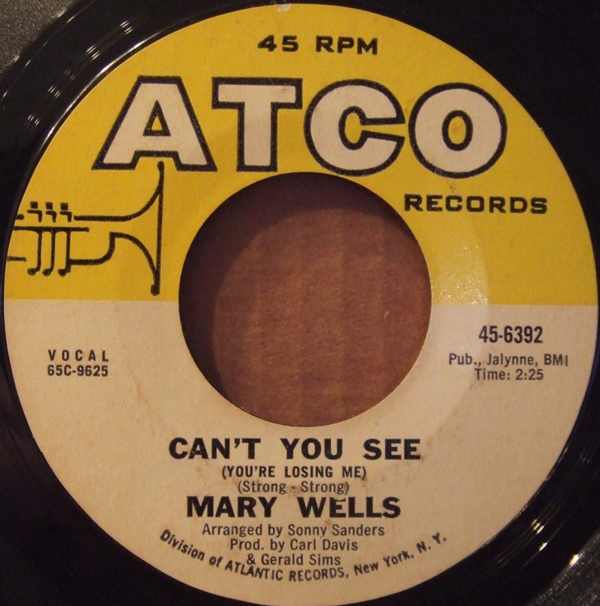
I first heard this tune via my man Agent 45, who had picked it up on a mispressed/labeled 45. When I heard ‘Cant’ You See (You’re Losing Me)’ I flipped my wig.
What a fucking stormer!
Not only is the song a bit of Northern Soul genius (that honking baritone sax is the shit!), with a powerful, propulsive dancer’s beat, but the song itself is a killer.
Written by none other than Barrett Strong (another tie back to Motown), and recorded in Chicago with a brilliant arrangement by Sonny Sanders, another former Detroiter who had worked on a number of classics at the Golden World label, ‘Can’t You See (You’re Losing Me)’ is yet another example of a record that should have been a huge hit, yet only finds its reward in the hearts of soulies decades on.
‘Can’t You See (You’re Losing Me)’ has since become a staple of my Northern Soul box, and always brings someone up to the decks to see what’s playing.
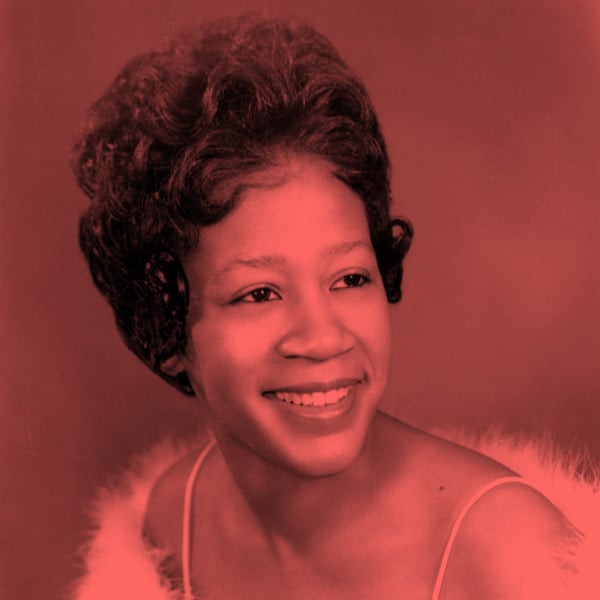
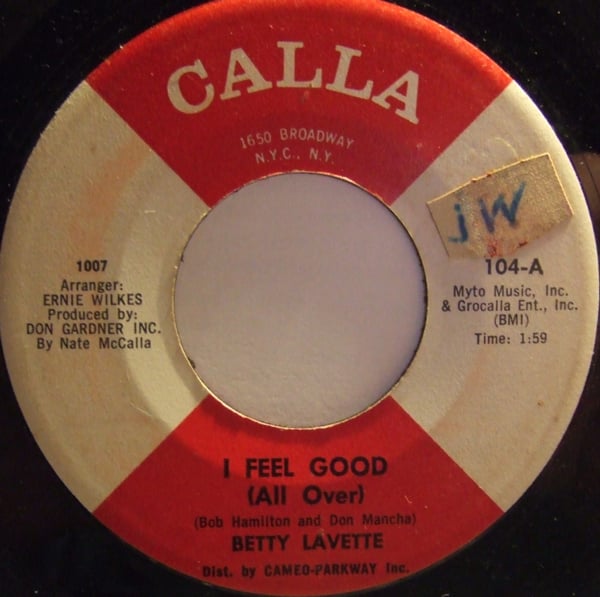
Listen/Download – Betty Lavette – I Feel Good (All Over)
Greetings all.
I hope the end of the week finds you all well.
There was no mid-week post, mainly so that the post honoring Gene Ludwig could remain in place.
I’ll be featuring one of his rarer sides in the coming weeks.
The tune I bring you today is one of those records that I chased for a long time.
I first heard Betty Lavette’s ‘I Feel Good (All Over)’ in a most unexpected place, that being a European compilation album devoted to releases from the Pama label. I picked it up years ago to get my hands on a couple of Mohawks tracks (and some reggae) and was surprised when a number of the tracks turned out to be UK issues of US soul 45s, none of which I’d heard before (this was maybe ten years ago).
The one track that really flipped my wig was ‘I Feel Good (All Over)’.
Over the course of the last decade, on and off, I made several attempts to get myself a copy, being outbid every single time.
This time, the copy in question had a poor grade, but since the opening bid was low, I figured I’d try to grab it. It ended up going for around 20 bucks, but I thought that I could live with having spent a Jackson on a filler copy until I had an opportunity to mint up in the future. With any luck it wouldn’t take another ten years.
So, the record shows up, and once again, the chance taken paid off in spades in that as soon as I played the record I realized that no upgrade would be necessary.
If you haven’t heard ‘I Feel Good All Over’ before, give it a spin and you’ll see why I coveted it for so long.
It is a rock solid, Detroit soul dancer with a dynamite vocal by Lavette and a blazing horn chart. This is 100%, guaranteed dance floor fire.
Give it a close listen, and once you get past Betty’s amazing singing, check out that guitar running underneath things (especially near the beginning of the record). It’s an ever so slightly rough, almost Southern touch to a slamming Motor City side (I’d love to know who it is…).
The flipside, ‘Only Your Love Can Save Me’ is less aggressive, but also excellent.
Lavette, a native Michigander recorded for a variety of labels during the 60s, releasing her first 45 in 1962 (on Atlantic) when she was just 16 years old. She went on (at some point changing the spelling of her first name to ‘Bettye’) to record for Calla, Karen, Silver Fox, SSS Intl, Atco and a few other labels into the mid-70s, when she took a break from recording.
She recorded an album for Motown in 1982, after which she didn’t go back into the studio until making a serious comeback in the 2000s.
Her most recent album, ‘Interpretations: The British Rock Songbook’ found her covering the Who, Pink Floyd, the Beatles, Rolling Stones and Traffic among others.
I hope you’re all having a good week, and that you’ve taken the time to check out Tony C’s F16C Soul Club mix, on account of it’s a banger.
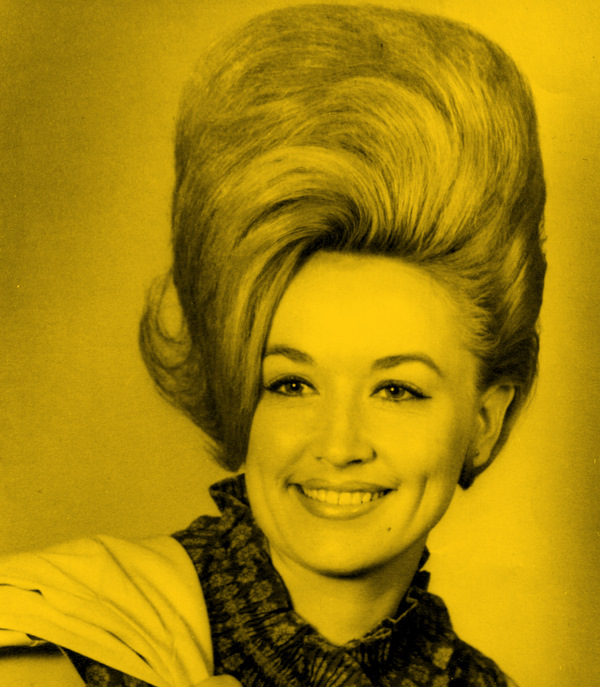
I think it’s safe to assume that many of you are already scraping your jaws off of the floor, having read the name of today’s artist, Dolly Parton. Allow me to ‘splain… [cliché] The 60s were a turbulent time [/cliché].
The above statement is true on many levels, and aside from the politics and social upheaval, musically things were going nuts. Take a look at a random Top 40 chart from any week between 1964 and 1968 and you are in for some real surprises.
The pop music scene of the mid 60s was incredibly diverse (maybe more diverse than at any other time) and within that diversity, where Frank Sinatra and Ed Ames bumped up against the Turtles and the Buffalo Springfield, there formed a vast, diffuse crucible of sorts where all of those crazy threads were – on occasion – woven together in very unusual ways.
Part of this weaving was deliberate, wherein some enterprising soul, perhaps used to doing things one way, decided to take a shot at another part of the market.
It was just such a shot that made today’s selection.
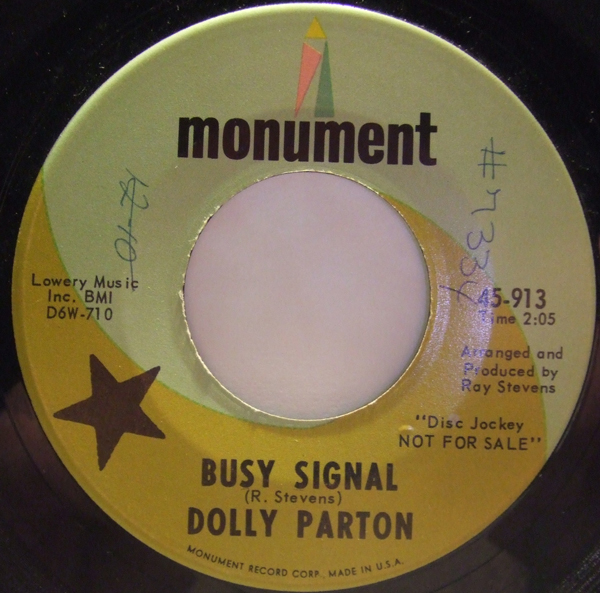
I can’t recall exactly where I first heard Dolly Parton’s ‘Busy Signal’, but I do remember being knocked flat on my ass when I did.
I doubt there are many among you who don’t already know who Miss Parton is, but I also doubt there are more than a few of you who had any idea that her discography harbored anything this interesting (outside of a country music context, natch…).
The world of ‘blue-eyed soul’ (which is kind of a bullshit term, since if a record is soulful there really ought not be a need to make note of the race of the performer, and yes I know I’ve used it here but when I get some extra time I’ll cook up something more appropriate, and yes your suggestions are welcome…) is generally the province of performers who were mainly, or at least peripherally performers of music in a soul, funk or R&B style. When you listen to folks like Billy Harner, Mitch Ryder, Steve Colt etc, what you hear is an artist devoted to recreating the sound of black music.
When you take a look at the long and distinguished discography of Dolly Parton, you generally see something else, that being a country singer.
I have no idea how she came to record ‘Busy Signal’, but the other name on the label, composer and producer Ray Stevens give us a clue or two.
Stevens, who had his first pop hit in 1962 with ’Ahab the Arab’ (his forte was novelty records) and his last in 1975 with ’Misty’ was, in addition to his own recording career, a busy songwriter, producer and session musician on the Nashville scene of the 1960s. He recorded with Brenda Lee, Brook Benton, the Blue Things, BJ Thomas and countless others in his many capacities.
The records he worked on, as well as his own recordings indicate that he was able to tap into a wide variety of styles, from rock’n’roll, to country, to pop.
‘Busy Signal’ is a perfect example of the fact that he was also conversant in soul.
The record opens – not surprisingly – the sound of a busy signal, created with human voices. Dolly drops in with the initial statement of the lyric, followed by a wonderful shift marked with the sound of a snare drum and a chorus of backing singers. While her voice is readily recognizable, the style she uses here travels in that grey area where girl group sounds cross over into soul, which of course could lead into another discussion of country music as “soul” music of another kind, and all the various and sundry intersections of the two, usually racially segregated styles in the actually segregated south. There’s certainly a book or two that could be written about the way white and black artists were exchanging (actively and passively) musical ideas and the countless amazing records that came out of that bubbling stew pot.
‘Busy Signal’ was released late in 1965, and as far as I can tell met with little success (though the flip side is fairly traditional, mid-60s Nashville country). Whether Steven’s was deliberately attempting a soul record, or just happened to toss the right ingredients into the pot at random, the world may never know.
Naturally, as if often the case with unusual, soulful records bouncing around the periphery of soul itself, ‘Busy Signal’ enjoys a certain level of popularity with the Northern Soul crowd over in the UK. It’s a record that can get fairly expensive, and one I chased for a long time (and was outbid on more than once). I can’t help but sense an element of kismet in the fact that when I did finally get myself a copy I grabbed it for less than three flimsy US dollars (my hands shaking pretty much from the time I won it to the moment my trusty mail carrier brought it to the house). It only got here this week, but I felt I had to move it right to the front of the queue. I hope you dig it as much as I do. Peace
The middle of the week is here, so what better time for a couple of very tasty bits of Northern Soul (with a very interesting backstory)?
As someone who experienced the 80s firsthand, I have to admit that I don’t find nostalgia aimed in that direction all that entertaining, especially since so many of the nostalgic aren’t old enough to have weathered it the first time.
You see, alongside MTV, crazy haircuts and quirky new wave music, there was of course the reality of the Reagan era, during which the American right kicked open the door and let in the wide variety of religious and political pests that 30 years down the line have completely infested this country.
So, you’ll understand if I’m not in my garage slapping together a time machine so that I can take the ride all over again.
This is not to say that the music was all bad, since a lot of it was very good. The best of new wave was in essence high quality reworking of the 60s pop palette.
One of the biggest new wave hits, that has become a major musical symbol of the era, is Soft Cell’s 1981 hit ‘Tainted Love’.
I’ll even cop to digging it the first time around, years before I had any idea that it was a synthesized reworking of a Northern Soul anthem.
In fact, a few years on, during the whole mod/garage explosion of the mid-80s, when I was initially clued in to the fact that the song had originally been recorded by a singer named Gloria Jones, I was still a decade away from even the tiniest inkling about the existence of the Northern Soul movement.
As a result, I didn’t consider Soft Cell’s covering of ‘Tainted Love’ to have any more subtext that Phil Collins’ execrable mangling of the Supremes’ ‘You Can’t Hurry Love’.
Flash forward twenty-five odd years and yours truly is neck deep in the sounds of the Northern movement, with all manner of storming Wigan faves spilling out of my record boxes. I’m rambling around YouTube looking for videos of Northern Soul dancers (and of you haven’t seen them, you simply must on account of it’s a wild bag that they were/are in) and I happen upon a short documentary that featured lots of the acrobatic terpsichorian delights.
About six minutes into the video a song came on the soundtrack that knocked me on my ass with its propulsive tempo and pop hooks. A little bit of the Googling, and I discover that the record in question was called ‘What’ by a singer named Judy Street.
A little more exploration on the interwebs and I found myself a copy of same, since I wanted to give it a good home and hear it blasting over some of those big club speakers we all love so much.
Once I had my hands on the 45 (a 1977 era reissue, but more on that in a minute) I started digging into my reference books, and back on the web and I discovered something very interesting about ‘What’, that were I a bigger Soft Cell fan, or a resident of the UK, I might have already been aware of, that being that the group had their second UK hit with this very song, which, not at all coincidentally was also a huge Northern Soul anthem.
‘Hmmmmm…’ says I, realizing that I was going to have to dig a little bit further.
Two hits in a row by one of the great synth-pop acts of the 80s, both yanked from the Northern Soul canon was indeed a curious thing.
As it turns out, aside from the odd juxtaposition of styles, it wasn’t that curious at all.
But first, a little musical history. Gloria Jones was still a teenager when she was discovered by songwriter/producer Ed Cobb (who also penned ‘Every Little Bit Hurts’ for Brenda Holloway) in 1964. The following year she recorded Cobb’s ‘Tainted Love’ for the Champion label.
Jones’ version of the song was – when I finally heard it – a real shocker, every bit as propulsive and soulful as the Soft Cell cover was wan, dissipated and blasé. It was immediately obvious how it had become a very popular spin on the dance floors in the North of England.
Jones went on to record a stack of 45s for Uptown and Minit in the 60s, eventually going on a European tour with the cast of ‘Hair’, where she met none other that former ace face converted into post-psychedelic mushroom gobbler Marc Bolan of T-Rex. She and Bolan fell in love and had a son, performing together until his untimely death in 1977, after which Jones returned to the US and recorded both as a solo and as a backing vocalist.
Jones was herself a songwriter, composing a number of songs for Motown artists, co-writing ‘If I Were Your Woman’ for Gladys Knight and the Pips.
There isn’t much information out there about Judy Street. Her original version of ‘What’ was recorded for HB Barnum’s LA-based Strider label in 1966 (I’ve never seen a picture of the original label), and promptly dropped off the face of the earth. Interestingly enough there was another (inferior) recording of ‘What’ by Melinda Marx (daughter of Groucho, seriously) on VeeJay. Come 1977, and Judy Street’s recording is a popular Northern Soul spin, so much so that John Anderson reissued it on his Grapevine label, where it went on to become the label’s biggest selling 45.
It was during this time period that a young lad named Marc Almond was (according to famed DJ Russ Winstanely) a habitue of the storied Wigan Casino, where he first heard, requested and danced to the records you see before you this fine day.
A few years later, he had the good creative sense to cut a small but significant segment of one scene and paste it on top of another, creating two pop hits (one huge, one not so much). Chances are while any number of soulies were poleaxed when they heard Soft Cell’s ‘Tainted Love’ and ‘What’ on their radios (or saw them on Top of the Pops), the vast majority of the pop audience had little or no inkling of where these songs had come from, or that so many of their countrymen and women had been dancing to the original versions of these songs for years.
I don’t know about you, but I find this kind of cross-pollination to be very interesting, and the kind of thing that the post-modern, post-internet, post-everything else culture has all but erased. Would such a scenario be possible today, where McLuhan’s Global Village has rendered international communication and sharing of obscure facts but a mouse-click away? I doubt it.
Either way, I hope you dig the tunes and I’ll see you all on Friday.
Greetings all, and welcome to the 2010 Funky16Corners Pledge Drive, beer blast and chili cook-off (well…just the first one, really, but I wouldn’t mind some cold beer and hot chili alongside the funk and soul 45s).
This is the fifth year I’ve come to you with my hand outstretched, asking that those of you that are so inclined, and of course can afford to, donate some small sum to contribute to the upkeep of the Funky16Corners empire (as it is).
To go into the WABAC machine for a moment, this all started four years ago, when Funky16Corners was the only blog I did, and was operated at very little cost, employing the same cheapo file storage and bandwidth that I used for the Funky16Corners web zine.
Then, out of the blue the good people at BoingBoing, a VERY heavily traveled site, linked to one of my posts, and in a single day Funky16Corners got enough traffic to erase a months worth of bandwidth, just about shutting things down.
It was at that point that I checked in with some of my more, how do they say ‘web savvy’ friends, who informed me that I should probably take the opportunity to move the whole shebang to a paid server space where storage and bandwidth spikes would not present such an issue.
So, I signed up and moved on to bigger and better things.
As a result, I started the yearly Pledge Drive in an attempt to offset the cost of the server.
In the years that followed, the Funky16Corners Radio Podcast (and the ensuing archive, the most heavily attended section of the site) got started, the blog moved from Blogger to WordPress, and then this year, following some menacing behavior by the otherwise wonderful folks at the free WordPress service, I crated up the whole mess and made the move to run the WordPress software (a related but separate entity from the blog host) our of my own server space. While doing that, I redesigned the blog, opened the Guest Mix Archive and watched my stats drop and subsequently rebound as the rest of the world adjusted their links accordingly. Of course, the fact that I only just discovered that I neglected to set up the post archives properly, means that they’ve been offline from when the blog moved in January until yesterday. That didn’t help.
As in previous Pledge Drives, I wanted to do something special to mark the occasion. This year’s shindig evolved out of a recent change, in the blog, and the real world as well.
The last year has seen two important acquisitions in the Funky16Corners equipment arsenal. First and foremost, last Christmas my wife got me a portable digital recorder. Second – thanks to an unexpected windfall from a rare trip to the slot machines – I finally picked up a second turntable and a mixer, completing my home DJ set-up.
What this new equipment allowed me to do was (among other things) to record, and present to you, ‘live’ DJ mixes. The first of these appeared at Funky16Corners via sets recorded live at Master Groove in New York City. Later on, after the Funky16Corners Record Vault and Podcast Lab was up and running, I started to record mixes from my own turntables.
It was after I posted one of these, with the caveat that mixes recorded live would not have accompanying zip files of individually recorded tracks (for obvious, labor intensive reasons), that a reader (thanks Michael!) suggested that these mixes have their own section of the blog, and their own numbering sequence.
I had been thinking of something similar, and decided to take this idea a step further.
Though I have done a fair number of guest mixes for other blogs/sites, I have never (aside from a collaboration with my man DJ Prestige) ever hosted guest mixes by other DJs here at Funky16Corners.
Taking a page from the ‘two birds with one stone’ book, I decided that this year’s Pledge Drive would be a great time for the opening of what I’m calling the Funky16Corners Soul Club.
The Soul Club will be a repository for live mixes (whether recorded in the club, or on the decks at home), both by yours truly, and by DJs whoes work and sensibility I respect.
The Funky16Corners Soul Club will be opening with a virtual ‘Allnighter’, that being a collection of eight separate mixes (two by me to open and close the festivities, six by others). Once you pull down the ones and zeros you’ll be able to simulate, in the home setting, free of sweat (other people’s anyway), spilled beer (same there) and the like, a full evening (and then some) of high quality, professionally mixed funk and soul music.
When I decided to put this together, I put out some feelers to some of my favorite DJs, including the core of the Asbury Park 45 Sessions Crew, Brian Poust aka Agent45, and DJ Tarik Thornton and asked them to contribute mixes for the grand opening of Soul Club.
If you’ve been a reader of this blog for any length of time, you’ve definitely heard about DJs Prestige, Prime Mundo, Bluewater and M-Fasis. I’ve been spinning with the Asbury Park 45 sessions crew for almost three years now, and during that time have developed a huge amount of respect for my fellow resident selectors.
Though I’ve DJ’d with a lot of people, my time with the AP45 crew has been a serious learning experience. These DJs have not only skills, and deep crates, but above all it’s their extraordinary taste that makes them great. I’ve written about it in this space before, but I have to reiterate how often an AP45 Sessions turns into a learning experience with one (or often more) DJ running up to the decks to see what another selector is spinning. There are many hot 45s in my DJ box that can be traced directly back to the AP45 Sessions, whether from one of the residents, or from one of the many distinguished guests that have graced us with their presence over the years.
DJ Prime Mundo may very well have the deepest crates of any working chef (including well known digger Julia Child). He applies the same levels of care and imagination to his DJ sets as he does to his food. Prime Mundo is – like every DJ represented here – a tireless digger with exceptional taste.
DJ Bluewater, in addition to being a longtime resident selector on the AP45 crew is the founder of Master Groove in NYC and a well regarded drum’n’bass DJ. He is a self described ‘funk 45 nerd’ and a connoisseur of heavy, heavy breakbeats.
M-Fasis, DJ and producer is the master of digging up and uncovering the heaviest records you’ve never heard of (or never expected). A resident at both the Asbury Park 45 Sessions and Master Groove, he also makes beats and produces.
Brian Poust, aka Agent45 is, in addition to running the most excellent Georgia Soul web site and blog, is one of the most respected soul DJs working today. Based out of Georgia, but traveling far and wide to spin funk, soul and gospel, Brian always brings the heat.
DJ Tarik Thornton is a native of New Orleans who has DJ’d (in clubs and on the radio) all over the country. He has a generosity of spirit, and like all the other DJs here, excellent taste in music. He started in college radio at WTUL in New Orleans, before relocating to New York City, and eventually Milwaukee, WI where he met up and started working with the crew at Burn Hearts. He has since spun with DJ Finewine (WFMU), Justin Salinas and the Hot Pants crew as well as the Hipshaker DJs in Minneapolis.
I don’t expect many of you to listen to these mixes end to end (though considering the amount of heat therein, you could do much worse with the next seven plus hours of your life) but the interwebs and MP3s being what they are, you can pull them down, file them however you like and soak up the good stuff at your leisure.
Once again, if you dig what I do here at Funky16Corners (and over at Iron Leg as well), and the current economy hasn’t left you destitute, please take the time to click on the Paypal link and toss a couple of shekels into the hat to help keep things going. It would be greatly appreciated, and since I’m going to keep working on this blog as long as time (and money) allow, it’ll keep the long list (close to 100) of mixes up and growing.
Over the last ten years, with the web zine, the blogs and getting to spin records in a variety of settings, the whole Funky16Corners ‘thing’ has become a big part of my life. The reason for this (aside from obvious matters of time spent) has a lot to do with the interaction these efforts bring me with many cool people, including the collectors and DJs, but also with the folks who just plain love the music and take the time to come out to the gigs or stop by the blog to add to the conversation, or just to say ‘Hi!’.
I’ve made many new friends, been turned on to lots of new music and most importantly found a productive outlet for my passion.
So, dig in, enjoy the music (click on the pledge links) and I’ll see you all next week.
Welcome once again to the beginning of what should be another stellar week at the Funky16Corners blog.
The weekend was a busy one, with operations commencing on the restructuring of the Funky16Corners Record Vault. Many records were moved, much junk was taken out to the trash cans and I went back to the drawing board to try and figure out how to consolidate the computer equipment (some of which is going to be retired) and construct a surface on which to install my DJ setup.
Since the closest I’ve ever come to being a carpenter is owning a Carpenter’s record, this may prove more daunting than it sounds. I suspect that whatever I manage to put together will be both sturdy, and incredibly unattractive, but since it will be covered from end to end by turntables, a mixer and a couple of big speakers, I’m allowing myself a certain amount of aesthetic leeway.
I’ll probably get it figured out this week (the first in a long time that isn’t packed with appointments and such), so I’ll keep you posted on my progress.
The tune I bring you today is another one of those that has proven especially resistant when it comes to digging up facts.
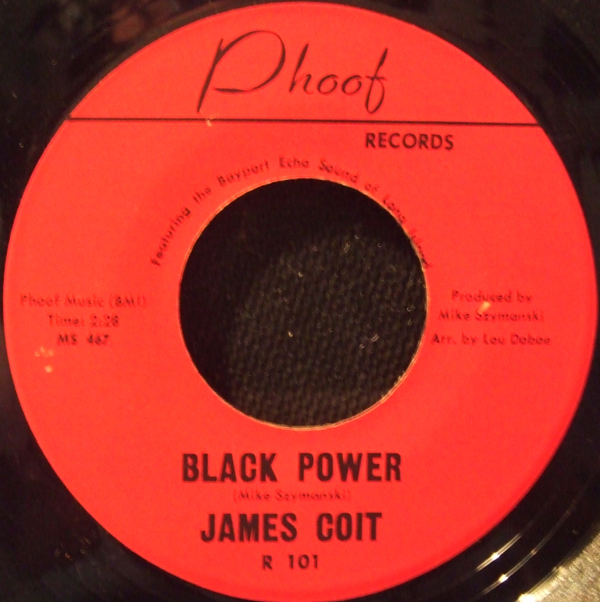
‘Black Power’ by James Coit was something I picked up from a friend last year after hearing a short but extremely intriguing sound clip. When I finally got to give both sides of the record a thorough listening to, I was more than pleased with my purchase.
Aside from the music, the first thing I noticed was that it appeared that the record (or at least the label, Phoof) was from Long Island, NY, affixed with the snappy slogan: “Featuring the Bayport Echo Sound of Long Island”.
Both sides of the record are excellent in their own way. ‘Black Power’ opens with catchy, fast moving guitar riff, followed by some heavy drums and sharp horns. Mr Coit drops in with a rough and ready, Eddie Floyd-esque vocal. The lyrics are – if not exactly as militant as the title might suggest – certainly topical and powerful, and might be even more so if the composition thereof weren’t credited to someone named ‘Mike Szymanski’.
The flip side, ‘Phillandrine’ is a mid-tempo, melodic number with a very catchy chorus and an incongruous, psychedelic interlude.
One of the very few things I was able to find out about ‘Black Power’ is that it enjoyed a period of popularity on the Northern Soul scene (Wigan Casino specifically) in the late 70s. It is a storming dancer, but not at all what one would consider a stereotypical ‘Northern’ side.
Other than that (and the fact that it appears to have been bootlegged/reissued a few times for the UK market) my searching has yielded nothing. If you know anything else about Messrs Coit or Szymanski, Phoof records or the Bayport Echo Sound of Long Island, please drop me a line.
I’ll be back on Wednesday with some more soul.
Harold Melvin and the Blue Notes – Get Out (and Let Me Cry) (Landa)
Pat Lewis – Look At What I Almost Missed (Solid Hit)
Maurice and the Radiants – Baby You’ve Got It (Chess)
Broadways – You Just Don’t Know (MGM)
Four Larks – Groovin’ at the Go Go (Tower)
Bob Brady and the Con Chords – Everybody’s Goin’ To the Love In (Chariot)
Volcanos – (It’s Against) The Laws of Love (Arctic)
Barbara Banks – River of Tears (Veep)
Bonnie and Lee – The Way I Feel About You (Fairmount)
Irma Thomas – What Are You Trying To Do (Imperial)
Olympics – Mine Exclusively (Mirwood)
Mary Wells – Can’t You See (You’re Losing Me)
Vontastics – Never Let Your Love Grow Cold (St Lawrence)
JJ Barnes – Chains of Love (Groovesville)
Marvelettes – I’ll Keep On Holding On (Tamla)
Sam and Bill – I’ll Try (Decca)
Fascinations – Girls Are Out To Get You (Mayfield)
Young-Holt Unlimited – California Montage (Brunswick)
Eddie Holman – Eddie’s My Name (Parkway)
Ethics – Look at Me Now (Vent)
Intruders – (You Better) Check Yourself (Gamble)
Just Brothers – Sliced Tomatoes (Music Merchant)
Lorraine Ellison – Call Me Anytime You Need Some Lovin’ (Mercury)
Marvin Gaye – Baby Don’t You Do It (Tamla)
Len Barry – I Struck It Rich (Decca)
Welcome to something unusual, that being the second consecutive week in a row starting with a new Funky16Corners Radio mix. While I normally wouldn’t stack them so close together, the circumstances are unusual.
Last week – as you already know – I returned to DJ Bluewater’s Master Groove night with a promised all-Northern Soul set. One of the great things for me about spinning at Master Groove is that I have a certain amount of flexibility in what I can spin, the only real constraints being those of the genres funk and soul (and there’s even a bit of wiggle room therein), and the format of the seven-inch, 45RPM single. Outside of those rather expansive guidelines, pretty much anything (assuming that the attendees dig it) goes.
The last time I brought my record box to Forbidden City, the sounds therein were entirely organ driven. It was on that night that I was rapping about the scene with my man Bluewater, when I said that I’d been thinking about working on a Northern (style) set, to which my esteemed host said ‘Why not?’.
Early last week I strode into the Funky16Corners record vault – which is in a seemingly constant state of chaos – and set upon the crates in search of my favorite Northern Soul 45s.
I should take a second here to mention that the definition of ‘Northern Soul’ that I’m using here is strictly a stylistic one, i.e. not every record I played is necessarily an accepted part of the Northern canon (though some are long standing faves on the scene), but rather hew fairly close to the ‘sound’ in question.
I pulled every single 45 box off of the shelves in search of the best and brightest (necessary since at least five of these records were in the very last box) and pulled out enough 45s for at least three hours worth of play. I spent the next few days at the turntable, working out which records I wanted to play, revising the set more than a few times until I was happy with the chosen sides. I’m happy to say that with one exception (the very last record on the playlist) I stayed with all the 45s I had originally selected.
As I’ve stated here many times before, while I’m no expert on the subject of Northern Soul, I am a huge fan of the sound, and the playlist above represents several of my very favorite soul records. And when I say ‘favorite’ I’m not referring to some passing affection. I’m talking about the kinds of 45s that set my hair on end and shivers up and down my spine. Heavy, heavy stuff. There are 45s here that combine propulsive, soulful power with pop hooks and brilliant performances in ways that very few records can approach. Getting to play them for people over a nice sound system is (as it is with any great record) an absolute blast.
My plan was – as I had done on my previous visit – to bring my digital recorder, hook it into the board and record the set as I laid the records on the turntables. Murphy’s Law being what it is, I drove all the way into the city without the necessary cable with which to make the connection. This was a huge drag, but I decided there and then that although I would be unable to present the “live” mix as promised, (since I was so happy with the results) I would record the set at home and bring it to you anyway, thus the new mix.
The mix features a lot of Philly sides, selections from Chicago, Detroit (natch) and even a couple of New Jersey sides, one hailing from my home turf on the Jersey Shore.
Things get started with a classic by Harold Melvin and the Bluenotes. ‘Get Out (and Let Me Cry)’ is probably unfamiliar to folks who’s concept of the group starts with the Teddy Pendergrass era, but by the time ‘Get Out…’ was released in 1965 the group had been together for almost a decade. It has a deceptively mellow opening, but once things get going it evolves into a hard charging dance number.
The original recording of ‘Look at What I Almost Missed’ by Miss Pat Lewis was the first tune to appear on the latest incarnation of the Funky16Corners blog. Though it’s better known via the version by its author George Clinton with his group the Parliaments, the Solid Hit version by Lewis is sweet. Maurice (McCallister) and the Radiants are one of the greatest Chicago groups of the 60s. They recorded a number of classics, including ‘Voice Your Choice’. The selection included in this set, the epic ‘Baby You’ve Got It’ first made its way into my ears via the cover by the Action.
The Jersey Shore record I mentioned above is ‘You Just Don’t Know’ by the mighty Broadways. Hailing from Asbury Park and Long Branch, and featuring members that would go on to join the Moments, the Broadways recorded two outstanding 45s for MGM. ‘You Just Don’t Know’ is a soaring, hook-filled masterpiece.
Of the many Philadelphia records revered by the Northern Soulies, my favorite (out of the remarkable Harthon stable) is the Four Larks ‘Groovin’ at the Go Go’. Having found almost every other45 by the group, I chased this record for years, ultimately convinced that I would never find – or be able to afford – a copy of my own. Until, that is, a reader of the blog, in one of the greatest recorded acts of vinyl-related altruism, found a mint copy at a New York City stoop sale and sent it to me. To say that I was pole-axed when I opened the package and saw that it contained one of my all-time white whales is an understatement. One of the many records in this mix that might be described as ‘anthemic’, ‘Groovin’ at the Go Go’ – penned by Thom Bell – has it all, and is justifiably considered a classic.
Possessor of the greatest faux-Smokey Robinson voice in soul history, Baltimore’s Bob Brady (and the Con Chords) recorded a number of excellent sides for the Chariot label, but none of them is as flat-out amazing as ‘Everybody’s Goin’ to the Love In’, with its pounding piano line, blaring horns and era-specific lyrics. I dare you to stay in your seat when this one starts playing.
Heading back to Philly – and one of my all-time fave soul groups – we hear the Volcanos and ‘(It’s Against) the Laws of Love’. When I packed my record box for the night it contained no less that four Volcanos 45s, from both their Arctic and Harthon periods. Though ‘Storm Warning’ is still my fave, I decided to go a little deeper and drop ‘(It’s Against) The Laws of Love’ instead. Written by Carl Fisher (who also wrote ‘Storm Warning’), the tune features Vince Montana’s vibes and a typically excellent Gene Faith vocal.
I’ve gone on at length in this space before about my love for Barbara Banks’ ‘River of Tears’ (as well as the Royalettes’ cover of same). It’s simply a brilliant record.
Though Bonnie and Lee’s storming ‘The Way I Feel About You’ was released on Philadelphia’s Fairmount label, I’ve never been able to nail down any info on the duo. It opens with a jangling guitar line, and then the rest of the band falls in like a ton of bricks. It was – as far as I can tell – the last 45 to be released on the label, which would place it somewhere in 1965/66. Irma Thomas has long been known as the Soul Queen of New Orleans for good reason. Her discography is packed with winners, from soaring ballads like ‘I Wish Someone Would Care’, to uptempo dancefloor killers like her cover of Jackie DeShannon’s ‘Breakaway’, and the song included in this mix, the amazing ‘What Are You Trying To Do’. Unusual in her Imperial discography in that it was written and produced by the master Allen Toussaint ‘What Are You Trying To Do’ sounds a lot more Detroit than New Orleans.
Oddly enough, the first time I heard the Olympics’ ‘Mine Exclusively’ was in an unjustly forgotten, period/teen film called ‘The In Crowd’. A barely disguised retelling of the story of Jerry Blavat’s Philly dance party TV show, the movie features a great soundtrack and some wonderful production numbers. ‘Mine Exclusively’ is one of the finest late-period numbers in the Olympics discography.
I have to admit that I only heard Mary Wells powerful ‘Can’t You See (You’re Losing Me)’ a few months ago, via a tip by Atlanta’s finest, Agent 45. This was another one of those ‘where has this record been all my life’ numbers which knocked my flat on my ass the first time I heard it. I wasted no time in tracking down a copy.
When I mentioned that some of these records sent chills up my spine, I was referring specifically to the Vontastics’ “Never Let Your Love Grow Cold’. One of my fave Chitown 45s, it has a fantastic arrangement which builds excitement from the first guitar riff all the way to the run off groove. If you find any of their 45s in the field, do not sleep! JJ Barnes made some of the greatest Detroit soul 45s, and is justly revered as a kind of patron saint of the Northern scene. ‘Chains Of Love’ is one of his harder 45s, and features my favorite vocal by Barnes.
I mentioned being turned on to the Radiants ‘Baby You’ve Got It’ by UK mod gods the Action, and such is also the case with the Marvelettes ‘I’ll Keep On Holding On’. Though this mix features a lot of favorites, this is probably – for me – the very top of the heap. It’s not only a great dancer, but the chorus builds into one of the great soul anthems of all time. I remember sweating this record heavily for years until I scored a copy (at a premium) many, many years ago. Oddly enough I found a second, mint copy about a month ago for a pittance. I plan on keeping it in cold storage in case anything untoward happens to my original.
We return to New Jersey with the great ‘I’ll Try’ by Sam and Bill. This is another one of those 45s that I pulled out a huge, multi-thousand record haul some years back, and it sat, unlistened to for a good, long time until it finally blew me away. It’s records like this that remind me that I need to be more thorough when I’m reviewing my finds.
It wouldn’t be very cool if I put a set like this together and didn’t include anything from the pen of the brilliant Curtis Mayfield.The Fascinations 1967 ‘Girls Are Out To Get You’ (one of their six 45s for the Mayfield label, almost half of its entire discography) is a classic.
When I mentioned accepted numbers from the Northern Soul canon, I was referring to 45s like Young-Holt Unlimited’s ‘California Montage’. Actually a piece of film music (from the movie ‘Winning’), ‘California Montage’ is a classy instrumental, with a strong dancers beat and layer upon layer of strings and horns. Eddie Holman is best known for his late 60s ABC sides like ‘Hey There Lonely Girl’, but I’m here to tell you that unless you’ve heard his Cameo/Parkway 45s, you’re missing a big part of the picture. Holman worked as both a performer and songwriter attached to Philadelphia’s Harthon organization for a few years before he hit it big, and made some really brilliant 45s. ‘Eddie’s My Name’ – featuring Holman’s soaring tenor – is my personal fave, and it makes me happy that after a long search, I dug up my own copy inside the Philadelphia city limits.
Another great Philly side is the Ethics’ ‘Look at Me Now’, which should have been a huge hit (they did have a couple of R&B chart placements, but this wasn’t one of them), instead of the local sensation that it was.
The most successful of the classic Philly soul groups, the Intruders had no less that twenty-four (?!?) R&B chart hits between 1966 and 1975, including 1968’s Number One hit ‘Cowboys to Girls’. The storming ‘(You Better) Check Yourself’, from 1966 is proof that they were capable of more than the sweet soul they were best known for.
Another Northern classic (a fave at the UK – Stoke On Trent – venue the Golden Torch) ‘Sliced Tomatoes’ by Just Brothers is actually a later record, having been released in 1972. I always enjoy dropping this one since most people, if they’re unfamiliar with the OG, recognize it as the song Fatboy Slim sampled for ‘Rockafella Skank’.
If you follow the Funky16Corners blog, you already know that I verily worship at the altar of the mighty Lou Courtney. He penned (and produced) Lorraine Ellison’s stratospheric ‘Call Me Anytime You Need Some Loving’. Featuring a propulsive verse and a positively explosive chorus, ‘Call Me…’ is a great illustration of Ellison’s amazing range. Marvin Gaye’s oft covered ‘Baby Don’t You Do It’ is yet another great tune that I first heard via a performance by a UK 60s mod band, in this case the mighty Small Faces. Though their version is very cool, Gaye’s original snaps, crackles and pops on a whole ‘nother level. Listen to how those drums explode from the speakers as Marvin winds his smooth way in and out of that powerful Motown sound. Solid, solid stuff.
This edition of the Funky16Corners Radio Podcast comes to a conclusion with a killer song by Len Barry. I knew (and loved) ‘I Struck It Rich’ in the version by Billy Harner, but only found the original (written by Barry with Kenny Gamble and Leon Huff) late last year. While it lacks the power of Harner’s cover, it has a certain stylish, polished vibe that I dig a lot. I’ve always considered Barry to be an underrated singer, and ‘I Struck It Rich’ is proof as to why.
I hope you dig the mix, and hopefully the next time I hit the decks at Master Groove, I’ll have all my technical ducks in a row.
See you later in the week.
Peace
Larry
PS – One of the benefits of running the blog out of my own web space, is the opportunity for better statistical tracking. One of the benefits of that is seeing where all of you fine folks are visiting from, which has been a sobering experience. If you take a look at the list below the Funky16Corners blog is bringing folks in from all over the world. In addition to almost every one of the United States (especially one person in Atlanta who seems to be the biggest fan this blog has ever had), people are falling by from all corners of the world.
I drive my wife nuts every day as I check the visitor stats to see if I can find a flag I haven’t seen before.
I’d just like to say thanks to the folks in…
Peru
Chile
Italy
Sri Lanka
India
Tahiti (French Polynesia)
Reunion Island
Madagascar
Ukraine
Russia
Hungary
Sweden
Denmark
Germany
Jordan
Dubai
Argentina
Bulgaria
Netherlands
Belgium
Yemen
Israel
England
China
Thailand
Hong Kong
Austria
France
Greece
Spain
Japan
Portugal
Brazil
Switzerland
Czech Republic
Slovenia
Croatia
Australia
Finland
South Africa
Mexico
South Korea
Iran
Poland
Latvia
Estonia
Malaysia
Serbia
Puerto Rico
Canada
New Zealand
Malta
England
Ireland
Scotland
Wales
Just added 2/26 ! Venezuela, Cambodia and Bulgaria!!!
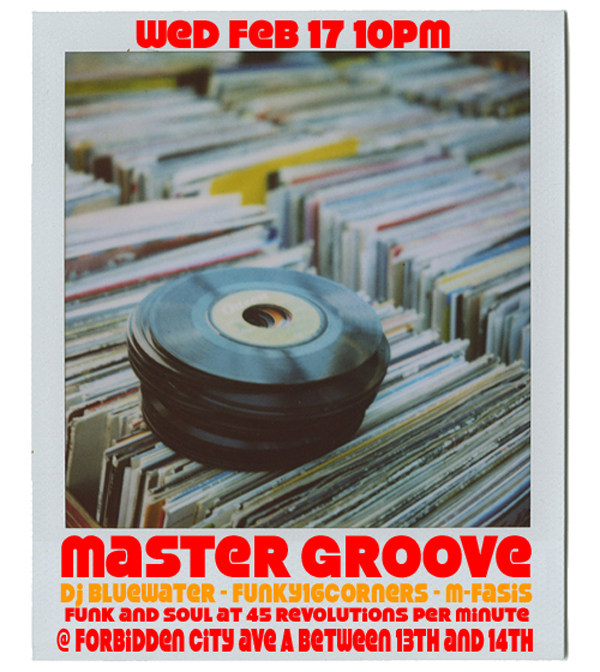
That’s right kids. I’m heading back into NYC tonight for another set with DJ Bluewater and M-Fasis at Master Groove @ Forbidden City, Ave A between 13th and 14th Streets.
I’ve dipped into the crates and will be spinning a set of classic, upbeat Northern Soul that you will not want to miss. Things get going at 10PM, so fall by Forbidden City and get you drink (and eat, the food is excellent) on while letting your tired ears be massaged by the best in funk and soul, all spun at 45 revolutions per minute.


 Comments (3)









 Themocracy