Category: R&B

Gene Ludwig 1937-2010

By , July 18, 2010 2:03 pm

Example

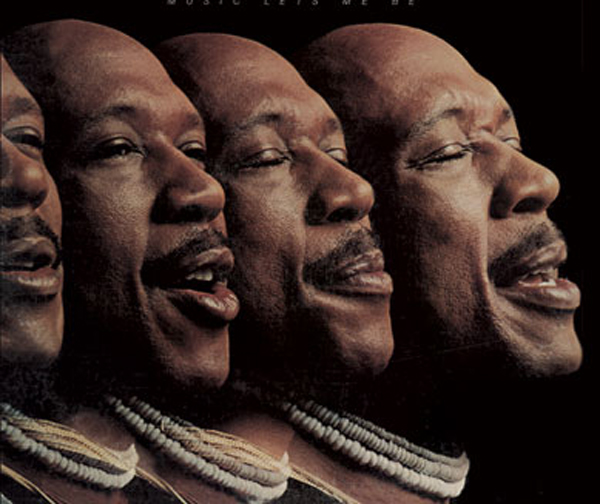
The painting of Gene from the cover of ‘Organ Out Loud’ by Jack Lonshein

Example

Gene Ludwig at the organ (Circa 1965)

Listen/Download – Gene Ludwig -Sticks and Stones

Listen/Download – Gene Ludwig – The Vamp

Listen/Download – Gene Ludwig – Blues For Mr Fink

Listen/Download – Gene Ludwig – House of the Rising Sun

Listen/Download – Gene Ludwig – Comin’ Home Baby

Listen/Download – Gene Ludwig – Moanin’


Greetings all.
As I mentioned in Friday’s post, I got the very sad news last week that Hammond master Gene Ludwig had passed away at the age of 72.
If you’re one of the rare few that’s been on the Funky16Corners tip since the web zine days, you know I ride for the Hammond organ in a big way, from the greasiest R&B, to pure soul, soul jazz and funk, I have never been able to get enough of the Hammond sound.
Gene Ludwig was one of the last of what I would call the accepted past masters of the jazz organ. He was a contemporary of Brother Jack McDuff, Jimmy McGriff, Dr Lonnie Smith, Seleno Clarke and pretty much everyone else that was part of the jazz organ explosion of the 50s and 60s.
What Gene was also a part of was the great – mostly unexplored – Pennsylvania organ tradition. One of the really interesting things I picked up out of years of collecting and researching Hammond records was how many great players hailed from the Keystone State (and not just Philly). The man that launched a thousand organ combos, the mighty Jimmy Smith as well as Jimmy McGriff, Charles Earland, Richie Varola, Greg Hatza, Papa John and Joey DeFrancesco, Shirley Scott and of course Gene Ludwig all got their start in the bars and nightclubs of Pennsylvania, in both the big cities and out in the hinterlands. Was it something in the water? An abundance of organs (or bars/lounges with organs in them)?
In his obit Gene was quoted as saying that he turned on to R&B (and organ players) by listening to Pittsburgh radio legend Porky Chedwick. Pittsburgh has a long history as a kind of isolated Shangri La for R&B and soul fans where any number of brilliant but obscure records are worshipped by the locals because they were circulated on the radio and at dances.
Whether this had anything to do with spawning organists, as opposed to just fans of the sound, I have no idea, but it is intriguing.
Gene Ludwig – a native of the wester PA town of Twin Rocks started out as a pianist, and had his ‘road to Damascus’ moment when he saw Jimmy Smith perform at a Pittsburgh club called the Hurricane in 1957.
Ludwig went on to have a 50 year career as one of the great proponents of the Hammond, recording locally as well as on national labels like Mainstream and Atlantic.
He was really what I would consider (at least for my taste) the consummate organist in that he approached the instrument from a jazz perspective (with serious chops to match) yet was not afraid to cut loose and burn on the keyboard, expanding into the realms of R&B and soul.
I’ve consumed a lot of virtual ink rambling on about this or that ultra-raw organ 45, but the best Hammond players, no matter how soulful or funky all came to the instrument from the jazz roots.
Gene Ludwig was old enough to hear the early rumblings of the Hammond sound from the jazz/jump/R&B nexus of cats like Wild Bill Davis, Bill Doggett and Milt Buckner, and mastered the instrument in the wake of the mid-50s scene when Jimmy Smith rewrote the book on jazz organ.
The ensuing expansion of the electronic organ, as both a performance platform and recorded instrument was wide ranging on both established jazz labels like Blue Note, Prestige, Riverside and Atlantic, but as my crates will attest, on countless tiny local labels eager for a piece of the action. It’s not at all hard to imagine walking into a bar in 1965, strolling up to the jukebox and seeing the organ stylings of a regional favorite among records from out of town.
Gene Ludwig was both a regional player (probably half of his discography is rooted locally) and an internationally known master of his instrument who headlined and worked as a sideman (replacing Don Patterson in Sony Stitt’s late 60s band).
Gene remained devoted to the Hammond, and a glimpse at his web site will reveal that he was playing, recording and above all staying relevant right up until his unexpected and tragic passing.
He was a musician of great taste with an ear for that perfect soul jazz vibe, yet was also conversant in standards (which any organist working the clubs in the 60s would have had to have been) and was by all accounts an unfailingly generous soul when it came to mentoring younger players.
Though I never got to meet Gene or his wife Pattye in person, I was lucky enough to correspond with them over the years (Gene had no bigger booster than Pattye), including an interview I did with the master back in 2005.

Example

The Gene Ludwig Trio in the 1960s (above) and reunited in 2004 (below)

Example

The tunes I bring you today represent a cross-section of the sound of Gene Ludwig through the 1960s. As far as I can tell all of these cuts feature his classic 60s-era trio which featured Randy Gelispie (or Gillespie, I’ve seen it spelled both ways) on drums and Jerry Byrd on guitar.
A few of these cuts have been featured here in the past, but they deserve to be heard again.
The first track is the Ludwig’s trio’s smoking version of the Henry Glover/Titus Turner classic ‘Sticks and Stones’, which appeared as a two-part 45 in 1963 (I’ve spliced the two parts together). The trio’s playing is spot on, relaxed yet generating a considerable amount of heat, and Gene is in rare form. I’ve heard there’s at least one other unissued side from that date, a version of ‘High Heel Sneakers’.
Next up is a track discussed here in the past, the brilliant ‘The Vamp’, which appeared as a 45 and on the LP ‘The Educated Sound of Gene Ludwig’ in 1965. If you haven’t heard ‘The Vamp’ strap yourself in because it’s a killer. Improvised in the studio by the trio, it featured Gene on the organ, Byrd on guitar and Gelispie on tambourine only. It has the feeling of an after-hours session gone wild, and is probably my favorite moment in Gene’s discography.
‘Blues For Mr. Fink’ and ‘House of the Rising Sun’ are both culled from an oddball 1960s compilation called ‘The Keyboards’ on the Time label, which features Gene Ludwig, and five other players performing in a wide variety of disparate styles. None of the album’s 20 tracks are attributed to anyone specific, but I knew of the Ludwig tracks from other sources (which is why I picked it up).
My suspicion has always been that all of the Gene Ludwig material on that record came from his time with the Mainstream label, since Bob Shad is credited with A&R on the jacket, and a few of the tracks also appear on the 1964 Mainstream LP ‘Organ Out Loud’.
The last two tracks appeared on what I would consider to be one of the great soul jazz organ sessions of the classic era, the aforementioned ‘Organ Out Loud’. Here Gene and the trio work it out on two classics of the genre (the LP also included wonderful versions of Cannonball Adderley’s ‘Sermonette’ and Horace Silver’s ‘The Preacher’), Bob Dorough and Ben Tucker’s ‘Comin’ Home Baby’ and Bobby Timmons’ ‘Moanin’.
‘Comin’ Home Baby’ is taken at a touch more relaxed pace than you usually hear, but the group keeps it moving and grooving, and Gene takes a wild solo.
‘Moanin’ on the other hand takes off like a rocket and never slows down. It’s the kind of performance that makes me want to step into the WABAC machine and hear the group in some smoky lounge. Gene’s fingers fly over the keys while the rhythm section provides a rock solid bottom.
If you ever get a chance to get your hands on any of his 60s albums or 45s (and there’s still a couple of things I have yet to track down) do yourself a favor and do it.
You still have the chance to hear his more recent recordings, which are uniformly excellent.
That all said, it’s so sad to have to talk about this great music in light of Gene’s passing.
He was a great musician, and by all accounts as solid a human being as has passed this way.
He will be missed.
My sincere condolences go out to his wife Pattye.
See you later in the week.

Peace

Larry


Example


Check out the Funky16Corners Store at Cafe Press

PS Head over to Iron Leg for some classic British Beat


Sack(s) O’Woe…

By , July 13, 2010 4:18 pm

Example

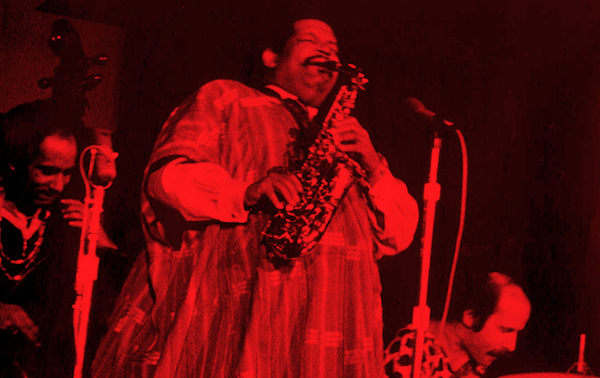
The Mighty Julian ‘Cannonball’ Adderley


Greetings all.
I hope that the middle of the week finds you all in a soul jazz kind of mood.
I’ve spent a fair amount of time over the course of the life of this blog discussing, compiling, exploring and above all digging soul jazz.
One of the elements of that discussion (though if I’m doing all the talking is it really a discussion?) is the issue of pure soul jazz, that being music that meets the definition of soul(ful) jazz, blending R&B, soul and or funk with a post-hard-bop base in a manner that creates something new that displays, yet transcends the listed ingredients.
There are a number of artists for whom soul jazz was a specialty, and of those, a few who created enduring ‘standards’ of the genre like Bobby Timmons, Freddie McCoy, Eddie Harris and the man who composed the tune I bring you (served four different ways) today, the mighty Julian ‘Cannonball’ Adderley.
Adderley composed and first recorded the tune ‘Sack O’Woe’ in 1960. Of the countless soul jazz songs that I have collected over the years, ‘Sack O’ Woe’ is probably my favorite. It is propulsive enough to be danceable (Adderley was great at stuff like that) , soulful, spare but not too spare, and a great launching point for soloists.
It’s one of those songs that when I find a new version I try to add it to my stack because in hands of almost any competent musician it releases something special, and every once in a while I like to post multiple versions of a great song so you can get a feeling for the breadth of sounds that covers of a classic can yield.
The four versions of the song I bring you today date from the 60s, 70s and 90s (?!?)

Example

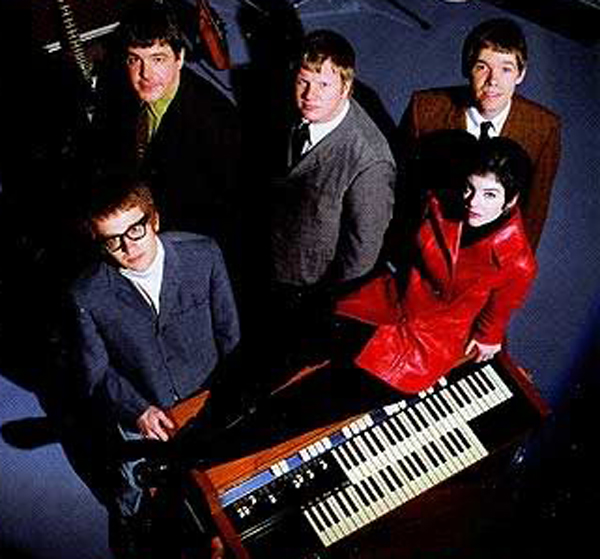
The Omega Men

Listen/Download – The Omega Men – Sack O’Woe (Live 1997)

My all-time favorite version is by a band of fairly modern vintage called the Omega Men. Featuring a number of veterans of the Pennsylvania end of the garage/mod revival (from the Cellar Dwellars and Stump Wizards) , the Omega Men, featuring the organ work of the sole non-male member of the band Susan Mackey, really set fire to Adderly’s classic. You can catch it on iTunes as part of a comp called ‘Rock Don’t Run Vol 3’, or you can track down their 1997 CD ‘The Spy Fi Sound of the Omega Men’. The version included here has been digimatized from a video of the band performing live in 1997. The fidelity is pretty good and the playing is first-rate. It isn’t much of a stretch to imagine the sound of the Omega Men as a close approximation of what you might have heard on-stage in the UK circa 1965, where the organ combos of masters like Georgie Fame, Brian Auger and Graham Bond were re-imagining the US soul jazz and R&B that gave them inspiration.

Example

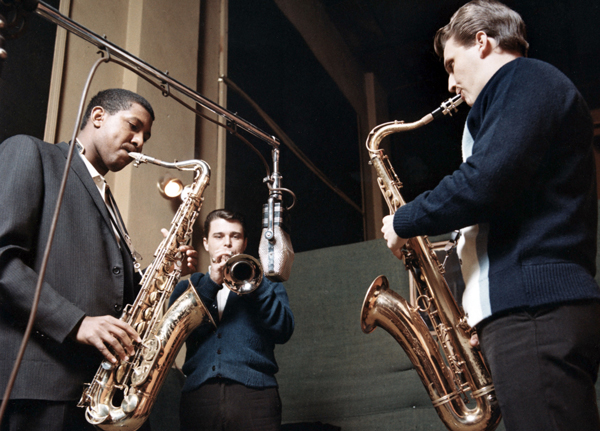
The Mar-Keys horn section (Packy Axton, right)

Example

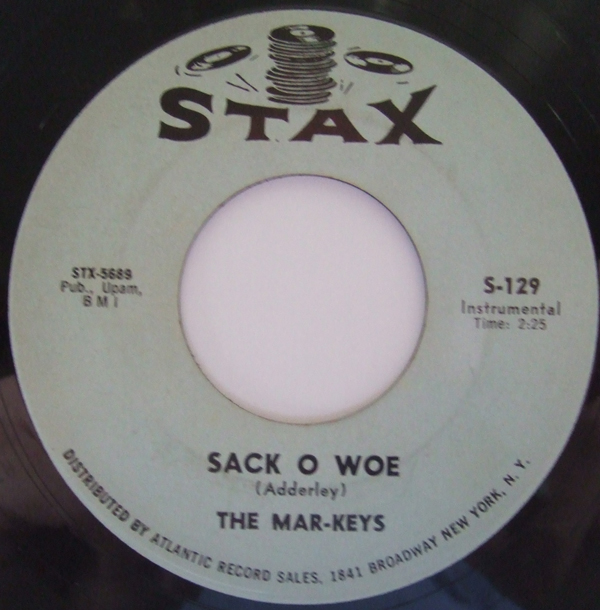
Listen/Download – The Mar-Keys – Sack O’Woe (1961)

As I said before, Adderley’s original dated from 1960. The Mar-Key’s smoking Memphis version is from a year later. It has that solid Stax sound and I really dig the organ solo. If my chronology is correct this also features a pre-MGs Steve Cropper and Duck Dunn on guitar and bass, as well as Packy Axton, later of the many mysterious incarnations of the Packers on sax. Note the horn intro that approximates the band’s only hit, ‘Last Night’.

Example

The legendary Les McCann

Example

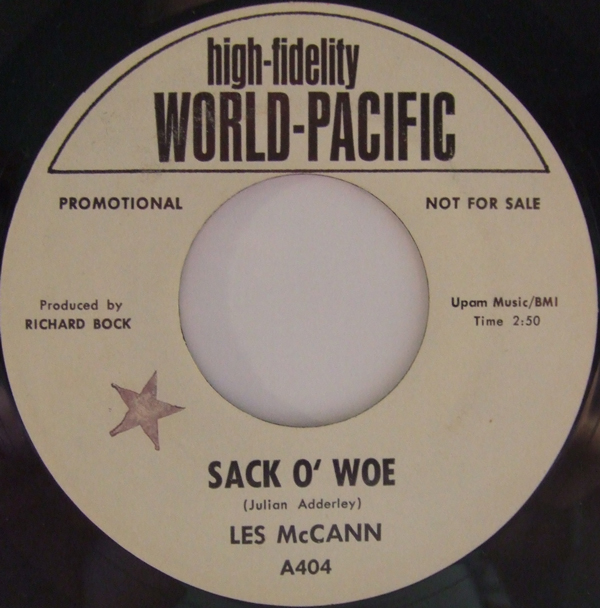
Listen/Download – Les McCann – Sack O’Woe (1963)

The version by the equally mighty Les McCann is from 1963, and features McCann on piano and a fantastic guitar solo by Joe Pass. It’s by far the jazziest version of the tune here. Les McCann is a true giant of the soul jazz genre, having had bona fide hits (like ‘Compared to What’ with Eddie Harris) and can be counted on to give this classic a righteous reading.

Example

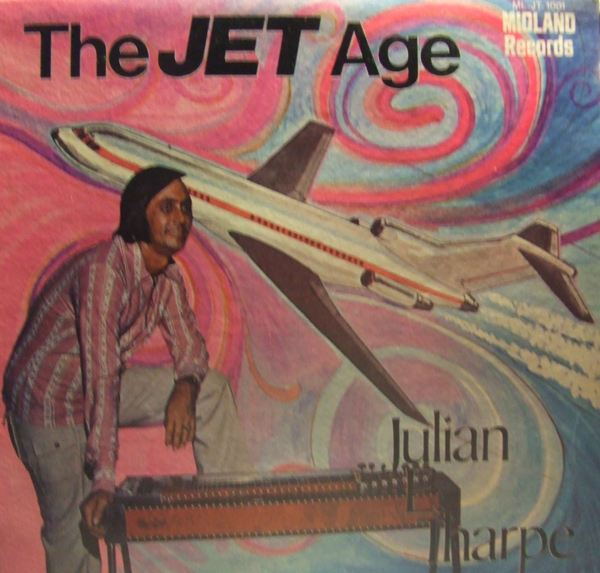
Julian Tharpe

Example

Listen/Download – Julian Tharpe – Sack O’Woe (197?)

The fourth and last version of ‘Sack O’ Woe’ is (as far as I can tell) and early-to-mid 70s recording by a Nashville cat named Julian Tharpe.
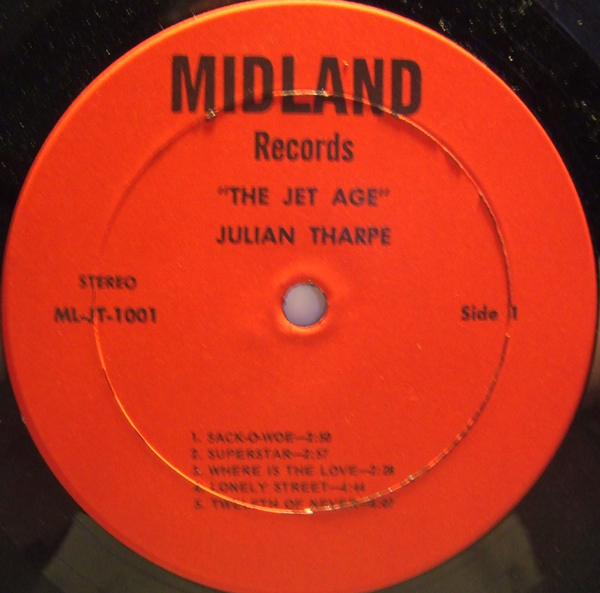
Tharpe was a Music City sessioner and touring player who often worked with guitar legend Jimmy Bryant and was inducted into the Steel Guitar Hall of Fame in 2008. His LP ‘Jet Age’ featured Tharpe playing a variety of styles, covering pop, rock, country and the soul jazz of ‘Sack O’ Woe’. I picked up this album specifically for the version of today’s selection, and it proved to be an interesting one.
I always dig hearing pedal steel guitar used outside of a strictly country context, especially on soul records like Peggy Scott and Jo Jo Benson’s ‘Soulshake’, which featured another Nashville steel legend, Pete Drake.
Tharpe’s version of ‘Sack O’Woe’ is very cool, and it’s worth it if only to hear the Adderley classic interpreted on such an unusual instrument.
I hope you dig all four versions, and if you’re not familiar with Cannonball Adderley’s work, start looking because he laid down decades of fantastic music in straight jazz and funky sessions.
See you on Friday.

Peace

Larry


Example


Check out the Funky16Corners Store at Cafe Press

PS Head over to Iron Leg for a remembrance of the late Tuli Kupferberg of the Fugs and some Canadian sunshine pop


Dr Feelgood & the Interns – Mr Moonlight

By , June 6, 2010 2:41 pm

Example

Dr Feelgood & the Interns – Piano Red/Dr Feelgood (left), Roy Lee Johnson (3rd from right)

Example

Listen/Download – Dr Feelgood & the Interns – Mr Moonlight


Greetings all.

Welcome back to the Funky16Corners blog.
I have to start by thanking those of you who contributed to the 2010 Pledge Drive.
While this wasn’t the best year, you’d have to be locked in a subterranean bunker somewhere to know that it REALLY hasn’t been a good year for a lot of people. That fact makes it all the more significant that some of you felt strongly enough about Funky16Corners to dig deep and send something our way.
I’ve never taken advertising on the blog (though it has been considered) for a couple of reasons.
First and foremost, I don’t like the way it looks, and second, I don’t like the way it would change the feel of Funky16Corners.
In some ways – especially thanks to the response I’ve gotten over the years at fund-raising time – Funky16Corners has always been a collaborative effort. Those of you that stop by to partake in the discussion – often furthering it with new information and other leads – and those of you (more often than not some of the same people) who chip in during the pledge drive, are what keep the blog (and the blogger) going.
Despite the fact that blogging can often devolve into solipsism, I prefer it when it breaks through to a level where it really is a shared effort, not just with the music itself, but with the feeling of the music and the history behind it.
While I’m sure there are a lot of people who just stop by to click the links and collect the MP3s, there are a lot of folks, readers, collectors, fellow DJs and musicians who take the time to join in the conversation and make the blog something greater than the sum of its parts.
I’d like to take the time to thank all of you, because without you it wouldn’t really be worth the effort.

So, THANK YOU, VERY MUCH!

Consider this yet another new beginning, recharged for another year in the blog-o-mos-phere.
If you look up at the header, you’ll notice a couple of changes.
First, as promised the Funky16Corners Soul Club is up and running, with all the mixes that were up last week (and if you haven’t checked them all out, take the time to do so because they’re all excellent).
Second, following a number of requests, I’ve mixed down and archived the last several editions of the Funky16Corners Radio Show that I do for Viva internet radio. The shows date back to the end of April when I started doing the live mixes and the show moved to its Friday 9PM (EST) time slot. There are no playlists (I back announce every song) but there are short descriptions about what you can expect in each episode.
If you haven’t yet checked out the radio show, take the time to pull down a couple of episodes and check it out. I think you’ll like it.
Also, make sure you stop by Fleamarket Funk over the next few weeks. The Asbury Park 45 Sessions crew managed to record all the sets from the 5/28 session, and DJ Prestige will be posting them up over the coming weeks.

_______________________________________________________________________________

The tune I bring you today is an old fave that I only got my hands on (in 45 form) last year.
Something you might have picked up on over the years is that I am a regular hound when it comes to the original versions of songs covered and made famous during the 60s by (mainly) white singers, mostly associated with the British Invasion. This is mainly due to the fact that I came to much of the soul music I love via these covers when I was but a lad.

Today’s selection, ‘Mr Moonlight’ by Dr Feelgood and the Interns was covered by the biggest of them all, namely the Beatles (on the US LP “Beatles 65′).
Though my youthful Beatle-mania introduced me to the Fabs version when I was about 13, it wasn’t until decades later that I heard the OG. When I did I was blown away, especially when I began to dig a little.
As it turns out, ‘Mr Moonlight’ was penned (and sung) by Mr. Roy Lee Johnson, the performer of one of my all time fave 45s, 1966s ‘Boogaloo #3’. That, and the fact that ‘Dr Feelgood’ was a pseudonym for blues legend Piano Red (aka William Lee Perryman) who was 51 when this record was recorded. Perryman, who was playing and recording with Blind Willie McTell in the mid-1930s, spent years as both a musician and under the Dr Feelgood name, as a DJ in the Atlanta area.
It is in fact Perryman singing on the 45s A-side ‘Dr Feelgood’ which was a minor R&B hit.
It was the B-side, ‘Mr Moonlight’ which would – a few years later – put more than a few dollars in the pockets of Roy Lee Johnson.
One of those records that presents a perfect bridge between the harmony records of the 1950s and the soul of the 60s, ‘Mr Moonlight’ has a melody worthy of a Tin Pan Alley standard, and Johnson’s vocal is nothing less than epic.
This is one of those songs that I can’t help wailing along with when I play it in the car (or anywhere else I think I won’t get caught).
I hope you dig it, and I’ll be back on Wednesday with something cool.

Peace

Larry


Example


Check out the Funky16Corners Store at Cafe Press

PS Head over to Iron Leg for some psyche pop


PSSS Don’t forget to hit up Funky16Corners on Facebook

You can also follow Funky16Corners on Twitter


Panorama Theme by Themocracy