

Chic – Dance Dance Dance (Savarese 45 Edit)
Chic
Listen/Download – Chic – Dance Dance Dance (Savarese 45 Edit)
Greetings all.
Here’s hoping you’re all warm, dry and happy.
As has been discussed here several times, I am in the midst of a decades long effort to wrap my ears around disco.
Like any music, but especially music that has at times been reviled by a large segment of the population, disco has been misunderstood, if not totally written off by many. This happened for lots of reasons including race, musical subculture, homophobia, and as is also often the case, poor musical quality.
This is by no means an indictment of disco, but rather an acknowledgment of the fact that when any kind of music becomes hugely popular, it is often the worst of it, i.e. the most homogeneous, with the widest possible appeal to the lowest common denominator, that makes the most lasting mark.
There are of course always exceptions to the rule. But 30 years on, it’s not subtleties that get remembered.
It’s also important to note that by the time disco emerged from the nightlife underground and burst onto the national consciousness, much of the finest music that had gotten people out onto the dance floors had been supplanted by horrible, poorly constructed knock-offs, and all of the ephemera of disco culture.
Ask people old enough to remember the denouement of the disco era and you’re likely to get a word stew, equal parts Studio 54, cocaine, pre-AIDS sexual abandon and plodding, awful music.
However – there’s always one of those, isn’t there??? – do some digging (and as today’s records illustrate, you don’t have to go very deep) and there are lots of great sounds to be heard.
The real story of disco, a sound that is desperately in need of a new, better name that it will never get because nothing accurate (like 70s, urban, R&B based club dance music) rolls off the tongue quite as easily as what we already have, is a huge, interconnected saga of musicians transitioning out of the 60s soul era, pioneering DJs, producers and engineers, and of course the dancers, who for a few years in the mid -70s built a huge wave that is still breaking today.
Sadly, it seems that despite some very astute journalism on the subject (see links in this post), the true story of disco will likely never break out beyond the people that experienced it’s glory days first hand, and of course, record nerds. And to be totally honest, as is often the case, even though I know more about it than some folks, I’m barely scratching the surface. There are people out there that have spent years collecting this music, delving into the wildly varied permutations available with some records.
Unlike the music it replaced on the R&B spectrum, disco is harder to nail down because it had fundamental, structural differences.
Though a lot of the soul music the preceded it was meant to be danceable, disco, once it started to be ‘purpose built’ in the era of the 12 inch single, i.e. after the day of Loft classics like Eddie Kendricks ‘Girl You Need a Change of Mind’, was an entirely new kind of dance music.
There were auteur-producers before the 70s, but once disco began to happen, musicians, producers and engineers began deconstructing and rebuilding many of these records to fit the long-form dance experience.
Sometimes, when the raw materials were worthy, and the remixers talented (and occasionally visionary) the results were transcendent.
Of the Loft-era records that have been discussed here, specifically Booker T and the MGs ‘Melting Pot’ and the aforementioned Eddie Kendricks tune, what you were getting was an ‘organically’ long record with its own set of rhythmic and dynamic shifts that just happened, thanks to groundbreaking DJs like David Mancuso, to capture, and propel dancers.
As the mid-70s approached, and dance club culture (and the need for product) expanded, remixers stepped in and created longer – and in the best cases, better – records from raw material.
They also created a lot of pulsating, sonically uninteresting stuff as well, but as today’s selection illustrates, when it was good, it was REALLY good.
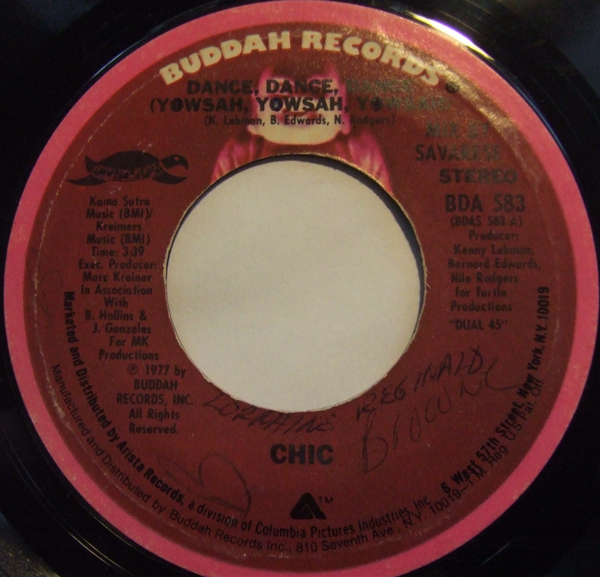
When I mentioned earlier that you didn’t have to dig very deep, Chic’s 1977 debut, ‘Dance Dance Dance (Yowsah, Yowsah, Yowsah)’ is the perfect example.
Released in 1977 (on Buddah, right before Chic signed to Atlantic*) was a Top 10 Pop and R&B hit.
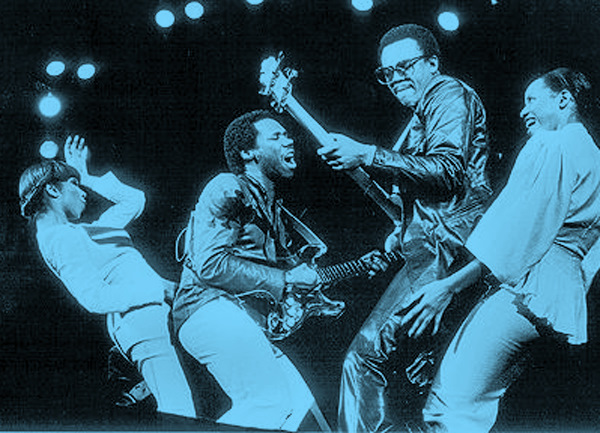
Chic is an especially interesting example, because in an era, and a style of music often thought of as the product of faceless session musicians, they were an actual band. Formed by guitarist Nile Rodgers and bassist Bernard Edwards in 1976 (the pair had been playing together since 1970), with drummer Tony Thompson and vocalist Norma Jean Wright, the music that they made in the 70s and 80s is proof that disco could be much more than just a thumping beat.
‘Dance Dance Dance’, which was mixed/edited by Tom Savarese a popular NY area DJ (one of the first disco DJs to receive a label credit for his mix), in both 45 (3:40) and 12 inch (8:21, you can get the long version on iTunes) versions.
The cool thing – at least to me – is that ‘Dance Dance Dance’ is not in any way (other than purely musical) a ‘deep’ record. The lyrics are spare (calling out popular dances, with the intermittent ‘Yowsah Yowsah Yowsah’**), but the music is nothing short of brilliant. It is the kind of record that forces you to move.
Compare it to a record like Bobby Freeman’s 1964 ‘C’Mon and Swim’, which although basically a laundry list of popular dance steps is still a brilliant dance record because of the combination of Freeman’s spirited delivery and a dynamic instrumental backing. It’s as basic as it gets, and in the wrong hands the formula can be leaden and idiotic, but in when done properly it can be anthemic and inspirational.
Opening with Edwards powerful, pulsing bass, Thompson’s sharp drumming and Rodgers slinky rhythm guitar, it also has (and this is the part I really dig) vocals that double as a device to carry both the melody and pure, rhythmic punch. The way the singers (including a young, unknown Luther Vandross) deliver the ‘BAH BAH BAH BAH BAH’s is as visceral as (occasionally more so than) the bass and drums and is truly a thing to behold.
I love the way the strings and the horns weave in and out of each other, as well as the latin percussion accents and hand claps.
Produced by Rogers and Edwards with Kenny Lehman (who gets a co-writing credit) is a record that bears up to close, repeated listening, as well as (naturally) dancing.
I hope you dig it, and I’ll be back on Friday.
Peace
Larry

*The 12 inch version was eventually released on both Buddah and Atlantic
**The chant originated in the 1920s with orchestra leader Ben Bernie and was resurrected in the 1969 film (about 1930s dance marathons) ‘They Shoot Horses, Don’t They’
If you want one of the new Funky16Corners stickers (free, of course) click here for info.
Check out the Funky16Corners Store at Cafe Press
PS Head over to Iron Leg for some classic 1965 LA garage folk.


 Themocracy
Larry……………….just a touch of history: the sign-on of an old radio personality in the 30’s/40’s named Ben Bernie, was…..”Yowsah, Yowsah, Yowsah.” No idea where he got it from…Pop
Thanks Pop
You reminded me to edit in the two footnotes I forgot to add yesterday, one of which was about Bernie.
I actually made that discovery last year, via a cartoon in a Warner Brothers boxed set, that included a short that was all caricatures of movies and pop culture figures of the early 30s, one of whom was Ben Bernie saying ‘Yowsah Yowsah Yowsah!’.
Now if we could only find where he got it from…
Larry
Great article, Larry!