I have so much stuff to do this weekend that I was going to forgo the regularly scheduled Friday post, but thought it might be a good idea to touch base with you all about the goings on here in Funky16Cornersville that I changed my mind.
First and foremost, I’ll be traveling down to Washington, DC this weekend with my records for a couple of DJ-type extravaganzas.
Saturday night I’ll be sharing the decks with my man DJ Birdman at Marvin (2007 14th Street, NW), and while we’re likely to get started on the mellower side of things, you know that as soon as the little hand starts pointing up the place will be banging, so if you dig delicious food, Belgian beer and the best in funk, soul and disco, you should fall by and join us.
The following day I’ll be doing a set at the DC Record Fair, and naturally also buying some records. I expect I’ll be running into all manner of interwebs friends, so stop by and say hi if you’re there.
Of course if you’re about on Friday night, say around 9PM you should head over to Viva internet radio for the Funky16Corners Radio Show for an hour of the best funk, soul, jazz and rare groove, all from original vinyl sources. The show will be then be archived (as an MP3) for download.
The track I bring you today is one of the truly great things that Jimmy Smith recorded during the 60s (maybe his best).
‘The Cat’ is a stunner, and that my friends is all I going to (or have time to) say this fine day (aside from the following bit of hyperbole…or is it???). It smokes from start to finish and is the bad-assiest of all the bad-ass, bad-assery ever committed via the intercession of Mr. Hammond’s mighty electric organ-o-phone.
Dig it, and I’ll be back on Monday with a whole new mix of Hammond organ goodness.
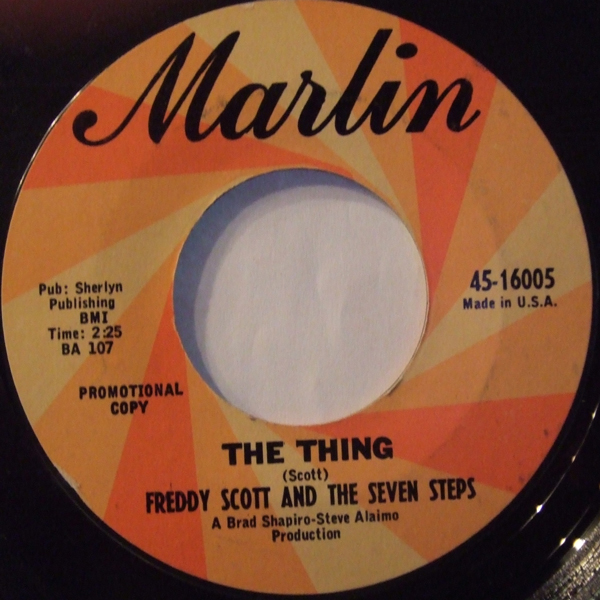
Listen/Download – Freddie Scott and the Seven Steps – The Thing
Greetings all.
The end of a very busy week has arrived and I feel the need for the freeing vibe of a soulful slab of of wax.
The kids (and the wife, a teacher) have returned to school and the routine hereabouts has been upended once again, with our vast and confusing network of appointments, comings and goings having to be reshuffled for a new season, which, since it only involves about two dozen people is predictably, what the great sages of our time have come to call a clusterfuck.
It’ll all probably settle down in a week or two, but right now my brain is mush.
The tune I bring you today is another hot Florida soul 45 from the mighty Freddie (Freddy) Scott.
At the time, I mentioned that one should not confuse Freddy Scott (drummer and bandleader from Florida) with Freddie Scott, soul singer who recorded for Shout and Colpix among other labels.
Then, while out digging I happened upon the 45 you see before you today, and discovered that Florida Freddy, but a few catalog numbers down the line was rechristened ‘Freddie’, nailed three more Steps onto his band and confused matters all by himself.
Variable spelling aside, I have no doubt at all that this is the Florida-based cat (for a variety of fairly obvious reasons).
As I mentioned, today’s selection ‘The Thing’ is only two catalog numbers further along from ‘Same Ole Beat’, and a quick listen to the song would seem to indicate that the extra Steps were employed in the horn section.
‘The Thing’ is a mid-tempo dancer with enough grease to get he kids sliding on the dance floor, and a refrain that sounds like a not so distant cousin to the soul jazz standard ‘Coming Home Baby’.
If you get a minute you should head over and check out Iron Leg Digital Trip #32, where I included the flipside of this very 45, a swinging organ instro version of Tom Jones’ ‘It’s Not Unusual’ as part of that au go go flavored mix.
So crack open a cold beer, sink your fist into a bowl of chips and stuff you ears full of ‘The Thing’.
Listen/Download – Joe Zawinul – Soul of a Village (45 edit)
Greetings all.
The middle of the week is here, and I may be tired, my nerves may be frayed, my brain may want to shut off, but I have a craving for some of that deep, deep stuff, so here we go.
The record I lay before you today is something I first heard during a long ago Asbury Park 45 Sessions, with my man Vincent the Soul Chef working the wheels du steel.
As I’ve said here many times before, the 45 Sessions are without fail, a DJs paradise, with the selectors slipping 45s under the needle that have the heads running up to the turntables to see what’s going on.
This blog has seen many, MANY sides that I first heard at the Lanes, and of we ever get it back up to speed, this will surely continue.
Anyway, when Vincent pulled this one out of his record box, and I heard the laid back but funky drums, and the electric piano (you know I love me some electric piano), and the spooky strings, my spidey sense started tingling, and when I found out that the music I was hearing had been created by none other than Joe Zawinul, I set out to find a copy of my own.
This took a little longer than I expected, and while I was waiting I pulled down the entire album from which it originated – ‘The Rise and Fall of the Third Stream’ – and was surprised to discover that there wasn’t much on that album that resembled the 45 I had heard (though the flip side of this 45, an edit of the track ‘Lord Lord Lord’ has a decided gospel edge).
For those of you to whom the term ‘Third Stream’ doesn’t ring any bells, I’ll tell you that it was affixed to classically influenced jazz in the 50s and 60s by folks like John Lewis of the Modern Jazz Quartet. There’s a lot of string-based action on ‘Rise and Fall..’ but the overall effect is much more jazz than classical.
Zawinul (and the name should be very familiar) was the Austrian born pianist who made his mark in Cannonball Adderley’s band (Zawinul composed ‘Mercy Mercy Mercy’ and ‘Country Preacher’ among others) , moving on to work with Miles Davis (on ‘In a Silent Way’), and then eventually as one of the founding members of Weather Report.
‘Rise of the Third Stream’ was recorded in 1968 and was only Zawinul’s second solo effort in 10 years. It came a year before his work on ‘In a Silent Way’, and echoes of ‘Soul of a Village’ can be heard in his work with Davis.
Though the 45 lists the piece as only ‘Soul of a Village’, the music you’re hearing is actually an edited version of ‘Soul of a Village Pt2’, having been preceded on the album by just over two minutes of prepared piano and strings droning in an approximation of an Indian raga.
The 45 version of ‘Soul of a Village’ has such a perfect, self-contained vibe that I’m torn as to whether you need to hear both parts. The album is overall a much more challenging listening experience than the 45, but if serious jazz is your bag, I’d suggest you seek it out.
That said, the 45 version of ‘Soul of a Village’ (roughly one and a half minutes shorter than the Pt2 on the LP) is a slice of groove perfection. It opens (again) with the drone, before Zawinul comes in with the electric piano, followed by funky drums (either Roy McCurdy or Freddie Waits), Jimmy Owens’ muted trumpet, and even more strings, and the really groovy thing is that the string section actually swings along with the drums.
The tune was written (like almost every track on the album, save one) by saxophonist/arranger William Fischer, who as far as I can tell was first and foremost a classical composer/musician, and as a result ‘Rise and Fall of the Third Stream’ must be considered a collaborative work between Fischer and Zawinul (a prolific composer in his own right).
This is serious ‘head’ music, in that it both spins around the inside of the cranium for full, mystical effect, but also compels the head to nod with the rhythm. I wouldn’t go as far as to suggest that anyone not sufficiently intoxicated might get up to dance, but it’s not entirely out of the question.
A truly unique and captivating record, and I hope you dig it.
Rahsaan Roland Kirk – Ain’t No Sunshine (Atlantic)
Paul Horn – Paramahansa (RCA)
Moe Koffman – Comin’ Home Baby (Jubilee)
Bobbi Humphrey – Sad Bag (Blue Note)
David Newman – The 13th Floor (Atlantic)
Keith Mansfield – Teenage Chase (KPM)
Hubert Laws – Bloodshot (Atlantic)
Jerome Richardson – Ode to Billie Joe (Verve)
Joe Thomas – Big Heart Giant Soul (Cobblestone)
Ernie Fields – Watch Your Step (Kent)
Herbie Mann – Push Push (Atlantic)
Jeremy Steig – Alias (Solid State)
Frank Wess – Signed Sealed and Delivered (Enterprise)
Tim Weisberg – Streak Out (A&M)
Jethro Tull – Serenade To a Cuckoo (Chrysalis)
How are the closing days of summer treating you?
I know we’ve got lots of good weather ahead, but it’s only a few weeks until the mass exodus of the tourists, when I will once again be able roam free amidst traffic that is just ‘bad’, not mind-bogglingly so.
The mix I bring you today is a continuation of a minor series of sorts, in which the Funky16Corners Radio thingy takes time out to focus on a specific instrument. We’ve already surveyed the vibes and the electric piano, and I’m sure that there are a few more such collections huddling in the crates awaiting release.
This time out we take a look (listen) to the much maligned, but very groovy sounds of the (mostly) jazz flute.
As I said when I wrote about the vibes, there are those among us for whom the sound of the flute is too ‘cool’, which naturally is why I dig it so much.
I love the sound of the flute in the hands of a great musician, and what you’re getting in this mix is 15 examples of that very thing.
Of course, not every single cut contains a virtuoso performance, on account of that would be boring and a few steps away from the prog sound of my teenage years that I have come to despise.
The vast majority of the players here (although one of them is anonymous) are at least tangentially connected to the world of jazz, with a few having crossed over into pop and rock and one (yes, you know the one…the one who’s name sent a shiver up your spine when you saw it, unfairly I might add) solidly camped out in rock and roll.
This one took a while to assemble, if only because a few of the artists in question have appeared in this space frequently (Koffman, Steig, Wess, Mann), their dulcet tones gracing other Funky16Corners Radio playlists.
Things get off to a serious start with Rahsaan Roland Kirk’s epic reading of Bill Withers’ ‘Ain’t No Sunshine’. Kirk, a master on many wind instruments – often simultaneously – had a pronounced influence on two of the other players in this mix, namely Jeremy Steig and Ian Anderson (more on him later). His frequent use of ‘overblowing’, and vocalizing through the flute make him one of the most dynamic stylists the instrument has ever produced. Paul Horn is best known for his pioneering new age recordings like ‘Inside’, but in the early to mid-60s he was still working a straight ahead jazz style. The Eastern-influenced ‘Paramahansa’ (which he re-recorded years later) appeared on his 1967 ‘Monday Monday’ LP, alongside a number of contemporary pop and rock covers. The tune sees Horn playing over a big band producing something that sounds like it’s from the soundtrack to a spy thriller. Moe Koffman, who has been featured here a number of time is one of those cats that started out as a pretty ‘straight’ jazz player and as the 60s progressed he got further out. In addition to the flute Koffman was a proponent of the electrified saxophone (like Eddie Harris and Sonny Stitt) and he made some very cool, au go go flavored stuff during the era. His take on Bob Dorough and Ben Tucker’s “Coming Home Baby’ has a relaxed swing to it, sounding once again like something lifted from era-specific TV or movie soundtrack. Bobbi Humphrey’s ‘Sad Bag’ has a mournful sound, with some very nice, reverbed flute. David ‘Fathead’ Newman is better known for his sax playing, especially in his association with the mighty Ray Charles. I first heard ‘The 13th Floor’ on an early-90s comp called ‘Heavy Flute’, shortly after which I grabbed myself a copy of the 45. The tune originally appeared on Newman’s 1968 ‘Bigger and Better’ LP and is a great illustration of that fact that he certainly knew his way around the flute.
‘Teenage Chase’ is a Keith Mansfield penned cut from the KPM sound library album ‘Beat Incidental’. Like many of the cuts it was intended to be used as a ‘theme’, and so it is relatively short. I have no idea who the flute player us, but it sure as hell sounds like the same cat blowing on the Hawkshaw/Parker tune ‘Hot Pants’ (also a KPM selection). Hubert Laws went on to great success with radio friendly R&B in the 70s with the CTI label, but in the mid-60s he was recording powerful soul jazz sessions for Atlantic. ‘Bloodshot’ is the opening track from his 1966 ‘Flute By Laws’ LP, and is driven by Laws’ flute, powerful brass and spot on Latin percussion. Jerome Richardson is best known as a prolific studio musician, but he spent decades playing bop and soul jazz. His take on Bobbie Gentry’s ‘Ode to Billie Joe’ is from his 1968 ‘Groove Merchant’ album, which features Richardson on a variety of wind instruments, including a few different kinds of flute (more than one on this track!). Aside from an odd, intermittent chime, this version of ‘Ode…’ is pretty cool, including some well placed harpsichord.
Like many of the players here, Joe Thomas doubled (tripled) on a variety of wind instruments. ‘Big Heart, Giant Soul’ from his 1970 Cobblestone album ‘Comin’ Home’ is indicative of the high quality of that funky soul jazz session. You get to hear Thomas (who also played in Rhoda Scott’s trio) vocalizing on what sounds like a Varitone (maybe attached to the flute), and then playing it straight. Thomas went on to record funkier stuff (even disco) in the 70s. Ernie Fields’ ‘Watch Your Step’ is one of my favorite 45s, period. I’ve never been able to find out much about Fields, but ‘Watch Your Step’ is so high-concept, so soulful yet psychedelic and well-arranged, that you can only hope that he did more stuff like this.
If you were to put together a list of cats with serious jazz chops who spent most of their career trying to reach a mass audience (and sometimes succeeding) Herbie Mann would have to be at the top of the list. Mann started out working in a Latin bag, but went on to record a serious grip of soul jazz and even pop through the 60s and 70s. The title track of his 1971 ‘Push Push’ album shows that Mann was very comfortable in a funky bag (where he spent most of the early 70s), eventually having his biggest hit with 1975’s ‘Hijack’. Jeremy Steig is beloved by crate diggers/beat heads for his track ‘Howling for Judy’ which was the main sample behind the Beastie Boys’ ‘Sure Shot’. Steig’s late 60s/early 70s stuff for Solid State and Blue Note is generally pretty far out, and skipping right along the border between funky and ‘out’. ‘Alias (ALi’as)’ (named for drummer Don Alias) features a wild performance by Steig over bass, drums and percussion., is from the same 1969 LP (‘Legwork’) as ‘Howling…’.
I’ve featured a number of very cool tunes from Frank Wess’s 1970 ‘Wess to Memphis’ LP on the Stax subsidiary Enterprise. Once again I must recommend this album highly, since it’s one of those great sessions where a jazz cat (Wess was well known as a tenor player as well as his work on the flute) really got into a more popular vibe with excellent results. The album, which includes a number of covers is well played and produced, and one I go back to frequently. He wails on his version of Stevie Wonder’s ‘Signed Sealed and Delivered’.
I can’t remember where I first heard of Tim Weisberg’s ‘Streak-Out’, but I know I was surprised because it was the very same Weisberg who had a mid-70s chart hit alongside Dan Fogelberg! ‘Streak-Out’ from 1974 (which he apparently performed on the ‘Midnight Special’, so it must have been a minor hit) is a nice bit of funky rock, with a little bit of a break at the beginning.
This edition of Funky16Corners Radio closes out with what no doubt seems like the oddest of artists, Jethro Tull. All 1970s prog/hobbit-isms aside, when Tull got started in the late 60s they were a jazz inflected heavy blues band, not unlike Cream. The song presented here is, to bring things full circle, a Rahsaan Roland Kirk tune called ‘Serenade to a Cuckoo’. It was reportedly the first song Ian Anderson learned on the flute (Kirk being by far his strongest influence), and he and the band acquit themselves nicely.
I hope you dig this little survey, and I’ll be back later in the week.
Listen/Download – Woody Herman and the Herd – Fanfare for the Common Man
Listen/Download – Deodato – Also Sprach Zarathustra (2001)
Greetings all.
I hope week is coming to a satisfying close for you all.
My wife has to head out for a few days, and the spuds and myself are bumming, but since we plan to wreck the joint while she’s away, there is a (very) minor silver lining.
We’ll just see if three people can survive on corn chips, frankfurters and slurpees for five days.
If you haven’t already pulled down the ones and zeros for this weeks Funky16Corners Soul Club mix by my man Vincent the Soul Chef, do so now, on account of it’s full of the funk, and will – as the kids say – rock your world.
Also, don’t forget to tune in Friday night at 9PM for this week’s edition of the Funky16Corners Radio Show over at Viva internet radio. If you are not already hip/hep, you can click on the Radio Show link in the header and check out the fifteen (!?!) weekly shows that have already been mixed down and archived as MP3s for your listening pleasure.
Today’s post is one of those things that kind of fell together organically over the course of a few months, wherein I was holding something in storage, and then something else climbed over the transom and into the to-be-blogged folder that, how do they say, augmented the existing track in the stylistic and theoretical (figurative/symbolic) sense, and so they came together like beer and stout in a black and tan, blended ever so carefully so that once they pass over the lobes and into the brain the desired effect is one of jazzy, funky wonderfulness (and naturally, as is the style here at Funky16Corners, a tremendous run-on sentence).
Not too long ago one of my Friendface pals posted a video of the mighty Woody Herman and his Thundering Herd working it out on Aaron Copland’s 1942 masterpiece of 20th century classical music ‘Fanfare for the Common Man’. I dug the arrangement a LOT, so I went in search of the vinyl equivalent and found another live recording of a slightly later (I think) version of the Herd laying down the same arrangement at Montreaux.
Back in the olden days, when I was a long-haired, drum mangling stoner type, I had a copy of a certain Emerson, Lake and Palmer album that contained their version of the same piece of music. Having been brought up in a house full of classical music, but then stuffing my head with as much contemporary rock as possible, as well as being your standard teenaged rube, I thought that the ELP ‘Fanfare’ was of a deepness theretofore unheard, and blasted it at high volume many, many times until a seriously untrustworthy fellow bandmember (who, if memory serves was also a pathological liar of singular talent) stole what was then a fairly expensive record (of course everything is expensive when you have no money).
In reflection, especially after hearing Woody Herman lay it down, the ELP version sounds like a meth-infused synthesizer orchestra trapped in an electrified mudslide. The Copland piece is both sublime and inspirational, and to hear it mangled so seems now to be something approaching a high crime.
Interestingly enough, Herman and his band were playing their Gary Anderson arrangement (recorded in 1974) of ‘Fanfare for the Common Man’ a few years before ELP got their hands on it, and as you might have already assumed, the touch is considerably lighter, using funky subtlety to finesse the brassy strains of Copland’s piece where ELP drove through it with a steamroller.
In addition to a hot band – Herman, a master of the original big band era made some serious moves in the fusion era, still with a big band – you get to hear the master working it out on the soprano sax.
If you get your hands on a copy of the ‘Herd at Montreux’ album, you also get to hear them play the Richard Evans arrangement of ‘I Can’t Get Next To You’ and a very tasty version of Billy Cobham’s ‘Crosswind’ that I’ll feature here in the future.
The second track featured today is something I’m sure a lot of you will be familiar with since it was a substantial hit in 1972. That tune is Eumir Deodato’s epic arrangement of Richard Strauss’s 1896 ‘Also Sprach Zarathustra’. Better known to one and all as the ‘2001’ music, Deodato’s take on the tune is in addition to being probably the biggest hit CTI ever had, a masterpiece of funky jazz.
Featuring Deodato on electric piano, Airto and Ray Barretto on percussion, Billy Cobham on drums, Stanley Clarke on bass and Jay Berliner on guitar, ‘Also Sprach Zarathustra’ goes on for nine minutes, and I’m here to tell you (though you should be able to hear it yourselves) that it never lags, never slips into fusion-y masturbation, never loses it’s kick.
The piece builds gradually, with a kind of amorphous tune-up, until the drums kick in at around 48 seconds, then the bass, guitar and of course Deodato’s electric piano (the heart and soul of the tune), followed by what has to be about the best known classical horn line in history, following the structure of the original until it settles down into a funky jam at around the two and a half minute mark. You know I love me some Fender Rhodes, and Deodato goes to town here. The coolest thing of all – and I hope you’ll agree – is that for what is basically a nine minute long jazz fusion interpretation of a piece of classical music (shades of Spinal Tap in Jazz Fantasy), ‘Also Sprach Zarathustra’ never gets cheesy or heavy handed, which is especially notable in an era when cheesy and heavy handed were the coin of the realm.
I hope you dig both of these cuts, and use them to get down with what the hipsters used to call ‘long hair’ music.
I’ll see you on Monday.
The painting of Gene from the cover of ‘Organ Out Loud’ by Jack Lonshein
Gene Ludwig at the organ (Circa 1965)
Listen/Download – Gene Ludwig -Sticks and Stones
Listen/Download – Gene Ludwig – The Vamp
Listen/Download – Gene Ludwig – Blues For Mr Fink
Listen/Download – Gene Ludwig – House of the Rising Sun
Listen/Download – Gene Ludwig – Comin’ Home Baby
Listen/Download – Gene Ludwig – Moanin’
Greetings all.
As I mentioned in Friday’s post, I got the very sad news last week that Hammond master Gene Ludwig had passed away at the age of 72.
If you’re one of the rare few that’s been on the Funky16Corners tip since the web zine days, you know I ride for the Hammond organ in a big way, from the greasiest R&B, to pure soul, soul jazz and funk, I have never been able to get enough of the Hammond sound.
Gene Ludwig was one of the last of what I would call the accepted past masters of the jazz organ. He was a contemporary of Brother Jack McDuff, Jimmy McGriff, Dr Lonnie Smith, Seleno Clarke and pretty much everyone else that was part of the jazz organ explosion of the 50s and 60s.
What Gene was also a part of was the great – mostly unexplored – Pennsylvania organ tradition. One of the really interesting things I picked up out of years of collecting and researching Hammond records was how many great players hailed from the Keystone State (and not just Philly). The man that launched a thousand organ combos, the mighty Jimmy Smith as well as Jimmy McGriff, Charles Earland, Richie Varola, Greg Hatza, Papa John and Joey DeFrancesco, Shirley Scott and of course Gene Ludwig all got their start in the bars and nightclubs of Pennsylvania, in both the big cities and out in the hinterlands. Was it something in the water? An abundance of organs (or bars/lounges with organs in them)? In his obit Gene was quoted as saying that he turned on to R&B (and organ players) by listening to Pittsburgh radio legend Porky Chedwick. Pittsburgh has a long history as a kind of isolated Shangri La for R&B and soul fans where any number of brilliant but obscure records are worshipped by the locals because they were circulated on the radio and at dances.
Whether this had anything to do with spawning organists, as opposed to just fans of the sound, I have no idea, but it is intriguing.
Gene Ludwig – a native of the wester PA town of Twin Rocks started out as a pianist, and had his ‘road to Damascus’ moment when he saw Jimmy Smith perform at a Pittsburgh club called the Hurricane in 1957.
Ludwig went on to have a 50 year career as one of the great proponents of the Hammond, recording locally as well as on national labels like Mainstream and Atlantic.
He was really what I would consider (at least for my taste) the consummate organist in that he approached the instrument from a jazz perspective (with serious chops to match) yet was not afraid to cut loose and burn on the keyboard, expanding into the realms of R&B and soul.
I’ve consumed a lot of virtual ink rambling on about this or that ultra-raw organ 45, but the best Hammond players, no matter how soulful or funky all came to the instrument from the jazz roots.
Gene Ludwig was old enough to hear the early rumblings of the Hammond sound from the jazz/jump/R&B nexus of cats like Wild Bill Davis, Bill Doggett and Milt Buckner, and mastered the instrument in the wake of the mid-50s scene when Jimmy Smith rewrote the book on jazz organ.
The ensuing expansion of the electronic organ, as both a performance platform and recorded instrument was wide ranging on both established jazz labels like Blue Note, Prestige, Riverside and Atlantic, but as my crates will attest, on countless tiny local labels eager for a piece of the action. It’s not at all hard to imagine walking into a bar in 1965, strolling up to the jukebox and seeing the organ stylings of a regional favorite among records from out of town.
Gene Ludwig was both a regional player (probably half of his discography is rooted locally) and an internationally known master of his instrument who headlined and worked as a sideman (replacing Don Patterson in Sony Stitt’s late 60s band).
Gene remained devoted to the Hammond, and a glimpse at his web site will reveal that he was playing, recording and above all staying relevant right up until his unexpected and tragic passing.
He was a musician of great taste with an ear for that perfect soul jazz vibe, yet was also conversant in standards (which any organist working the clubs in the 60s would have had to have been) and was by all accounts an unfailingly generous soul when it came to mentoring younger players.
Though I never got to meet Gene or his wife Pattye in person, I was lucky enough to correspond with them over the years (Gene had no bigger booster than Pattye), including an interview I did with the master back in 2005.
The Gene Ludwig Trio in the 1960s (above) and reunited in 2004 (below)
The tunes I bring you today represent a cross-section of the sound of Gene Ludwig through the 1960s. As far as I can tell all of these cuts feature his classic 60s-era trio which featured Randy Gelispie (or Gillespie, I’ve seen it spelled both ways) on drums and Jerry Byrd on guitar.
A few of these cuts have been featured here in the past, but they deserve to be heard again.
The first track is the Ludwig’s trio’s smoking version of the Henry Glover/Titus Turner classic ‘Sticks and Stones’, which appeared as a two-part 45 in 1963 (I’ve spliced the two parts together). The trio’s playing is spot on, relaxed yet generating a considerable amount of heat, and Gene is in rare form. I’ve heard there’s at least one other unissued side from that date, a version of ‘High Heel Sneakers’.
Next up is a track discussed here in the past, the brilliant ‘The Vamp’, which appeared as a 45 and on the LP ‘The Educated Sound of Gene Ludwig’ in 1965. If you haven’t heard ‘The Vamp’ strap yourself in because it’s a killer. Improvised in the studio by the trio, it featured Gene on the organ, Byrd on guitar and Gelispie on tambourine only. It has the feeling of an after-hours session gone wild, and is probably my favorite moment in Gene’s discography.
‘Blues For Mr. Fink’ and ‘House of the Rising Sun’ are both culled from an oddball 1960s compilation called ‘The Keyboards’ on the Time label, which features Gene Ludwig, and five other players performing in a wide variety of disparate styles. None of the album’s 20 tracks are attributed to anyone specific, but I knew of the Ludwig tracks from other sources (which is why I picked it up).
My suspicion has always been that all of the Gene Ludwig material on that record came from his time with the Mainstream label, since Bob Shad is credited with A&R on the jacket, and a few of the tracks also appear on the 1964 Mainstream LP ‘Organ Out Loud’.
The last two tracks appeared on what I would consider to be one of the great soul jazz organ sessions of the classic era, the aforementioned ‘Organ Out Loud’. Here Gene and the trio work it out on two classics of the genre (the LP also included wonderful versions of Cannonball Adderley’s ‘Sermonette’ and Horace Silver’s ‘The Preacher’), Bob Dorough and Ben Tucker’s ‘Comin’ Home Baby’ and Bobby Timmons’ ‘Moanin’.
‘Comin’ Home Baby’ is taken at a touch more relaxed pace than you usually hear, but the group keeps it moving and grooving, and Gene takes a wild solo.
‘Moanin’ on the other hand takes off like a rocket and never slows down. It’s the kind of performance that makes me want to step into the WABAC machine and hear the group in some smoky lounge. Gene’s fingers fly over the keys while the rhythm section provides a rock solid bottom.
If you ever get a chance to get your hands on any of his 60s albums or 45s (and there’s still a couple of things I have yet to track down) do yourself a favor and do it. You still have the chance to hear his more recent recordings, which are uniformly excellent.
That all said, it’s so sad to have to talk about this great music in light of Gene’s passing.
He was a great musician, and by all accounts as solid a human being as has passed this way.
He will be missed.
My sincere condolences go out to his wife Pattye.
See you later in the week.
Greetings all.
I hope that the middle of the week finds you all in a soul jazz kind of mood.
I’ve spent a fair amount of time over the course of the life of this blog discussing, compiling, exploring and above all digging soul jazz.
One of the elements of that discussion (though if I’m doing all the talking is it really a discussion?) is the issue of pure soul jazz, that being music that meets the definition of soul(ful) jazz, blending R&B, soul and or funk with a post-hard-bop base in a manner that creates something new that displays, yet transcends the listed ingredients.
There are a number of artists for whom soul jazz was a specialty, and of those, a few who created enduring ‘standards’ of the genre like Bobby Timmons, Freddie McCoy, Eddie Harris and the man who composed the tune I bring you (served four different ways) today, the mighty Julian ‘Cannonball’ Adderley.
Adderley composed and first recorded the tune ‘Sack O’Woe’ in 1960. Of the countless soul jazz songs that I have collected over the years, ‘Sack O’ Woe’ is probably my favorite. It is propulsive enough to be danceable (Adderley was great at stuff like that) , soulful, spare but not too spare, and a great launching point for soloists.
It’s one of those songs that when I find a new version I try to add it to my stack because in hands of almost any competent musician it releases something special, and every once in a while I like to post multiple versions of a great song so you can get a feeling for the breadth of sounds that covers of a classic can yield.
The four versions of the song I bring you today date from the 60s, 70s and 90s (?!?)
The Omega Men
Listen/Download – The Omega Men – Sack O’Woe (Live 1997)
My all-time favorite version is by a band of fairly modern vintage called the Omega Men. Featuring a number of veterans of the Pennsylvania end of the garage/mod revival (from the Cellar Dwellars and Stump Wizards) , the Omega Men, featuring the organ work of the sole non-male member of the band Susan Mackey, really set fire to Adderly’s classic. You can catch it on iTunes as part of a comp called ‘Rock Don’t Run Vol 3’, or you can track down their 1997 CD ‘The Spy Fi Sound of the Omega Men’. The version included here has been digimatized from a video of the band performing live in 1997. The fidelity is pretty good and the playing is first-rate. It isn’t much of a stretch to imagine the sound of the Omega Men as a close approximation of what you might have heard on-stage in the UK circa 1965, where the organ combos of masters like Georgie Fame, Brian Auger and Graham Bond were re-imagining the US soul jazz and R&B that gave them inspiration.
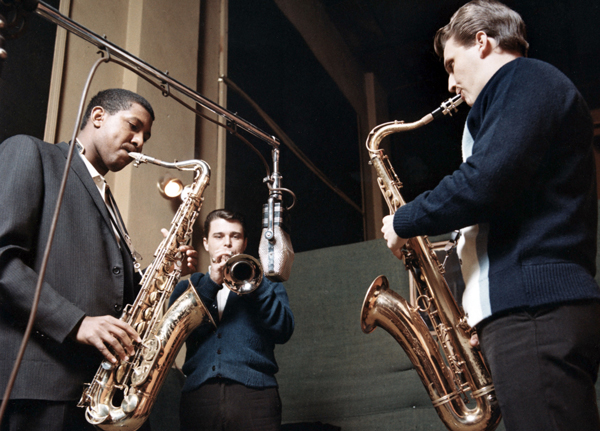
The Mar-Keys horn section (Packy Axton, right)
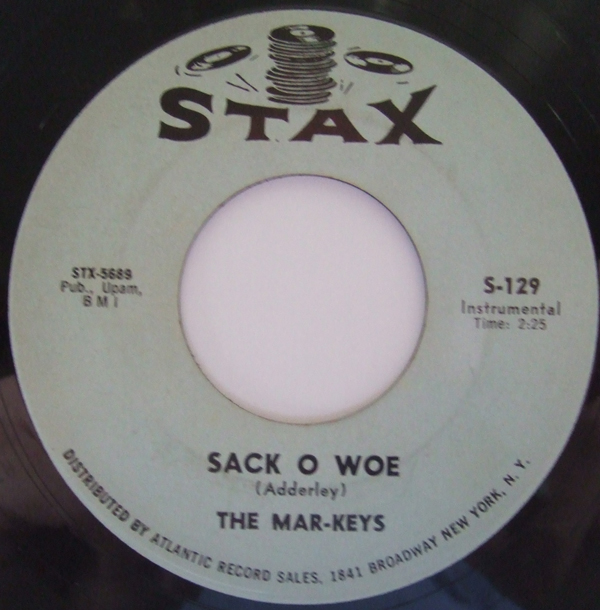
Listen/Download – The Mar-Keys – Sack O’Woe (1961)
As I said before, Adderley’s original dated from 1960. The Mar-Key’s smoking Memphis version is from a year later. It has that solid Stax sound and I really dig the organ solo. If my chronology is correct this also features a pre-MGs Steve Cropper and Duck Dunn on guitar and bass, as well as Packy Axton, later of the many mysterious incarnations of the Packers on sax. Note the horn intro that approximates the band’s only hit, ‘Last Night’.
The legendary Les McCann
Listen/Download – Les McCann – Sack O’Woe (1963)
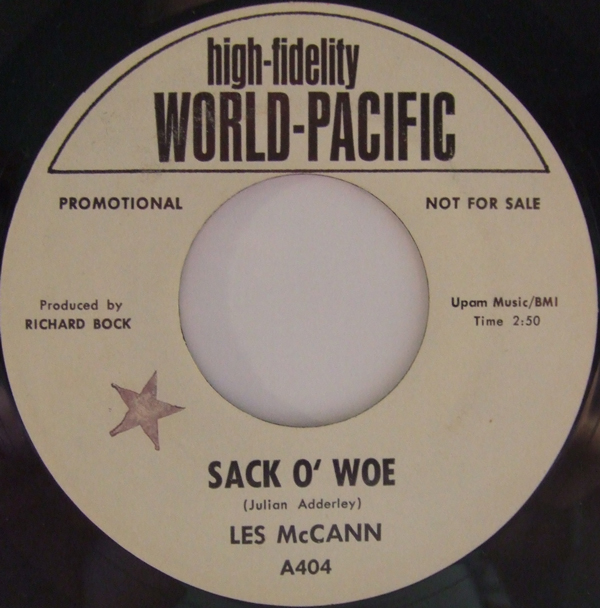
The version by the equally mighty Les McCann is from 1963, and features McCann on piano and a fantastic guitar solo by Joe Pass. It’s by far the jazziest version of the tune here. Les McCann is a true giant of the soul jazz genre, having had bona fide hits (like ‘Compared to What’ with Eddie Harris) and can be counted on to give this classic a righteous reading.
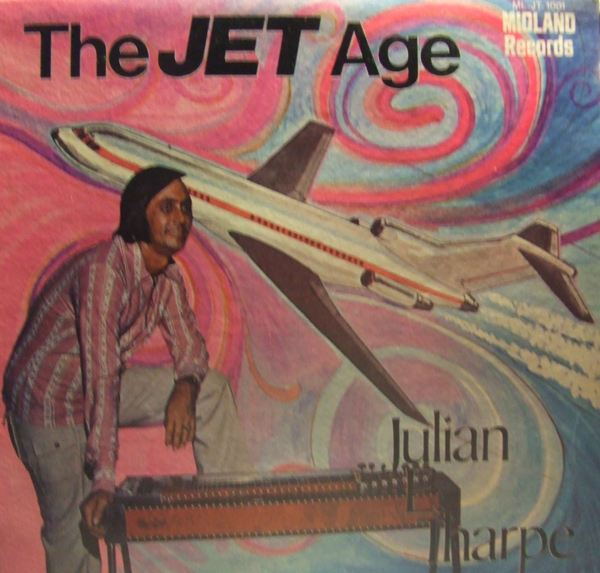
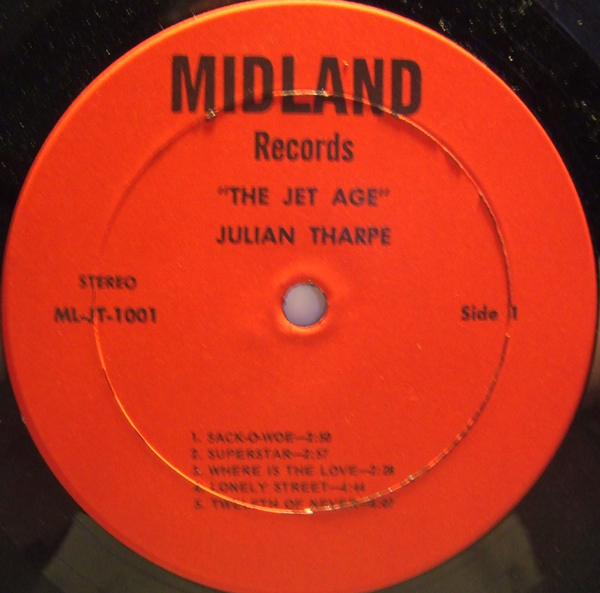
The fourth and last version of ‘Sack O’ Woe’ is (as far as I can tell) and early-to-mid 70s recording by a Nashville cat named Julian Tharpe.
Tharpe was a Music City sessioner and touring player who often worked with guitar legend Jimmy Bryant and was inducted into the Steel Guitar Hall of Fame in 2008. His LP ‘Jet Age’ featured Tharpe playing a variety of styles, covering pop, rock, country and the soul jazz of ‘Sack O’ Woe’. I picked up this album specifically for the version of today’s selection, and it proved to be an interesting one.
I always dig hearing pedal steel guitar used outside of a strictly country context, especially on soul records like Peggy Scott and Jo Jo Benson’s ‘Soulshake’, which featured another Nashville steel legend, Pete Drake.
Tharpe’s version of ‘Sack O’Woe’ is very cool, and it’s worth it if only to hear the Adderley classic interpreted on such an unusual instrument.
I hope you dig all four versions, and if you’re not familiar with Cannonball Adderley’s work, start looking because he laid down decades of fantastic music in straight jazz and funky sessions.
See you on Friday.
Stan Kenton & Orchestra – 2002 Zarathustrevisited (Creative World)
Frank Wess – Wessward Ho (Enterprise)
Larry Willis – Out On the Coast (Groove Merchant)
Gary Burton – Vibrafinger (Atlantic)
Gary McFarland – On This Site Shall Be Erected (edit) (Skye)
Jimmy Smith – Hang’Em High (Pride)
Phil Upchurch – Elektrik Head (Cadet)
Pete Jolly – Prairie Road (A&M)
Hampton Hawes – Don’t Pass Me By (Prestige)
Neal Creque – Jasmine (Cobblestone)
Roy Meriwether – Mean Greens (Capitol)
Eddie Jefferson – Psychedelic Sally (Prestige)
I hope the new week finds you well.
I was just sitting here in the Funky16Corners Record Vault and Podcasting Nerve Center, when I realized that in all the new equipment/live mix/pledge drive hysteria, it had been something like three months since the last ‘regular’ Funky16Corners Radio mix, i.e. one with the drops and the accompanying zip file and the whole – as they used to say in the olden days – ‘shooting match’, and as a result, I felt that I should get my – as they still say today – shit together, dip into the digimatized stock and get something going. So, I did.
Things being what they are, that being busy, both with the real world moves and the blog stuff, the old Funky16Corners mix schedule (as it was) has been stretched out somewhat. This has not however resulted in a lack of content, in fact the net result has been more music, with the Soul Club mixes (expect more of those from myself and guest selectors in the coming months) and the recent addition of archived/MP3 versions of the show I do weekly for Viva internet radio. As a result there’s probably more to listen to here than any sane person could digest, so dig in, slap some of the good stuff on your portable MP3 delivery device and stuff it in your ears (as time allows).
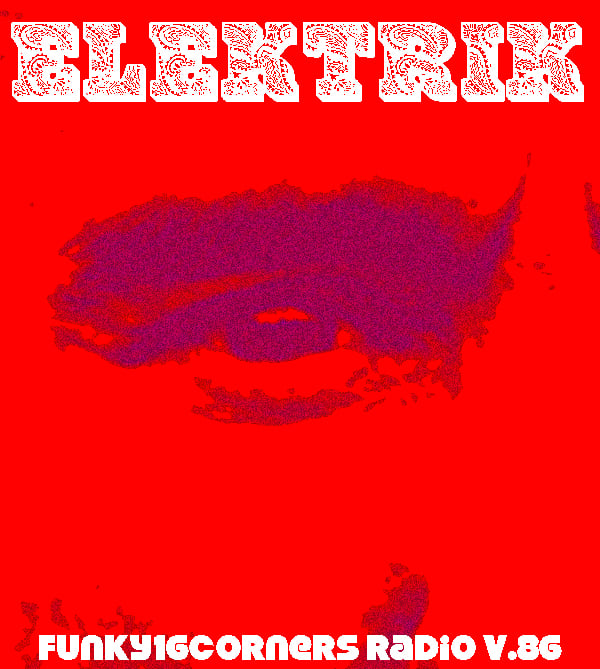
That said, I have whipped up a new mix, and I think you’ll dig it. Funky16Corners Radio v.86 – Elektrik is both jazzy and funky, with lots of the good stuff you’ve come to expect as part of the Funky16Corners Radio experience, with a perfect vibe for a warm summer night.
Things get started with something that surprised even me, that being Stan Kenton’s funky, fusion-y take on Deodato’s reworking of Strauss’s ‘Also Sprach Zarathustra’, cleverly titled ‘2002 Zarathustrevisited’ (Oh, Stan….), wherein the often overwrought master of heavily brassed West Coastery lets his sideburns grow in and hands the baton over to the younger cats in the band. Unlike similar sounds emitting from the Woody Herman organization, I have little faith that the man with his name on the bandstand had much to do with this one, and as a result, it is very groovy indeed. Frank Wess works a very cool, vaguely trippy (heavily echoed) and somewhat funky sound with ‘Wessward Ho’. Alongside his most excellent flute work, there’s plenty of vibes, wah wah guitar and clavinet to being up the soulful quotient. If you can get your hands on a copy of the 1970 ‘Wess to Memphis’ album, do so, because unlike so many of his hard bop contemporaries, Wess was able to work very well in a more modern bag.
I’ve featured tracks by pianist Larry Willis in a couple of previous mixes, and for good reason too, since he was a master of a certain extra-hot, era-specific, electric piano sound. The tune ‘Out On the Coast’ take the soul jazz vibe and funks it up without drifting into the land of fusion. It’s serious enough to be jazz, but with enough get down in it to work as funk.
If you’re familiar with some of the more ethereal work of vibist Gary Burton you may find ‘Vibrafinger’ to be a somewhat jarring experience. Here, instead of the soothing chimes of the vibraphone, Burton offers up a heavily treated, electrified and distorted sound, accompanied by some heavy guitar and drums.
‘On This Site Shall Be Erected’ is an edited (by me) version of the first track on Gary McFarland’s concept album ‘America the Beautiful’. Thanks no doubt to the fact that he was co-owner of the label, his work for Skye Records is at times very far out, ranging from his soft and mellow vocalizing alongside his vibes, to heavier orchestral work, which, like this track, sometimes got funky. With guitar by Eric Gale and drums by Bernard Purdie, ‘On This Site Shall Be Erected’ moves from a brief avant garde section, directly into a few short minutes of big band funk.
Though you’re probably familiar with the Booker T and the MGs version of the movie theme ‘Hang’Em High’ (a Top 10 hit in 1968), you’ll probably dig Jimmy Smith’s long-form take on the tune from the ‘Black Smith’ album. You get to hear Jimmy work the Hammond alongside a piano (almost the whole time) and he does a predictably great job.
Next up is something a little spacey from the king of Chicago studio axemen, Mr. Phil Upchurch. ‘Elektrik Head’ from his 1969 LP ‘The Way I Feel’ sees Upchurch getting all up inside the echoplex, managing to be jazzy, soulful and passably psychedelic all at the same time.
Things mellow out a little bit – yet remain funky – with ‘Prairie Road’ by pianist Pete Jolly. A track from the largely improvised and wholly excellent ‘Seasons’ album, it features Jolly on the electric piano, and none other than Paul Humphrey on the drums. If you can score this on vinyl, good for you (it took me a while). If you can’t, grab it in reissue because it really has to be heard in its entirely. GREAT record. Hampton Hawes was featured in the electric piano mix earlier this year. ‘Don’t Pass Me By’ is another fantastic cut from his 1972 ‘Universe’ album. Neal Creque is another great, underrated musician and composer who is better known for his work as a sideman (with Mongo Santamaria among others) than for his solo work (probably because there’s not a lot of it…). ‘Jasmine’ is from his 1972 ‘Contrast’ album, and features some West Indian flavor mixed in with the funky jazz, sounding like a younger, hipper cousin to Sonny Rollins’ ‘St Thomas’. Roy Meriwether recorded a fair amount of major label jazz sides, but it’s his private press stuff that is sweated the hardest by the collectors and beat diggers. His version of Eddie Harris’s ‘Mean Greens’ appeared on his Capitol LP ‘Soul Knight’. He takes the tune at a faster, more aggressive pace than Harris did on his OG.
This edition of the Funky16Corners Radio thang closes out with a very groovy track by the father of vocalese, Mr. Eddie Jefferson. I wish I could say I had a copy of the rare 45 of Jefferson’s version of Horace Silver’s ‘Psychedelic Sally’, but I’ll settle for the LP. Not very psychedelic, but quite funky, this sees Jefferson in a very modern bag.
I hope you dig the sounds, and I’ll be back later in the week with something cool.
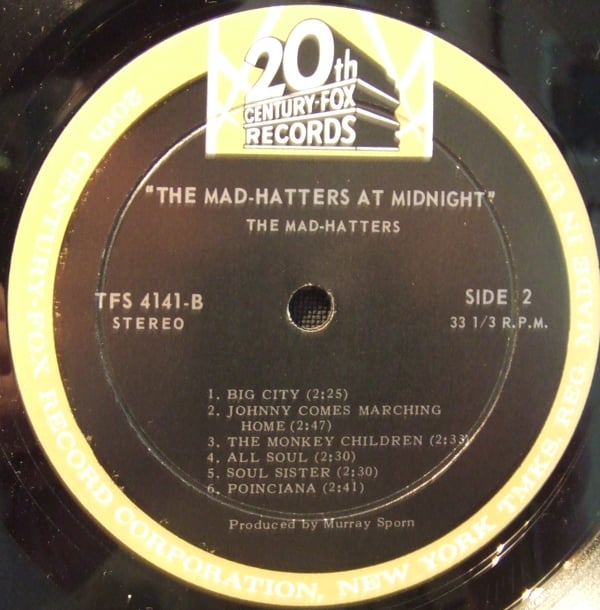
Listen/Download – The Mad Hatters – The Monkey Children
Greetings all.
The end of the week is here, and as usual, I am just about tapped out.
Things have been busy hereabouts, with all the bloggish stuff, and all of the real world stuff that keeps the old datebook stuffed full of commitments.
Next week will see the arrival of the 2010 Funky16Corners Pledge Drive, and as I’ve mentioned a few times in the last week I have something very cool lined up for he occasion (the main thing that’s been keeping me busy).
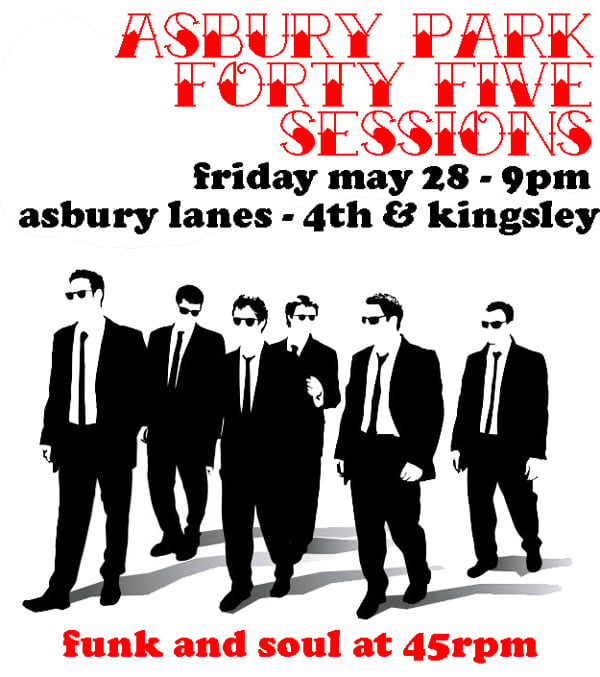
Also, this Friday sees the long awaited return of the Asbury Park 45 Sessions at the World Famous Asbury Lanes. The whole crew will be there, and will without a doubt be packing some serious heat of the funk and soul variety, so, if that sounds like a bag that you’d like to be in, and you’re withing driving distance it would be a very groovy thing if you were to fall by and check out the doings.
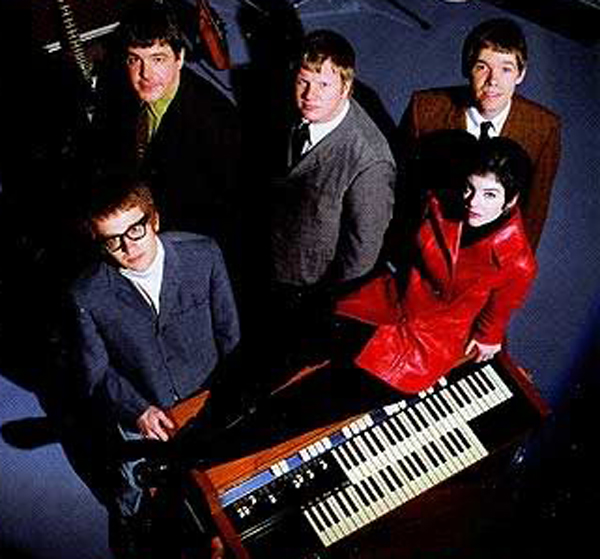
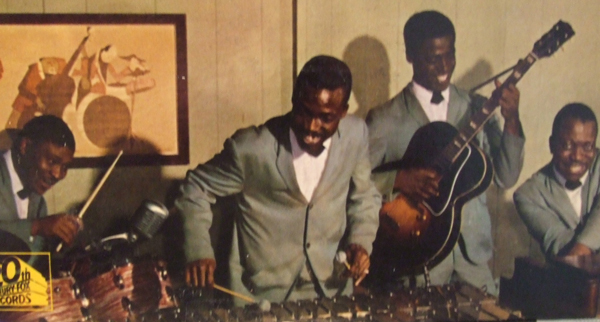
The tune I bring you today is something I picked up off of a sale list a while back, mainly because it looked very cool. I’d never heard of the group – The Mad Hatters – but one look at the combo in the picture above, and a glance at the song titles on the album convinced me that it was more than worth my while to unfold a couple of dollars and grab the disc.
I’ve gone on at length in this space (and elsewhere) about my love for, and definition of soul jazz. I am without question a huge fan of the genre, as well as a connoisseur thereof, in that I’ve spent way too much time putting what might be described as ‘too fine a point’ on what I consider true ‘soul jazz’.
There are those that will lump pretty much everything with an organ on it into the genre, or similarly anything with the slightest leaning toward rhythm and blues. Much of the music so defined is – at least nominally – soul jazz, but this says more about the omnipresence of the sound between the late 50s and the late 60s, than it does about the people making those sounds.
If there’s a point I’m trying to make, it is that while many people were including soul jazz as part of their own musical bouillabaisse, there were others who devoted themselves to, and specializing in this particular sound. The music of the Mad Hatters would suggest that the group fell into that latter category.
I haven’t been able to discover anything about the group. My instincts (and the jacket photo on the record) suggest to me that the Mad Hatters were a working outfit, as opposed to some anonymous grouping of studio heads.
The music on the album, represented here by the track ‘The Monkey Children’ is pure soul jazz, bluesy and swinging, never overplayed or taken too close to the edge, ultimately the kind of music with which to nod your head (and tap your feet) between sips of a cold beer or the cocktail of your choice.
Groovy stuff, and the kind of thing I can still listen to for hours on end.
I hope you dig it, and I’ll be back on Monday with the Pledge Drive extravaganza.
What is being up with you?
The ongoing Funky16Corners Record Vault project took a great leap forward yesterday with the new DJ set-up (improvements to which were financed by my slot machine winnings over vacation*) going on line. The rig was cobbled together using some donated speakers (thanks Cenzo), an old amp/tuner, my existing “good” turntable, and augmented with the new turntable and mixer. I expect that I’ll be spending some time hobbling around the old learning curve, but before long I should be cranking out some more ‘live’ mixes, as well as putting a somewhat sharper edge on my turntable skills.
In other, also important news, I’m getting upgraded to a nicer time-slot over at Viva Internet Radio, so as of next week (April 23) the Funky16Corners Radio Show will be airing at 9PM on Friday nights. This is a very groovy development, and I cab assure that with the addition of the home DJ thingy I’ll be laying down some live mixes, so fall by.
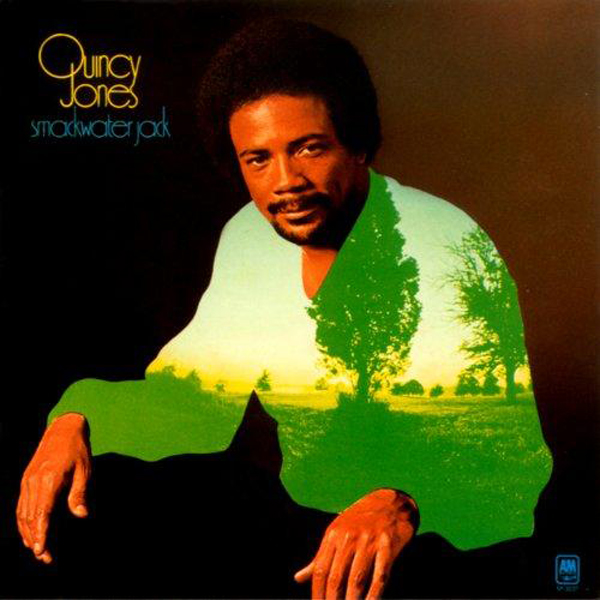
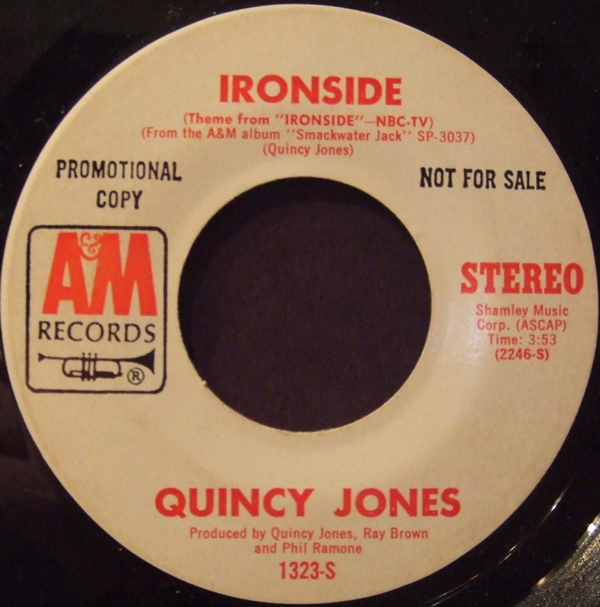
That said, the tune I bring you today is something I definitely plan on dropping in an upcoming set, Quincy Jones’s 1971 reading of the ‘Ironside’ theme.
For those of you too young to remember, ‘Ironside’ was a hit TV show (premiering in 1967) that featured Raymond Burr as a paraplegic, San Francisco police detective who went around solving crimes from the back of a specially engineered van (certainly no more ludicrous than much of what you’ll see spilling from the idiot box these days). The very groovy theme was penned by none other than the mighty Quincy Jones
The version you’re hearing this fine day appeared on Jones’s 1971 LP ‘Smackwater Jack’. I can’t say with one hundred percent certainty, but I suspect that like the version of ‘Hikky Burr’ on the same album, this take on the ‘Ironside’ theme was also re-recorded/embellished for that LP.
The whole affair manages to encapsulate a jazzy soundtrack feel, with some funky bass (Chuck Rainey), electric piano (Bob James), flute (Hubert Laws) and soprano sax (Jerome Richardson), taking the original theme and stretching it out for some solos. Jones manages to bring on the heavy brass without drowning out the rhythm section. This version starts out (like the TV theme) with something (synthesizer, I assume) imitating a police siren, with the Fender Rhodes bubbling underneath until the flute comes in to state the theme. There’s some groovy wah-wah guitar running in the background, and until the trumpet solo comes in, the feel is as much jazz rock as it is jazz. Aside from the impressive names listed above, the session was a who’s who of jazz and studio heavies, with Jones sharing producing duties with Phil Ramone and bass legend Ray Brown.
Very solid indeed.
I hope you dig it and I’ll be back on Monday.
Peace
Larry
*Only significant in that as a general rule I don’t gamble (no moral objection, I just like to spend my money on records). If you see me at the track, it’s because I like horsies. I hit the jackpot (as it was) playing the penny slots. That’s right – pennies. 30,000 of them…
As promised I have returned with the second hour of the show I put together for the Delirious Sunrise program.
Once again, it is firmly packed with heavy, yet oddly laid back sounds, including a large number of personal favorites.
It’s the end of the week, and I’m just about exhausted (mentally and physically) so I can’t recall – even after a couple of surveys – what in this mix has or has not appeared in this space already (a lot of it clearly has).
That said, I hope you dig it (and that you pulled down the ones and zeros for the first half as well, if you haven’t, make sure you, on account of it’s very groovy, very moody and the perfect complement to the second half, which is this…).
In other – mercifully brief – news, the long planned renovation of the Funky16Corners Record Vault is about to commence, including installation (fina-f*cking-ly) of a home DJ set up. I mentioned last week that I came home from vacation with some ill gotten gains, squeezed out of the slot machines in Connecticut, which I promptly rolled over and invested in a second turntable and a mixer. As soon as I get a bunch of stuff boxed up, hundreds of LPs off of the floor and into a wall unit of some kind (I hope I don’t have to go back to Ikea), and build a surface on which to set up the equipment (as well as some speakers) you can expect a new era of live mixes here, and I can spend some time working on my (admittedly rudimentary) turntable skills.
I will also be returning to Master Groove @ Forbidden City (Ave A between 13th and 14th in NYC) on Wednesday April 21st for some more of the good stuff spread over the turntables at the speed of 45 revolutions per minute. If you are in the area and are so inclined, pencil the date in your planner and fall by. It’d be great to see you, and since things are getting warmer every day it might make for a nice night in the city.
So, until I return on Monday with some funk, have yourself a great weekend and dig the sounds.
The mix you see before you today (the second part of which will be posted on Friday) is the first hour of the show I put together for the Delirious Sunrise show on WLUW.
Considering that the show airs from 4AM to 6AM, I wanted to whip up a downtempo blend, at times funky, but in that twilight, laid back, noir-ish way that characterizes those few, quiet hours before the dawn.
Though many of the tracks included in these two hours have appeared in this space before (whether as part of a Funky16Corners Radio mix or individually) the assemblage thereof is new, and if I say so myself, pretty tasty, at least as laid out for the time in question.
I’ve gone into my deep and abiding love for my iPod in this space (and over at Iron Leg) several times in the past. Though I could be considered a ‘late adapter’, to say that the last few years have seen the iPod become an integral part of my daily (and nightly) routine would be a drastic understatement.
My daily life – thanks to a variety of factors – can be fairly hectic, sometime rising to the level of brain-scrambling, and those few, precious hours after the kids have taken to their beds (those not devoted to working on the blogs) are often spent wandering around in one or both (I have one devoted to video) of the old MP3 delivery devices.
Aside from the occasional stint in the automobile, most of my intensive listening – the time when I dig particularly deeply into a record – is done right before passing out for the night.
With the lights out and the earbuds in place, I can elevate the volume, and jump wildly from song to song, genre to genre until I latch onto something that grabs my ears in a special way, drills down into my psyche, and eventually finds its way into this space, alongside my ruminations. It’s really the only time of day where things get quiet enough (within and without) to approach music the way that it deserves.
It kind of takes me back to the days when I’d go to sleep every night with the radio next to my pillow, listening to everything from music stations to weird (at least the early 70s version of ‘weird’) talk radio, to the local ABC TV affiliate with a signal that could be heard at the very bottom of the FM dial.
After I get to the point where I’m too tired to go on any more, I pick something meditative, running the gamut from Nick Drake, to Mississippi John Hurt, Thelonious Monk, Ravi Shankar, or Kraftwerk or whatever, turn over and surrender myself to sleep.
Thanks to the fact that I’ve always had a hard time getting to sleep (less so these days, for obvious reasons), and staying there, I always go to sleep listening to something – music or spoken word – and often put things on when I wake up during the night so that I can get back to sleep.
Though I have no idea about the science of the matter, I have always found that having music playing while I sleep helps me dream (or at least have more interesting dreams), and has enough of a soothing effect so that when sleep is interrupted (hitting the pleasure centers of the brain and masking background noise) it can be reestablished.
I’m not completely sure that everyone will take this as an endorsement, but for the last few weeks, these two mixes (I have them linked together in a playlist) have been the soundtrack to my nights. There are a lot of deep records over the course of these two hours, and I find no matter where I hit the mix timewise, I always get a little bit of that ‘Oh, cool…’ feeling, and my overactive brain downshifts a little and all is once again well.
Whether or not you (the listener) decides to employ it in the same way, or as a calming (yet oddly stimulating) companion to your waking hours, I hope you find that I have selected them well, and that you dig them too.


 Comments (2)






 Themocracy